Pearson+ LogoPearson+ Logo
Ch. 16 - Regulation of Gene Expression in Bacteria
Klug - Concepts of Genetics  12th Edition
Klug12th EditionConcepts of Genetics ISBN: 9780135564776Not the one you use?Change textbook
Chapter 16, Problem 19

In a theoretical operon, genes A, B, C, and D represent the repressor gene, the promoter sequence, the operator gene, and the structural gene, but not necessarily in the order named. This operon is concerned with the metabolism of a theoretical molecule (tm). From the data provided in the accompanying table, first decide whether the operon is inducible or repressible. Then assign A, B, C, and D to the four parts of the operon. Explain your rationale. (AE=active enzyme; IE=inactive enzyme; NE=no enzyme.) Genotype tm Present tm Absent A⁺B⁺C⁺D⁺ AE NE A⁻B⁺C⁺D⁺ AE AE A⁺B⁻C⁺D⁺ NE NE A⁺B⁺C⁻D⁺ IE NE A⁺B⁺C⁺D⁻ AE AE A⁻B⁺C⁺D⁺/F'A⁺B⁺C⁺D⁺ AE AE A⁺B⁻C⁺D⁺/F'A⁺B⁺C⁺D⁺ AE NE A⁺B⁺C⁻D⁺/F'A⁺B⁺C⁺D⁺ AE+IE NE A⁺B⁺C⁺D⁻/F'A⁺B⁺C⁺D⁺ AE NE

Verified step by step guidance
1
Identify whether the operon is inducible or repressible by analyzing the enzyme activity in the presence and absence of tm. If the enzyme is active only in the presence of tm, it is inducible. If it is inactive in the presence of tm, it is repressible.
Examine the genotype A⁺B⁺C⁺D⁺: Active enzyme (AE) is produced when tm is present, and no enzyme (NE) is produced when tm is absent, suggesting an inducible operon.
Determine the role of each gene by analyzing the effects of mutations: A⁻B⁺C⁺D⁺ results in AE regardless of tm presence, indicating A is the repressor gene.
Analyze the genotype A⁺B⁻C⁺D⁺: NE is produced regardless of tm presence, suggesting B is the promoter sequence, as its mutation prevents transcription.
Consider the genotype A⁺B⁺C⁻D⁺: Inactive enzyme (IE) is produced when tm is present, indicating C is the operator gene, as its mutation affects enzyme activity. D is the structural gene, as its mutation (A⁺B⁺C⁺D⁻) results in AE regardless of tm presence.

Verified video answer for a similar problem:

This video solution was recommended by our tutors as helpful for the problem above.
Video duration:
1m
Was this helpful?

Key Concepts

Here are the essential concepts you must grasp in order to answer the question correctly.

Operon Structure

An operon is a cluster of genes under the control of a single promoter, which includes regulatory elements such as the repressor, operator, and structural genes. The repressor gene produces a protein that can bind to the operator, blocking transcription of the structural genes. Understanding the arrangement and function of these components is crucial for determining how the operon responds to the presence or absence of specific molecules.
Recommended video:
Guided course
03:45
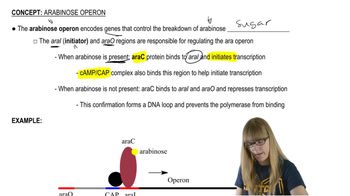
Arabinose Operon

Inducible vs. Repressible Operons

Inducible operons are typically off and can be turned on in response to an inducer, while repressible operons are usually on and can be turned off by a corepressor. The distinction is important for understanding metabolic pathways; for example, the lac operon is inducible, while the trp operon is repressible. Analyzing the data provided helps in identifying the nature of the operon in question.
Recommended video:
Guided course
04:29
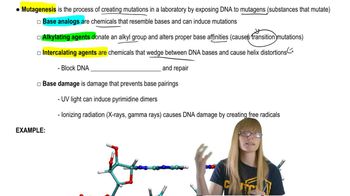
Induced Mutations

Enzyme Activity and Genotype

The activity of enzymes in response to different genotypes provides insight into the operon's functionality. The presence of active (AE), inactive (IE), or no enzyme (NE) under varying conditions indicates how the operon is regulated. By correlating the genotype with enzyme activity in the presence or absence of the theoretical molecule (tm), one can deduce the roles of genes A, B, C, and D in the operon.
Recommended video:
Guided course
07:52
Gamete Genotypes
Related Practice
Textbook Question

Both attenuation of the trp operon in E. coli and riboswitches in B. subtilis rely on changes in the secondary structure of the leader regions of mRNA to regulate gene expression. Compare and contrast the specific mechanisms in these two types of regulation with those involving short noncoding RNAs (sRNAs).

887
views
Textbook Question

During the reproductive cycle of a temperate bacteriophage, the viral DNA inserts into the bacterial chromosome, where the resultant prophage behaves much like a Trojan horse. It can remain quiescent, or it can become lytic and initiate a burst of progeny viruses. Several operons maintain the prophage state by interacting with a repressor that keeps the lytic cycle in check. Insults (ultraviolet light, for example) to the bacterial cell lead to a partial breakdown of the repressor, which in turn causes the production of enzymes involved in the lytic cycle. As stated in this simple form, would you consider this system of regulation to be operating under positive or negative control?

777
views
Textbook Question

Bacterial strategies to evade natural or human-imposed antibiotics are varied and include membrane-bound efflux pumps that export antibiotics from the cell. A review of efflux pumps [Grkovic, S., et al. (2002)] states that, because energy is required to drive the pumps, activating them in the absence of the antibiotic has a selective disadvantage. The review also states that a given antibiotic may play a role in the regulation of efflux by interacting with either an activator protein or a repressor protein, depending on the system involved. How might such systems be categorized in terms of negative control (inducible or repressible) or positive control (inducible or repressible)?

651
views
Textbook Question

A bacterial operon is responsible for the production of the biosynthetic enzymes needed to make the hypothetical amino acid tisophane (tis). The operon is regulated by a separate gene, R. The deletion of R causes the loss of enzyme synthesis. In the wild-type condition, when tis is present, no enzymes are made; in the absence of tis, the enzymes are made. Mutations in the operator gene (O⁻) result in repression regardless of the presence of tis. Is the operon under positive or negative control? Propose a model for:

(a) Repression of the genes in the presence of tis in wild-type cells

(b) The mutations.

1011
views
Textbook Question

A marine bacterium is isolated and shown to contain an inducible operon whose genetic products metabolize oil when it is encountered in the environment. Investigation demonstrates that the operon is under positive control and that there is a reg gene whose product interacts with an operator region (o) to regulate the structural genes, designated sg. In an attempt to understand how the operon functions, a constitutive mutant strain and several partial diploid strains were isolated and tested with the results shown in the following table. Host Chromosome F' Factor Phenotype Wild type None Inducible Wild type reg gene from mutant strain Inducible Wild type Operon from mutant strain Constitutive Mutant strain reg gene from wild type Constitutive Draw all possible conclusions about the mutation as well as the nature of regulation of the operon. Is the constitutive mutation in the trans-acting reg element or in the cis-acting o operator element?

779
views
Textbook Question

The SOS repair genes in E. coli are negatively regulated by the lexA gene product, called the LexA repressor. When a cell's DNA sustains extensive damage, the LexA repressor is inactivated by the recA gene product (RecA), and transcription of the SOS genes is increased dramatically. One of the SOS genes is the uvrA gene. You are a student studying the function of the UvrA gene product in DNA repair. You isolate a mutant strain that shows constitutive expression of the UvrA protein. Naming this mutant strain uvrAᶜ, you construct the diagram shown above in the right-hand column showing the lexA and uvrA operons:

Describe two different mutations that would result in a uvrA constitutive phenotype. Indicate the actual genotypes involved.

957
views