Pearson+ LogoPearson+ Logo
Ch. 17 - Transcriptional Regulation in Eukaryotes
Klug - Concepts of Genetics  12th Edition
Klug12th EditionConcepts of Genetics ISBN: 9780135564776Not the one you use?Change textbook
Chapter 17, Problem 23

The interphase nucleus is a highly structured organelle with chromosome territories, interchromatin compartments, and transcription factories. In cultured human cells, researchers have identified approximately 8000 transcription factories per cell, each containing an average of eight tightly associated RNAP II molecules actively transcribing RNA. If each RNAP II molecule is transcribing a different gene, how might such a transcription factory appear? Provide a simple diagram that shows eight different genes being transcribed in a transcription factory and include the promoters, structural genes, and nascent transcripts in your presentation.

Verified step by step guidance
1
Understand the concept of a transcription factory: it is a nuclear subcompartment where multiple RNA polymerase II (RNAP II) molecules cluster to transcribe different genes simultaneously, facilitating efficient transcription.
Visualize the transcription factory as a central hub containing eight RNAP II molecules, each bound to a different gene's promoter region, initiating transcription.
For each of the eight genes, depict the promoter region as a specific DNA sequence where RNAP II binds to start transcription, followed by the structural gene (the coding region) being transcribed.
Show nascent RNA transcripts emerging from each RNAP II molecule as it moves along the structural gene, indicating active transcription.
Arrange the eight gene units around or within the transcription factory to illustrate their spatial proximity, emphasizing that multiple genes are transcribed simultaneously in this shared nuclear space.

Verified video answer for a similar problem:

This video solution was recommended by our tutors as helpful for the problem above.
Video duration:
16s
Was this helpful?

Key Concepts

Here are the essential concepts you must grasp in order to answer the question correctly.

Transcription Factories

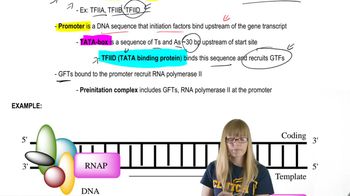
Transcription factories are discrete nuclear sites where multiple RNA polymerase II (RNAP II) molecules cluster to transcribe genes simultaneously. These factories concentrate the transcription machinery and regulatory factors, enhancing transcription efficiency. Each factory can transcribe several genes at once, often bringing distant genes into close spatial proximity.
Recommended video:
Guided course
09:16
Eukaryotic Transcription

RNA Polymerase II and Gene Transcription

RNA polymerase II is the enzyme responsible for transcribing protein-coding genes into messenger RNA (mRNA). It binds to gene promoters, initiates transcription, and elongates the RNA transcript along the structural gene. Multiple RNAP II molecules can transcribe different genes simultaneously within a transcription factory.
Recommended video:
Guided course
09:16
Eukaryotic Transcription

Chromosome Territories and Nuclear Organization

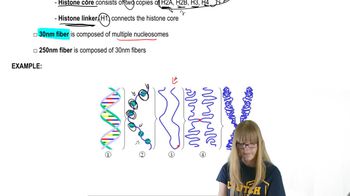
Chromosome territories refer to distinct, non-overlapping regions occupied by individual chromosomes within the interphase nucleus. Nuclear organization influences gene expression by spatially arranging genes and transcription factories, allowing co-regulated genes from different chromosomes to be transcribed together in shared factories.
Recommended video:
Guided course
07:10
Chromosome Structure
Related Practice
Textbook Question

Explain how the following mutations would affect transcription of the yeast GAL1 gene in the presence of galactose.

A mutation within the GAL80 gene that blocks the ability of Gal80 protein to interact with Gal3p.

728
views
Textbook Question

Explain how the following mutations would affect transcription of the yeast GAL1 gene in the presence of galactose.

A deletion of one of the four UASG elements upstream from the GAL1 gene.

558
views
Textbook Question

Explain how the following mutations would affect transcription of the yeast GAL1 gene in the presence of galactose.

A point mutation in the GAL1 core promoter that alters the sequence of the TATA box.

510
views
Textbook Question

A particular type of anemia in humans, called β-thalassemia, results from a severe reduction or absence of the normal β-globin chain of hemoglobin. However, the γ-globin chain, normally only expressed during fetal development, can functionally substitute for β-globin. A variety of studies have explored the use of the nucleoside 5-azacytidine for the expression of γ-globin in adult patients with β-thalassemia.

How might 5-azacytidine lead to expression of γ-globin in adult patients?

471
views
Textbook Question

A particular type of anemia in humans, called β-thalassemia, results from a severe reduction or absence of the normal β-globin chain of hemoglobin. However, the γ-globin chain, normally only expressed during fetal development, can functionally substitute for β-globin. A variety of studies have explored the use of the nucleoside 5-azacytidine for the expression of γ-globin in adult patients with β-thalassemia.

Explain why this drug may also have some adverse side effects.

457
views
Textbook Question

Regulation of the lac operon in E. coli and regulation of the GAL system in yeast are analogous in that they both serve to adapt cells to growth on different carbon sources. However, the transcriptional changes are accomplished very differently. Consider the conceptual similarities and differences as you address the following.

Compare and contrast the roles of the lac operon inducer in bacteria and Gal3p in eukaryotes in the regulation of their respective systems.

701
views