
Pearson+ LogoPearson+ Logo
Ch. 17 - Transcriptional Regulation in Eukaryotes
Klug - Concepts of Genetics  12th Edition
Klug12th EditionConcepts of Genetics ISBN: 9780135564776Not the one you use?Change textbook
Chapter 17, Problem 18

Many transcriptional activators are proteins with a DNA-binding domain (DBD) and an activation domain (AD). Explain how each domain contributes to transcriptional initiation. Would you expect repressors to also have each of these domains?

Verified step by step guidance
1
Understand that transcriptional activators are proteins that enhance gene expression by facilitating the initiation of transcription. They typically have two key domains: the DNA-binding domain (DBD) and the activation domain (AD).
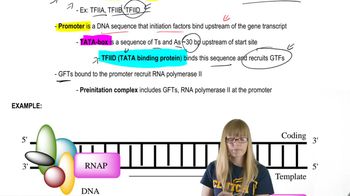
The DNA-binding domain (DBD) allows the activator protein to specifically recognize and bind to particular DNA sequences, often called enhancers or promoter-proximal elements. This targeting ensures that the activator influences the correct gene.
The activation domain (AD) interacts with other components of the transcription machinery, such as general transcription factors or coactivators. This interaction helps recruit or stabilize RNA polymerase II at the promoter, promoting the formation of the transcription initiation complex.
Consider whether repressors, which inhibit transcription, would also have these domains. Repressors often have a DNA-binding domain to target specific DNA sequences, but instead of an activation domain, they usually have a repression domain that interferes with transcription initiation or chromatin structure.
Summarize that while both activators and repressors have DNA-binding domains for specificity, their second domains differ in function: activators have activation domains to promote transcription, whereas repressors have repression domains to inhibit transcription.

Verified video answer for a similar problem:

This video solution was recommended by our tutors as helpful for the problem above.
Video duration:
1m
Was this helpful?

Key Concepts

Here are the essential concepts you must grasp in order to answer the question correctly.

DNA-Binding Domain (DBD)

The DNA-binding domain is a protein region that specifically recognizes and attaches to particular DNA sequences near target genes. This binding positions the activator at the correct site to influence transcription, ensuring gene expression is regulated precisely.
Recommended video:
Guided course
06:25
DNA Structure

Activation Domain (AD)

The activation domain interacts with other proteins, such as transcription factors and the RNA polymerase complex, to enhance the assembly of the transcription machinery. It facilitates the initiation of transcription by recruiting or stabilizing these components at the promoter.
Recommended video:
Guided course
09:16
Eukaryotic Transcription

Structure and Function of Repressors

Repressors often have DNA-binding domains to target specific genes but may lack activation domains. Instead, they possess repression domains that inhibit transcription by blocking activator binding, recruiting co-repressors, or modifying chromatin to reduce gene expression.
Recommended video:
Guided course
08:26
Functional Genomics
Related Practice
Textbook Question

Many promoter regions contain CAAT boxes containing consensus sequences CAAT or CCAAT approximately 70 to 80 bases upstream from the transcription start site. How might one determine the influence of CAAT boxes on the transcription rate of a given gene?

889
views
Textbook Question

Research indicates that promoters may fall into one of two classes: focused or dispersed. How do these classes differ, and which genes tend to be associated with each?

526
views
Textbook Question

Explain the features of the Initiator (Inr) elements, BREs, DPEs, and MTEs of focused promoters.

868
views
Textbook Question

How do the ENCODE data vastly help determine which enhancers regulate which genes?

579
views
Textbook Question

DNA supercoiling, which occurs when coiling tension is generated ahead of the replication fork, is relieved by DNA gyrase. Supercoiling may also be involved in transcription regulation. Researchers discovered that enhancers operating over a long distance (2500 bp) are dependent on DNA supercoiling, while enhancers operating over shorter distances (110 bp) are not so dependent [Liu et al. (2001). Proc. Natl. Acad. Sci. USA 98:14,883–14,888]. Using a diagram, suggest a way in which supercoiling may positively influence enhancer activity over long distances.

1095
views
Textbook Question

Because the degree of DNA methylation appears to be a relatively reliable genetic marker for some forms of cancer, researchers have explored the possibility of altering DNA methylation as a form of cancer therapy. Initial studies indicate that while hypomethylation suppresses the formation of some tumors, other tumors thrive. Why would one expect different cancers to respond differently to either hypomethylation or hypermethylation therapies?

619
views