Pearson+ LogoPearson+ Logo
Ch. 17 - Transcriptional Regulation in Eukaryotes
Klug - Concepts of Genetics  12th Edition
Klug12th EditionConcepts of Genetics ISBN: 9780135564776Not the one you use?Change textbook
Chapter 17, Problem 25c

Regulation of the lac operon in E. coli and regulation of the GAL system in yeast are analogous in that they both serve to adapt cells to growth on different carbon sources. However, the transcriptional changes are accomplished very differently. Consider the conceptual similarities and differences as you address the following.
Compare and contrast how these two systems are negatively regulated such that they are downregulated in the presence of glucose.

Verified step by step guidance
1
Step 1: Begin by defining the lac operon and the GAL system, emphasizing that both are gene regulatory systems that enable cells to utilize alternative carbon sources when glucose is scarce.
Step 2: Explain negative regulation in the lac operon, focusing on the role of the lac repressor protein, which binds to the operator region to block transcription in the absence of lactose, and how glucose presence leads to catabolite repression via low cAMP levels, reducing activation by CAP-cAMP complex.
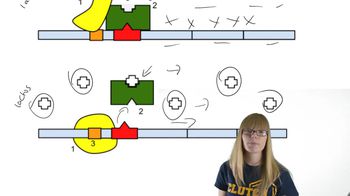
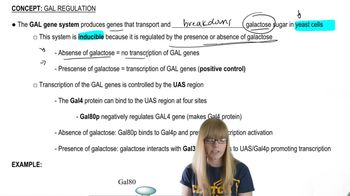
Step 3: Describe negative regulation in the GAL system, highlighting the role of the Gal80 protein as a repressor that inhibits the activator Gal4 in the absence of galactose, and how glucose presence represses GAL gene expression through a different mechanism involving Mig1, a glucose-responsive repressor that binds to the promoters of GAL genes to inhibit transcription.
Step 4: Compare the two systems by noting that both use repressors to downregulate gene expression in the presence of glucose, but the lac operon primarily uses catabolite repression affecting activator binding, while the GAL system uses a dedicated glucose-responsive repressor protein (Mig1) to directly inhibit transcription.
Step 5: Summarize the conceptual difference that the lac operon repression is largely indirect via modulation of activator availability (CAP-cAMP), whereas the GAL system repression involves direct binding of a glucose-activated repressor to the DNA, illustrating different molecular strategies to achieve similar regulatory outcomes.

Verified video answer for a similar problem:

This video solution was recommended by our tutors as helpful for the problem above.
Video duration:
58s
Was this helpful?

Key Concepts

Here are the essential concepts you must grasp in order to answer the question correctly.

Negative Regulation of the lac Operon

The lac operon in E. coli is negatively regulated by the lac repressor protein, which binds to the operator region to block transcription when lactose is absent. In the presence of glucose, catabolite repression occurs via low cAMP levels, preventing activation by CAP, thus downregulating the operon. This dual control ensures the operon is off when glucose is available, prioritizing its use over lactose.
Recommended video:
Guided course
06:55
Lac Operon Regulation

Negative Regulation of the GAL System in Yeast

The GAL system in yeast is negatively regulated primarily by the Gal80 protein, which inhibits the activator Gal4 in the absence of galactose. When glucose is present, repression occurs through Mig1, a glucose-responsive repressor that binds to the GAL gene promoters, recruiting corepressors to inhibit transcription. This mechanism ensures GAL genes are repressed when glucose is the preferred carbon source.
Recommended video:
Guided course
03:51
GAL Regulation

Conceptual Similarities and Differences in Glucose-Mediated Repression

Both systems downregulate gene expression in the presence of glucose to prioritize its metabolism, demonstrating catabolite repression. However, the lac operon uses a combination of repressor binding and activator absence (via cAMP-CAP), while the GAL system employs a dedicated glucose-responsive repressor (Mig1). Thus, both achieve similar outcomes through distinct molecular mechanisms.
Recommended video:
Guided course
06:55
Lac Operon Regulation
Related Practice
Textbook Question

A particular type of anemia in humans, called β-thalassemia, results from a severe reduction or absence of the normal β-globin chain of hemoglobin. However, the γ-globin chain, normally only expressed during fetal development, can functionally substitute for β-globin. A variety of studies have explored the use of the nucleoside 5-azacytidine for the expression of γ-globin in adult patients with β-thalassemia.

Explain why this drug may also have some adverse side effects.

457
views
Textbook Question

Regulation of the lac operon in E. coli and regulation of the GAL system in yeast are analogous in that they both serve to adapt cells to growth on different carbon sources. However, the transcriptional changes are accomplished very differently. Consider the conceptual similarities and differences as you address the following.

Compare and contrast the roles of the lac operon inducer in bacteria and Gal3p in eukaryotes in the regulation of their respective systems.

701
views
Textbook Question

Regulation of the lac operon in E. coli and regulation of the GAL system in yeast are analogous in that they both serve to adapt cells to growth on different carbon sources. However, the transcriptional changes are accomplished very differently. Consider the conceptual similarities and differences as you address the following.

Compare and contrast the cis-regulatory elements of the lac operon and GAL gene system.

852
views
Textbook Question

DNA methylation is commonly associated with a reduction of transcription. The following data come from a study of the impact of the location and extent of DNA methylation on gene activity in eukaryotic cells. A bacterial gene, luciferase, was inserted into plasmids next to eukaryotic promoter fragments. CpG sequences, either within the promoter and coding sequence (transcription unit) or outside of the transcription unit, were methylated to various degrees, in vitro. The chimeric plasmids were then introduced into cultured cells, and luciferase activity was assayed. These data compare the degree of expression of luciferase with differences in the location of DNA methylation [Irvine et al. (2002). Mol. and Cell. Biol. 22:6689–6696]. What general conclusions can be drawn from these data? 

776
views
Textbook Question

During an examination of the genomic sequences surrounding the human β-globin gene, you discover a region of DNA that bears sequence resemblance to the glucocorticoid response element (GRE) of the human metallothionein IIA (hMTIIA) gene. Describe experiments that you would design to test

(1) whether this sequence was necessary for accurate β-globin gene expression and

(2) whether this sequence acted in the same way as the hMTIIA gene's GRE.

532
views
Textbook Question

Marine stickleback fish have pelvic fins with long spines that provide protection from larger predatory fish. Some stickleback fish were trapped in lakes and have adapted to life in a different environment. Many lake populations of stickleback fish lack pelvic fins. Shapiro et al. (2004) (Nature 428:717.723) mapped the mutation associated with the loss of pelvic fins to the Pitx1 locus, a gene expressed in pelvic fins, the pituitary gland, and the jaw. However, the coding sequence of the Pitx1 gene is identical in marine and lake stickleback [Chan et al. (2010). Science 327:5963,302–305]. Moreover, when the Pitx1 coding region is deleted, the fish die with defects in the pituitary gland and the jaw, and they lack pelvic fins. Explain how a mutation near, but outside of, the coding region of Pitx1 may cause a loss of pelvic fins without pleiotropic effects on the pituitary gland and jaw.

623
views