Pearson+ LogoPearson+ Logo
Ch. 17 - Transcriptional Regulation in Eukaryotes
Klug - Concepts of Genetics  12th Edition
Klug12th EditionConcepts of Genetics ISBN: 9780135564776Not the one you use?Change textbook
Chapter 17, Problem 25b

Regulation of the lac operon in E. coli and regulation of the GAL system in yeast are analogous in that they both serve to adapt cells to growth on different carbon sources. However, the transcriptional changes are accomplished very differently. Consider the conceptual similarities and differences as you address the following.
Compare and contrast the cis-regulatory elements of the lac operon and GAL gene system.

Verified step by step guidance
1
Step 1: Define cis-regulatory elements as DNA sequences located near a gene that regulate the transcription of that gene by serving as binding sites for transcription factors or regulatory proteins.
Step 2: Identify the cis-regulatory elements of the lac operon, which include the promoter (where RNA polymerase binds), the operator (where the lac repressor binds), and the CAP binding site (where the catabolite activator protein binds to enhance transcription).
Step 3: Identify the cis-regulatory elements of the GAL gene system in yeast, which include upstream activating sequences (UAS) that serve as binding sites for activator proteins such as Gal4, as well as promoter regions where the general transcription machinery assembles.
Step 4: Compare the lac operon and GAL system cis-elements by noting that both have promoter regions and specific binding sites for regulatory proteins, but the lac operon uses an operator for repressor binding, while the GAL system primarily uses UAS for activator binding.
Step 5: Contrast the two systems by explaining that the lac operon’s cis-elements are organized to allow repression and activation primarily through repressor and CAP binding, whereas the GAL system’s cis-elements are designed to facilitate activation through multiple UAS sites and activator proteins, reflecting different regulatory strategies.

Verified video answer for a similar problem:

This video solution was recommended by our tutors as helpful for the problem above.
Video duration:
1m
Was this helpful?

Key Concepts

Here are the essential concepts you must grasp in order to answer the question correctly.

Cis-regulatory Elements

Cis-regulatory elements are DNA sequences located near a gene that regulate its transcription by serving as binding sites for transcription factors. These include promoters, operators, and enhancers, which control gene expression by facilitating or blocking RNA polymerase access. Understanding these elements is essential to compare how the lac operon and GAL system control gene activity.
Recommended video:
Guided course
05:30
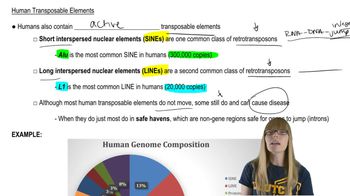
Human Transposable Elements

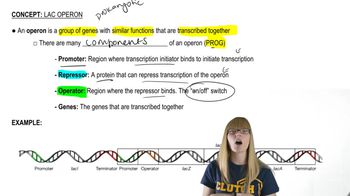
Lac Operon Cis-regulatory Elements

The lac operon contains key cis-regulatory elements such as the promoter, operator, and CAP binding site. The operator binds the lac repressor to inhibit transcription in the absence of lactose, while the CAP site binds an activator protein to enhance transcription when glucose is low. These elements enable tight control of lactose metabolism genes in E. coli.
Recommended video:
Guided course
04:27
Lac Operon Overview

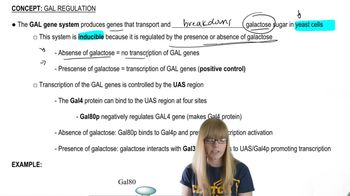
GAL System Cis-regulatory Elements

The GAL gene system in yeast uses upstream activating sequences (UAS) as cis-regulatory elements, which bind activator proteins like Gal4 to promote transcription. Unlike the lac operon, the GAL system relies heavily on activators and chromatin remodeling, with less emphasis on repressor binding sites, reflecting a different regulatory strategy for adapting to galactose.
Recommended video:
Guided course
03:51
GAL Regulation
Related Practice
Textbook Question

A particular type of anemia in humans, called β-thalassemia, results from a severe reduction or absence of the normal β-globin chain of hemoglobin. However, the γ-globin chain, normally only expressed during fetal development, can functionally substitute for β-globin. A variety of studies have explored the use of the nucleoside 5-azacytidine for the expression of γ-globin in adult patients with β-thalassemia.

How might 5-azacytidine lead to expression of γ-globin in adult patients?

471
views
Textbook Question

A particular type of anemia in humans, called β-thalassemia, results from a severe reduction or absence of the normal β-globin chain of hemoglobin. However, the γ-globin chain, normally only expressed during fetal development, can functionally substitute for β-globin. A variety of studies have explored the use of the nucleoside 5-azacytidine for the expression of γ-globin in adult patients with β-thalassemia.

Explain why this drug may also have some adverse side effects.

457
views
Textbook Question

Regulation of the lac operon in E. coli and regulation of the GAL system in yeast are analogous in that they both serve to adapt cells to growth on different carbon sources. However, the transcriptional changes are accomplished very differently. Consider the conceptual similarities and differences as you address the following.

Compare and contrast the roles of the lac operon inducer in bacteria and Gal3p in eukaryotes in the regulation of their respective systems.

701
views
Textbook Question

Regulation of the lac operon in E. coli and regulation of the GAL system in yeast are analogous in that they both serve to adapt cells to growth on different carbon sources. However, the transcriptional changes are accomplished very differently. Consider the conceptual similarities and differences as you address the following.

Compare and contrast how these two systems are negatively regulated such that they are downregulated in the presence of glucose.

713
views
Textbook Question

DNA methylation is commonly associated with a reduction of transcription. The following data come from a study of the impact of the location and extent of DNA methylation on gene activity in eukaryotic cells. A bacterial gene, luciferase, was inserted into plasmids next to eukaryotic promoter fragments. CpG sequences, either within the promoter and coding sequence (transcription unit) or outside of the transcription unit, were methylated to various degrees, in vitro. The chimeric plasmids were then introduced into cultured cells, and luciferase activity was assayed. These data compare the degree of expression of luciferase with differences in the location of DNA methylation [Irvine et al. (2002). Mol. and Cell. Biol. 22:6689–6696]. What general conclusions can be drawn from these data? 

776
views
Textbook Question

During an examination of the genomic sequences surrounding the human β-globin gene, you discover a region of DNA that bears sequence resemblance to the glucocorticoid response element (GRE) of the human metallothionein IIA (hMTIIA) gene. Describe experiments that you would design to test

(1) whether this sequence was necessary for accurate β-globin gene expression and

(2) whether this sequence acted in the same way as the hMTIIA gene's GRE.

532
views