Pearson+ LogoPearson+ Logo
Ch. 18 - Post-transcriptional Regulation in Eukaryotes
Klug - Concepts of Genetics  12th Edition
Klug12th EditionConcepts of Genetics ISBN: 9780135564776Not the one you use?Change textbook
Chapter 18, Problem 13

RNAi may be directed by small interfering RNAs (siRNAs) or microRNAs (miRNAs); how are these similar, and how are they different?

Verified step by step guidance
1
Begin by defining both small interfering RNAs (siRNAs) and microRNAs (miRNAs) as short, non-coding RNA molecules involved in RNA interference (RNAi), a process that regulates gene expression post-transcriptionally.
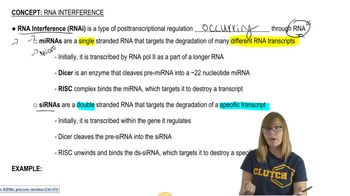
Explain the similarity: both siRNAs and miRNAs guide the RNA-induced silencing complex (RISC) to target messenger RNAs (mRNAs) based on sequence complementarity, leading to gene silencing either by mRNA degradation or translational repression.
Describe the origin difference: siRNAs typically arise from exogenous double-stranded RNA (dsRNA) or long dsRNA precursors, while miRNAs are endogenously encoded in the genome and transcribed as primary miRNAs (pri-miRNAs) that are processed into mature miRNAs.
Highlight the targeting difference: siRNAs usually have perfect or near-perfect complementarity to their target mRNA, resulting in cleavage and degradation, whereas miRNAs often have partial complementarity, leading mainly to translational repression or destabilization of the mRNA.
Summarize by noting that despite their differences in origin and targeting mechanisms, both siRNAs and miRNAs play crucial roles in regulating gene expression through the RNAi pathway.

Verified video answer for a similar problem:

This video solution was recommended by our tutors as helpful for the problem above.
Video duration:
4m
Was this helpful?

Key Concepts

Here are the essential concepts you must grasp in order to answer the question correctly.

RNA Interference (RNAi)

RNA interference is a biological process where small RNA molecules inhibit gene expression by neutralizing targeted mRNA molecules. It serves as a regulatory mechanism to control gene activity and defend against viral genomes. Both siRNAs and miRNAs function within this pathway to silence genes post-transcriptionally.
Recommended video:
Guided course
06:59
RNA Interference

Small Interfering RNAs (siRNAs)

siRNAs are short, double-stranded RNA molecules typically derived from exogenous sources like viruses or experimental introduction. They guide the RNA-induced silencing complex (RISC) to perfectly complementary mRNA targets, leading to their cleavage and degradation, thus silencing specific genes.
Recommended video:

MicroRNAs (miRNAs)

miRNAs are endogenous, single-stranded RNA molecules processed from hairpin precursors within the cell. They usually bind imperfectly to target mRNAs, causing translational repression or destabilization rather than direct cleavage, allowing fine-tuned regulation of multiple genes simultaneously.
Recommended video:
Guided course
06:59
RNA Interference