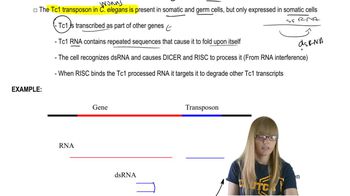
In 1998, future Nobel laureates Andrew Fire and Craig Mello, and colleagues, published an article in Nature entitled, 'Potent and Specific Genetic Interference by Double-Stranded RNA in Caenorhabditis elegans.' Explain how RNAi is both 'potent and specific.'
Ch. 18 - Post-transcriptional Regulation in Eukaryotes

Chapter 18, Problem 14
miRNAs target endogenous mRNAs in a sequence-specific manner. Explain, conceptually, how one might identify potential mRNA targets for a given miRNA if you only know the sequence of the miRNA and the sequence of all mRNAs in a cell or tissue of interest.
Verified step by step guidance1
Understand that miRNAs regulate gene expression by binding to complementary sequences on target mRNAs, usually within the 3' untranslated region (3' UTR), leading to mRNA degradation or translational repression.
Recognize that identifying potential mRNA targets involves searching for regions in mRNAs that are complementary to the miRNA sequence, especially focusing on the 'seed region' of the miRNA, which is typically nucleotides 2-8 at the 5' end and is critical for target recognition.
Use bioinformatics tools or algorithms to perform sequence alignment between the miRNA seed region and the sequences of all mRNAs in the cell or tissue, looking for perfect or near-perfect complementary matches.
Consider additional factors such as the accessibility of the target site on the mRNA (secondary structure), evolutionary conservation of the target site across species, and the presence of multiple binding sites to increase confidence in predicted targets.
Compile a list of candidate mRNAs with complementary sequences and evaluate them further experimentally or through additional computational analyses to confirm functional miRNA-mRNA interactions.

Verified video answer for a similar problem:
This video solution was recommended by our tutors as helpful for the problem above.
Video duration:
2mWas this helpful?
Key Concepts
Here are the essential concepts you must grasp in order to answer the question correctly.
miRNA-mRNA Base Pairing
miRNAs regulate gene expression by binding to complementary sequences on target mRNAs, usually within the 3' untranslated region. This binding is sequence-specific, relying on Watson-Crick base pairing, especially in the miRNA seed region (nucleotides 2-8). Identifying potential targets involves finding mRNAs with complementary sequences to the miRNA seed region.
Recommended video:
Guided course
Base Distortions
Sequence Alignment and Complementarity Search
To identify potential mRNA targets, computational tools align the miRNA sequence against mRNA sequences to find regions of complementarity. Algorithms consider perfect or near-perfect matches in the seed region and allow some mismatches elsewhere. This approach narrows down candidate mRNAs that may be regulated by the miRNA.
Recommended video:
Guided course
Sequencing Difficulties
Biological Context and Target Validation
Not all sequence matches result in functional targeting; factors like mRNA accessibility, secondary structure, and expression levels influence miRNA binding. Therefore, after computational prediction, experimental validation (e.g., reporter assays) is necessary to confirm true miRNA-mRNA interactions in the specific cell or tissue context.
Recommended video:
Guided course
Regulation
Related Practice
Textbook Question
623
views
Textbook Question
Present an overview of RNA interference (RNAi). How does the silencing process begin, and what major components participate?
956
views
Textbook Question
RNAi may be directed by small interfering RNAs (siRNAs) or microRNAs (miRNAs); how are these similar, and how are they different?
974
views
Textbook Question
In principle, RNAi may be used to fight viral infection. How might this work?
544
views
Textbook Question
Competing endogenous RNAs act as molecular 'sponges.' What does this mean, and what do they compete with?
563
views
Textbook Question
While circular RNAs were first described long ago, they have only recently been investigated for function. What are their known and suspected functions in the cell?
461
views