Pearson+ LogoPearson+ Logo
Ch. 18 - Post-transcriptional Regulation in Eukaryotes
Klug - Concepts of Genetics  12th Edition
Klug12th EditionConcepts of Genetics ISBN: 9780135564776Not the one you use?Change textbook
Chapter 18, Problem 11

In 1998, future Nobel laureates Andrew Fire and Craig Mello, and colleagues, published an article in Nature entitled, 'Potent and Specific Genetic Interference by Double-Stranded RNA in Caenorhabditis elegans.' Explain how RNAi is both 'potent and specific.'

Verified step by step guidance
1
Understand that RNA interference (RNAi) is a biological process where double-stranded RNA (dsRNA) molecules inhibit gene expression by causing the degradation of specific messenger RNA (mRNA) molecules.
Recognize that RNAi is 'potent' because even small amounts of dsRNA can trigger a strong gene-silencing effect, efficiently reducing the target mRNA levels and thus protein production.
Note that RNAi is 'specific' because the dsRNA sequence is complementary to the target mRNA sequence, allowing the RNA-induced silencing complex (RISC) to precisely recognize and degrade only the matching mRNA without affecting other genes.
Recall that the specificity arises from base-pairing rules, where the small interfering RNA (siRNA) guides RISC to the exact mRNA sequence through Watson-Crick base pairing, ensuring targeted gene silencing.
Summarize that the combination of high efficiency in silencing (potency) and precise sequence recognition (specificity) makes RNAi a powerful tool for gene regulation and functional genomics studies.

Verified video answer for a similar problem:

This video solution was recommended by our tutors as helpful for the problem above.
Video duration:
2m
Was this helpful?

Key Concepts

Here are the essential concepts you must grasp in order to answer the question correctly.

RNA Interference (RNAi) Mechanism

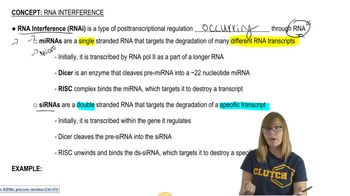
RNAi is a biological process where double-stranded RNA (dsRNA) triggers the degradation of complementary messenger RNA (mRNA), effectively silencing specific genes. This mechanism involves the enzyme Dicer cutting dsRNA into small interfering RNAs (siRNAs), which guide the RNA-induced silencing complex (RISC) to target and degrade matching mRNA sequences.
Recommended video:
Guided course
06:59
RNA Interference

Specificity of RNAi

RNAi is highly specific because the siRNAs produced are complementary to particular mRNA sequences. This base-pairing ensures that only mRNAs with matching sequences are targeted for degradation, allowing precise gene silencing without affecting unrelated genes.
Recommended video:
Guided course
01:45
DNA Proofreading

Potency of RNAi

RNAi is potent because a small amount of dsRNA can trigger the degradation of many mRNA molecules, amplifying the gene-silencing effect. This amplification and the catalytic nature of the RISC complex enable efficient and robust suppression of gene expression.