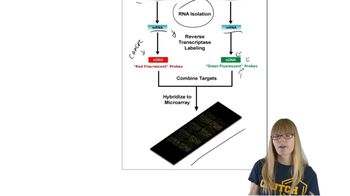
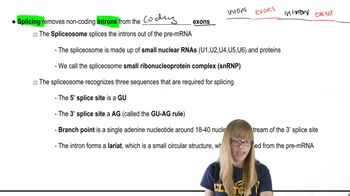
Incorrectly spliced RNAs often lead to human pathologies. Scientists have examined cancer cells for splice-specific changes and found that many of the changes disrupt tumor-suppressor gene function [Xu and Lee (2003). Nucl. Acids Res. 31:5635–5643]. In general, what would be the effects of splicing changes on these RNAs and the function of tumor-suppressor gene function? How might loss of splicing specificity be associated with cancer?

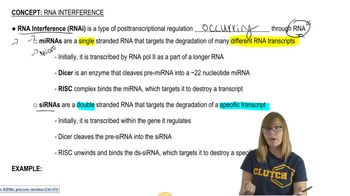
While miRNA response elements (MREs) may be located anywhere within an mRNA, they are most often found outside the coding region in the 5' or 3' UTR. Explain why this is likely the case given that miRNAs often target more than one mRNA.
Verified step by step guidance
Verified video answer for a similar problem:
Key Concepts
miRNA Function and Targeting
Untranslated Regions (UTRs) of mRNA
Conservation and Flexibility of miRNA Target Sites
Mutations in the low-density lipoprotein receptor (LDLR) gene are a primary cause of familial hypercholesterolemia. One such mutation is a SNP in exon 12 of the LDLR. In premenopausal women, but not in men or postmenopausal women, this SNP leads to skipping of exon 12 and production of a truncated nonfunctional protein. It is hypothesized that this SNP compromises a splice enhancer [Zhu et al. (2007). Hum Mol Genet. 16:1765–1772]. What are some possible ways in which this SNP can lead to this defect, but only in premenopausal women?
RNA helicases are a class of proteins that bind mRNAs and influence their secondary structures and interactions with other proteins. RNA helicases have been implicated in many steps of RNA regulation such as splicing, decay, and translation. Why might these enzymes be so ubiquitously required for RNA regulation?
RNAi is currently being tested as a therapeutic tool for genetic diseases and other conditions. Consider the following: cystic fibrosis caused by loss of function of the CFTR gene, HIV infection, and cancer caused by hyperactivity of a growth factor receptor. Which of these may be treatable by RNAi, and which not? Explain your reasoning.
The localization and translational control of actin mRNA is important for the migration of fibroblasts and is regulated by the activity of the kinase Src. Src is activated by phosphorylation when cell surface receptors bind to signaling molecules. How might this system lead to a cell migrating in a specific direction? How might the cell migrate away from repulsive signals?
Explain how the expression of a single gene can be quickly, efficiently, and specifically shut down at the transcriptional, posttranscriptional, and posttranslational stages through the coordinated expression of a transcriptional repressor, an miRNA, and a ubiquitin ligase.
