Pearson+ LogoPearson+ Logo
Ch. 2 - Mitosis and Meiosis
Klug - Concepts of Genetics  12th Edition
Klug12th EditionConcepts of Genetics ISBN: 9780135564776Not the one you use?Change textbook
Chapter 2, Problem 10

Define and discuss these terms:
(a) synapsis
(b) bivalents
(c) chiasmata
(d) crossing over
(e) chromomeres
(f) sister chromatids
(g) tetrads
(h) dyad
(i) monads

Verified step by step guidance
1
Step 1: Define 'synapsis' as the pairing of homologous chromosomes during prophase I of meiosis, where they align closely along their lengths to facilitate genetic recombination.
Step 2: Explain 'bivalents' as the paired homologous chromosomes, each consisting of two sister chromatids, that are physically connected during synapsis.
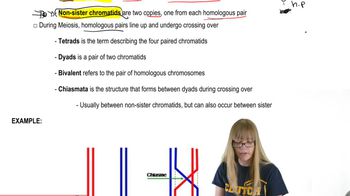
Step 3: Describe 'chiasmata' as the visible points where homologous chromosomes exchange genetic material during crossing over; these are the sites of genetic recombination.
Step 4: Define 'crossing over' as the process during meiosis where homologous chromosomes exchange segments of DNA, increasing genetic diversity in gametes.
Step 5: Clarify 'chromomeres' as bead-like, localized thickened regions seen on chromosomes during prophase, representing areas of tightly coiled DNA.

Verified video answer for a similar problem:

This video solution was recommended by our tutors as helpful for the problem above.
Video duration:
1m
Was this helpful?

Key Concepts

Here are the essential concepts you must grasp in order to answer the question correctly.

Synapsis and Bivalents

Synapsis is the pairing of homologous chromosomes during prophase I of meiosis, allowing them to align closely. This pairing forms structures called bivalents, which consist of two homologous chromosomes, each made of two sister chromatids. Bivalents are essential for genetic recombination and accurate chromosome segregation.
Recommended video:
Guided course
07:38
Crossing Over Terminology

Chiasmata and Crossing Over

Chiasmata are the visible points where homologous chromosomes exchange genetic material during crossing over in meiosis. Crossing over is the process where non-sister chromatids exchange segments, increasing genetic diversity in gametes. Chiasmata physically hold homologs together until they separate.
Recommended video:
Guided course
07:38
Crossing Over Terminology

Chromomeres, Sister Chromatids, Tetrads, Dyads, and Monads

Chromomeres are bead-like structures on chromosomes visible during early meiosis. Sister chromatids are identical copies of a chromosome connected at the centromere. A tetrad refers to the four chromatids of a bivalent. Dyads are pairs of sister chromatids after the first meiotic division, and monads are single chromatids after the second division.
Recommended video:
Guided course
07:38
Crossing Over Terminology