Pearson+ LogoPearson+ Logo
Ch. 2 - Mitosis and Meiosis
Klug - Concepts of Genetics  12th Edition
Klug12th EditionConcepts of Genetics ISBN: 9780135564776Not the one you use?Change textbook
Chapter 2, Problem 11

Contrast the genetic content and the origin of sister versus nonsister chromatids during their earliest appearance in prophase I of meiosis. How might the genetic content of these change by the time tetrads have aligned at the equatorial plate during metaphase I?

Verified step by step guidance
1
Step 1: Define sister chromatids and nonsister chromatids. Sister chromatids are two identical copies of a single chromosome connected by a centromere, formed during DNA replication in the S phase. Nonsister chromatids are chromatids belonging to homologous chromosomes (one from each parent) that pair up during meiosis I.
Step 2: Describe the genetic content of sister chromatids at the earliest appearance in prophase I. At this stage, sister chromatids are genetically identical because they are replicated copies of the same chromosome.
Step 3: Describe the genetic content of nonsister chromatids at the earliest appearance in prophase I. Nonsister chromatids come from homologous chromosomes, so they carry the same genes but may have different alleles inherited from each parent, making them genetically similar but not identical.
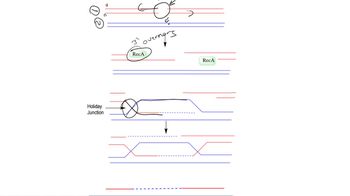
Step 4: Explain the process of crossing over during prophase I. Homologous chromosomes undergo synapsis, forming tetrads, and nonsister chromatids exchange genetic material at chiasmata, resulting in recombination. This alters the genetic content of nonsister chromatids by mixing alleles between homologs.
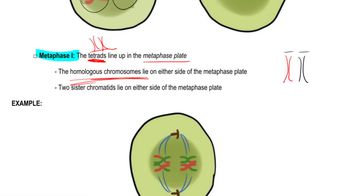
Step 5: Discuss how the genetic content changes by metaphase I. After crossing over, sister chromatids remain identical, but nonsister chromatids now contain recombinant segments, increasing genetic diversity. The tetrads align at the equatorial plate with these recombined nonsister chromatids paired together.

Verified video answer for a similar problem:

This video solution was recommended by our tutors as helpful for the problem above.
Video duration:
2m
Was this helpful?

Key Concepts

Here are the essential concepts you must grasp in order to answer the question correctly.

Sister vs. Nonsister Chromatids

Sister chromatids are identical copies of a single chromosome, formed by DNA replication and joined at the centromere. Nonsister chromatids belong to homologous chromosomes, one inherited from each parent, and are similar but not identical. Understanding their origin is key to distinguishing their genetic content during meiosis.
Recommended video:

Prophase I of Meiosis and Homologous Pairing

During prophase I, homologous chromosomes pair up to form tetrads, aligning sister chromatids side by side. This pairing facilitates genetic recombination between nonsister chromatids through crossing over, which alters their genetic content and increases genetic diversity.
Recommended video:
Guided course
09:06
Meiosis Steps

Genetic Recombination and Changes by Metaphase I

By metaphase I, crossing over has exchanged genetic material between nonsister chromatids, creating recombinant chromatids with new allele combinations. Sister chromatids remain genetically identical unless crossing over occurs between them, which is rare, so the genetic content of nonsister chromatids changes while sister chromatids largely remain the same.
Recommended video:
Guided course
03:37
Recombination after Double Strand Breaks