Pearson+ LogoPearson+ Logo
Ch. 2 - Mitosis and Meiosis
Klug - Concepts of Genetics  12th Edition
Klug12th EditionConcepts of Genetics ISBN: 9780135564776Not the one you use?Change textbook
Chapter 2, Problem 8

Contrast telophase in plant and animal mitosis.

Verified step by step guidance
1
Begin by defining telophase as the final stage of mitosis where the chromosomes arrive at opposite poles of the cell and begin to decondense, and the nuclear envelope re-forms around each set of chromosomes.
Explain that in animal cells during telophase, the cell membrane starts to pinch inward through a process called cleavage furrow formation, which eventually leads to cytokinesis (division of the cytoplasm).
Describe that in plant cells, because of the rigid cell wall, telophase involves the formation of a cell plate at the center of the cell, which will develop into a new cell wall separating the two daughter cells.
Highlight that the nuclear envelope re-forms in both plant and animal cells during telophase, but the mechanism of cytoplasmic division differs due to structural differences (cell wall in plants vs. flexible membrane in animals).
Summarize the contrast by emphasizing that animal cells use cleavage furrow for cytokinesis, while plant cells form a cell plate, reflecting adaptations to their cellular structures.

Verified video answer for a similar problem:

This video solution was recommended by our tutors as helpful for the problem above.
Video duration:
3m
Was this helpful?

Key Concepts

Here are the essential concepts you must grasp in order to answer the question correctly.

Telophase in Mitosis

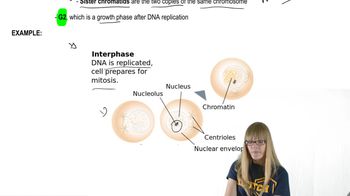
Telophase is the final stage of mitosis where chromosomes decondense, nuclear envelopes re-form around each set of chromosomes, and the cell prepares to divide. It marks the near completion of nuclear division before cytokinesis separates the cytoplasm.
Recommended video:
Guided course
09:46
Mitosis Steps

Cytokinesis Differences in Plant and Animal Cells

Cytokinesis follows telophase and differs between plants and animals. Animal cells form a cleavage furrow by constricting the plasma membrane, while plant cells build a cell plate from vesicles to create a new cell wall, due to their rigid cell walls.
Recommended video:
Guided course
04:06
Formation of Plant Gametes

Cell Structure Impact on Mitosis

The presence of a rigid cell wall in plants influences how cell division occurs, necessitating the formation of a cell plate during cytokinesis. In contrast, animal cells lack a cell wall, allowing the membrane to pinch inward easily during division.
Recommended video:
Guided course
09:46
Mitosis Steps