
Textbook Question
Restriction sites are palindromic; that is, they read the same in the 5' to 3' direction on each strand of DNA. What is the advantage of having restriction sites organized this way?
854
views

 Verified step by step guidance
 03:49
03:49
 09:16
09:16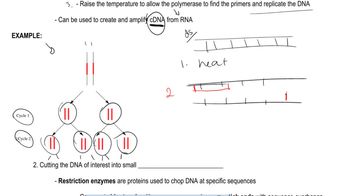 07:39
07:39Restriction sites are palindromic; that is, they read the same in the 5' to 3' direction on each strand of DNA. What is the advantage of having restriction sites organized this way?
Using DNA sequencing on a cloned DNA segment, you recover the nucleotide sequence shown below. Does this segment contain a palindromic recognition sequence for a restriction enzyme? If so, what is the double-stranded sequence of the palindrome, and what enzyme would cut at this sequence?
CAGTATGGATCCCAT
How can gene knockouts, transgenic animals, and gene editing techniques be used to explore gene function?
What roles do restriction enzymes, vectors, and host cells play in recombinant DNA studies? What role does DNA ligase perform in a DNA cloning experiment? How does the action of DNA ligase differ from the function of restriction enzymes?
Write a short essay or sketch a diagram that provides an overview of how recombinant DNA techniques help geneticists study genes.
Although many cloning applications involve introducing recombinant DNA into bacterial host cells, many other cell types are also used as hosts for recombinant DNA. Why?