Pearson+ LogoPearson+ Logo
Ch. 20 - Recombinant DNA Technology
Klug - Concepts of Genetics  12th Edition
Klug12th EditionConcepts of Genetics ISBN: 9780135564776Not the one you use?Change textbook
Chapter 20, Problem 2

Write a short essay or sketch a diagram that provides an overview of how recombinant DNA techniques help geneticists study genes.

Verified step by step guidance
1
Begin by explaining that recombinant DNA techniques involve combining DNA from different sources to create new genetic combinations that are useful for research, medicine, and biotechnology.
Describe the process of isolating a gene of interest using restriction enzymes, which cut DNA at specific sequences, allowing geneticists to extract and manipulate specific DNA fragments.
Explain how these DNA fragments can be inserted into vectors, such as plasmids, which are circular DNA molecules that can replicate independently within bacterial cells, facilitating gene cloning.
Discuss how the recombinant DNA is introduced into host cells (transformation), enabling the replication and expression of the gene, which allows geneticists to study gene function, regulation, and protein production.
Conclude by highlighting that recombinant DNA technology enables detailed analysis of genes, including sequencing, mutagenesis, and gene therapy applications, thus providing powerful tools to understand genetics at a molecular level.

Verified video answer for a similar problem:

This video solution was recommended by our tutors as helpful for the problem above.
Video duration:
2m
Was this helpful?

Key Concepts

Here are the essential concepts you must grasp in order to answer the question correctly.

Recombinant DNA Technology

Recombinant DNA technology involves combining DNA molecules from different sources into one molecule to create new genetic combinations. This technique allows scientists to isolate, manipulate, and study specific genes by inserting them into vectors like plasmids, which can be replicated in host cells.
Recommended video:
Guided course
03:51
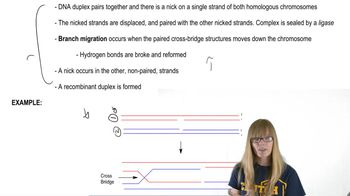
Recombination after Single Strand Breaks

Gene Cloning and Expression

Gene cloning is the process of making multiple copies of a particular gene using recombinant DNA methods. By cloning genes into host organisms, geneticists can produce large amounts of DNA or protein, enabling detailed study of gene function, regulation, and expression patterns.
Recommended video:
Guided course
02:09
Penetrance and Expressivity

Applications in Genetic Analysis

Recombinant DNA techniques facilitate various genetic analyses, such as identifying gene sequences, studying mutations, and producing genetically modified organisms. These methods help in understanding gene structure, function, and interactions, advancing research in medicine, agriculture, and biotechnology.
Recommended video:
Guided course
02:48
Chi Square Analysis