Pearson+ LogoPearson+ Logo
Ch. 20 - Recombinant DNA Technology
Klug - Concepts of Genetics  12th Edition
Klug12th EditionConcepts of Genetics ISBN: 9780135564776Not the one you use?Change textbook
Chapter 20, Problem 25

When disrupting a mouse gene by knockout, why is it desirable to breed mice until offspring homozygous (−/−) for the knockout target gene are obtained?

Verified step by step guidance
1
Understand that a knockout mouse has one or both copies of a specific gene disrupted or inactivated, which helps study the gene's function by observing the effects of its absence.
Recognize that heterozygous mice (−/+) carry one disrupted allele and one normal allele, so they may still produce some functional gene product, potentially masking the full effect of the knockout.
Know that breeding mice to obtain homozygous knockout offspring (−/−) ensures both copies of the gene are disrupted, completely eliminating the gene's function in these animals.
Realize that studying homozygous knockout mice allows researchers to observe the full phenotypic consequences of losing the gene, providing clearer insights into its biological role.
Therefore, breeding until homozygous knockouts are obtained is essential for definitive functional analysis and to avoid confounding effects from residual gene activity in heterozygotes.

Verified video answer for a similar problem:

This video solution was recommended by our tutors as helpful for the problem above.
Video duration:
2m
Was this helpful?

Key Concepts

Here are the essential concepts you must grasp in order to answer the question correctly.

Gene Knockout Technique

Gene knockout involves deliberately disabling a specific gene to study its function by observing the effects of its absence. In mice, this is typically done by inserting a mutation or deletion into embryonic stem cells, which are then used to generate genetically modified animals. This technique helps reveal the role of the targeted gene in development, physiology, or disease.
Recommended video:
Guided course
09:09
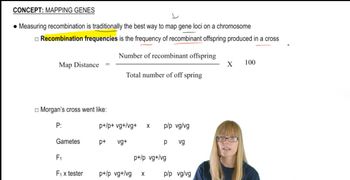
Mapping Genes

Homozygosity in Genetic Studies

Homozygosity means having two identical alleles of a gene, one inherited from each parent. Breeding mice to obtain homozygous knockout offspring ensures that both copies of the target gene are disrupted, eliminating any residual gene function. This allows researchers to study the full effect of gene loss without interference from a functional allele.
Recommended video:
Guided course
08:30
Genetics of Development

Genetic Breeding Strategies for Knockout Mice

Breeding heterozygous knockout mice (carrying one disrupted and one normal allele) produces offspring with varying genotypes, including homozygous knockouts. Repeated breeding is necessary to obtain sufficient numbers of homozygous (−/−) mice for experiments. This strategy ensures consistent and reliable phenotypic analysis of gene function.
Recommended video:
Guided course
11:35
History of Genetics