Pearson+ LogoPearson+ Logo
Ch. 24 - Cancer Genetics
Klug - Concepts of Genetics  12th Edition
Klug12th EditionConcepts of Genetics ISBN: 9780135564776Not the one you use?Change textbook
Chapter 24, Problem 29

Researchers have identified some tumors that have no recurrent mutations or deletions in known oncogenes or tumor-suppressor genes and no detectable epigenetic alterations. However, these tumors often have large chromosomal deletions. What are some possible explanations that could account for the genetic causes behind these tumors?

Verified step by step guidance
1
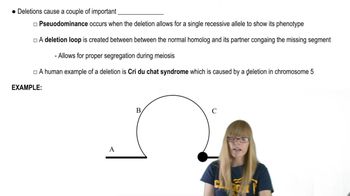
Step 1: Understand that large chromosomal deletions can remove multiple genes simultaneously, including genes not previously identified as oncogenes or tumor suppressors, which may contribute to tumor development through loss of function.
Step 2: Consider the possibility that these deletions might affect regulatory regions or non-coding RNAs that control gene expression, leading to dysregulation of critical cellular pathways without direct mutations in known cancer genes.
Step 3: Explore the concept of haploinsufficiency, where losing one copy of a gene (due to deletion) reduces gene dosage enough to disrupt normal cellular function and promote tumorigenesis, even if the remaining allele is normal.
Step 4: Recognize that chromosomal deletions can cause genomic instability, increasing the likelihood of further genetic alterations that may not be immediately detectable but contribute to cancer progression.
Step 5: Investigate the role of structural variations and chromosomal rearrangements that accompany large deletions, which might create novel gene fusions or disrupt gene networks, providing alternative mechanisms for tumor development.

Verified video answer for a similar problem:

This video solution was recommended by our tutors as helpful for the problem above.
Video duration:
2m
Was this helpful?

Key Concepts

Here are the essential concepts you must grasp in order to answer the question correctly.

Chromosomal Deletions and Their Impact

Chromosomal deletions involve the loss of large DNA segments, which can remove multiple genes simultaneously. Such deletions may eliminate tumor suppressor genes or regulatory regions, disrupting normal cell growth control even if no single recurrent mutation is detected. This can lead to tumor development through combined gene dosage effects.
Recommended video:

Non-Mutational Genetic Mechanisms in Cancer

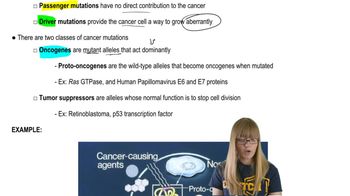
Tumors can arise from genetic alterations beyond point mutations or epigenetic changes, such as structural variations like deletions, duplications, or translocations. These large-scale changes can alter gene expression or genome stability, contributing to cancer without involving classic oncogene activation or tumor suppressor gene mutation.
Recommended video:
Guided course
04:46
Cancer Mutations

Role of Haploinsufficiency in Tumorigenesis

Haploinsufficiency occurs when a single functional copy of a gene is insufficient for normal function. Large chromosomal deletions may reduce gene dosage below a critical threshold, impairing tumor suppressor pathways and promoting cancer development, even in the absence of mutations or epigenetic silencing.
Recommended video:
Related Practice
Textbook Question

The table in this problem summarizes some of the data that have been collected on mutations in the BRCA1 tumor-suppressor gene in families with a high incidence of both early-onset breast cancer and ovarian cancer.

Note the coding effect of the mutation found in kindred group 2082. This results from a single base-pair substitution. Draw the normal double-stranded DNA sequence for this codon (with the 5' and 3' ends labeled), and show the sequence of events that generated this mutation, assuming that it resulted from an uncorrected mismatch event during DNA replication.

480
views
Textbook Question

The table in this problem summarizes some of the data that have been collected on mutations in the BRCA1 tumor-suppressor gene in families with a high incidence of both early-onset breast cancer and ovarian cancer.

Examine the types of mutations that are listed in the table, and determine if the BRCA1 gene is likely to be a tumor-suppressor gene or an oncogene.

380
views
Textbook Question

The table in this problem summarizes some of the data that have been collected on mutations in the BRCA1 tumor-suppressor gene in families with a high incidence of both early-onset breast cancer and ovarian cancer.

Although the mutations listed in the table are clearly deleterious and cause breast cancer in women at very young ages, each of the kindred groups had at least one woman who carried the mutation but lived until age 80 without developing cancer. Name at least two different mechanisms (or variables) that could underlie variation in the expression of a mutant phenotype, and propose an explanation for the incomplete penetrance of this mutation. How do these mechanisms or variables relate to this explanation?

445
views
Textbook Question

Although cancer is not a contagious disease in humans or other vertebrates, there have been rare cases in which cancers have spread from one organism to another. Describe three cases of these contagious cancers and what conditions might have led to their appearance.

423
views