A study by Bose and colleagues (1998). Blood 92:3362-3367] and a previous study by Biernaux and others (1996). Bone Marrow Transplant 17:(Suppl. 3) S45–S47] showed that BCR-ABL fusion gene transcripts can be detected in 25 to 30 percent of healthy adults who do not develop chronic myelogenous leukemia (CML). Explain how these individuals can carry a fusion gene that is transcriptionally active and yet does not develop CML.

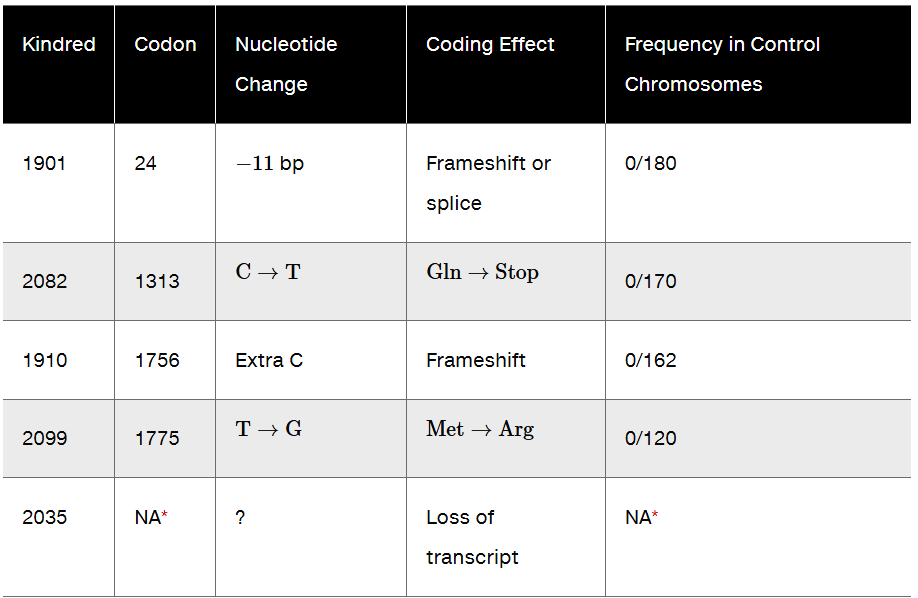
The table in this problem summarizes some of the data that have been collected on mutations in the BRCA1 tumor-suppressor gene in families with a high incidence of both early-onset breast cancer and ovarian cancer.

Examine the types of mutations that are listed in the table, and determine if the BRCA1 gene is likely to be a tumor-suppressor gene or an oncogene.
Verified step by step guidance
Verified video answer for a similar problem:
Key Concepts
Tumor-Suppressor Genes
Types of Mutations
Oncogenes vs. Tumor-Suppressor Genes
Those who inherit a mutant allele of the RB1 tumor-suppressor gene are at risk for developing a bone cancer called osteosarcoma. You suspect that in these cases, osteosarcoma requires a mutation in the second RB1 allele, and you have cultured some osteosarcoma cells and obtained a cDNA clone of a normal human RB1 gene. A colleague sends you a research paper revealing that a strain of cancer-prone mice develops malignant tumors when injected with osteosarcoma cells, and you obtain these mice. Using these three resources, what experiments would you perform to determine:
(a) Whether osteosarcoma cells carry two RB1 mutations
(b) Whether osteosarcoma cells produce any pRB protein
(c) If the addition of a normal RB1 gene will change the cancer-causing potential of osteosarcoma cells?
The table in this problem summarizes some of the data that have been collected on mutations in the BRCA1 tumor-suppressor gene in families with a high incidence of both early-onset breast cancer and ovarian cancer.
Note the coding effect of the mutation found in kindred group 2082. This results from a single base-pair substitution. Draw the normal double-stranded DNA sequence for this codon (with the 5' and 3' ends labeled), and show the sequence of events that generated this mutation, assuming that it resulted from an uncorrected mismatch event during DNA replication.
The table in this problem summarizes some of the data that have been collected on mutations in the BRCA1 tumor-suppressor gene in families with a high incidence of both early-onset breast cancer and ovarian cancer.
Although the mutations listed in the table are clearly deleterious and cause breast cancer in women at very young ages, each of the kindred groups had at least one woman who carried the mutation but lived until age 80 without developing cancer. Name at least two different mechanisms (or variables) that could underlie variation in the expression of a mutant phenotype, and propose an explanation for the incomplete penetrance of this mutation. How do these mechanisms or variables relate to this explanation?
Researchers have identified some tumors that have no recurrent mutations or deletions in known oncogenes or tumor-suppressor genes and no detectable epigenetic alterations. However, these tumors often have large chromosomal deletions. What are some possible explanations that could account for the genetic causes behind these tumors?
Although cancer is not a contagious disease in humans or other vertebrates, there have been rare cases in which cancers have spread from one organism to another. Describe three cases of these contagious cancers and what conditions might have led to their appearance.