Pearson+ LogoPearson+ Logo
Ch. 24 - Cancer Genetics
Klug - Concepts of Genetics  12th Edition
Klug12th EditionConcepts of Genetics ISBN: 9780135564776Not the one you use?Change textbook
Chapter 24, Problem 28c

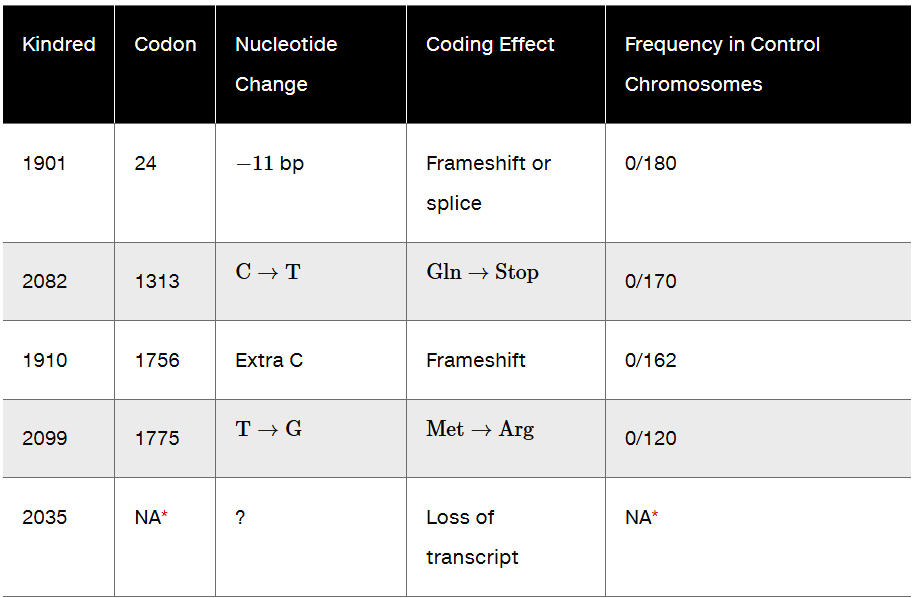
The table in this problem summarizes some of the data that have been collected on mutations in the BRCA1 tumor-suppressor gene in families with a high incidence of both early-onset breast cancer and ovarian cancer.
Table listing BRCA1 gene mutations by kindred, codon, nucleotide change, coding effect, and control chromosome frequency.
Although the mutations listed in the table are clearly deleterious and cause breast cancer in women at very young ages, each of the kindred groups had at least one woman who carried the mutation but lived until age 80 without developing cancer. Name at least two different mechanisms (or variables) that could underlie variation in the expression of a mutant phenotype, and propose an explanation for the incomplete penetrance of this mutation. How do these mechanisms or variables relate to this explanation?

Verified step by step guidance
1
Step 1: Understand the concept of incomplete penetrance. Incomplete penetrance occurs when individuals with a genetic mutation do not exhibit the associated phenotype. This means that not all carriers of a deleterious mutation will develop the disease, as seen in the BRCA1 mutation carriers who lived until age 80 without developing cancer.
Step 2: Identify potential mechanisms or variables that could influence the expression of the mutant phenotype. Two common mechanisms include: (1) Environmental factors, such as lifestyle choices (e.g., diet, exercise, exposure to carcinogens) that may mitigate or exacerbate the risk of developing cancer, and (2) Genetic modifiers, which are other genes that interact with the BRCA1 mutation and influence its phenotypic expression.
Step 3: Propose an explanation for incomplete penetrance based on environmental factors. For example, a woman carrying the BRCA1 mutation may have avoided environmental triggers such as smoking or excessive alcohol consumption, which are known to increase cancer risk. Additionally, she may have engaged in protective behaviors like maintaining a healthy diet rich in antioxidants or undergoing regular medical screenings.
Step 4: Propose an explanation for incomplete penetrance based on genetic modifiers. Certain genetic variants in other genes may suppress the deleterious effects of the BRCA1 mutation. For instance, genes involved in DNA repair pathways might compensate for the loss of BRCA1 function, reducing the likelihood of cancer development.
Step 5: Relate these mechanisms to the observed variation in phenotype. Environmental factors and genetic modifiers can act independently or synergistically to influence the expression of the BRCA1 mutation. This explains why some individuals with the mutation develop cancer at a young age, while others remain unaffected even into old age. These mechanisms highlight the complexity of gene-environment interactions and the role of genetic background in determining disease risk.

Verified video answer for a similar problem:

This video solution was recommended by our tutors as helpful for the problem above.
Video duration:
2m
Was this helpful?

Key Concepts

Here are the essential concepts you must grasp in order to answer the question correctly.

BRCA1 Gene Function

The BRCA1 gene is crucial for maintaining genomic stability and repairing DNA breaks. It encodes a protein that plays a significant role in the homologous recombination repair pathway, which fixes double-strand breaks in DNA. Mutations in BRCA1 can lead to a loss of function, increasing the risk of breast and ovarian cancers. Understanding its normal function helps explain how mutations can lead to cancer predisposition.
Recommended video:
Guided course
08:26
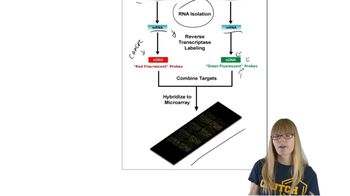
Functional Genomics

Incomplete Penetrance

Incomplete penetrance refers to the phenomenon where not all individuals with a specific genotype express the expected phenotype. In the context of BRCA1 mutations, some carriers may not develop cancer due to various factors, such as environmental influences, lifestyle choices, or the presence of other genetic modifiers. This concept is essential for understanding why some individuals with deleterious mutations remain unaffected.
Recommended video:
Guided course
02:09
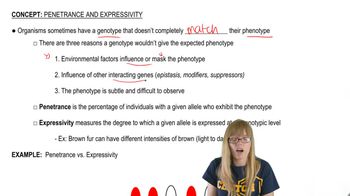
Penetrance and Expressivity

Modifier Genes

Modifier genes are additional genes that can influence the expression of a primary gene's phenotype. In the case of BRCA1 mutations, these modifier genes may enhance or suppress the risk of developing cancer. They can interact with the BRCA1 mutation, affecting cellular pathways and responses to DNA damage, thereby contributing to the variability in cancer risk among mutation carriers.
Recommended video:
Guided course
09:09
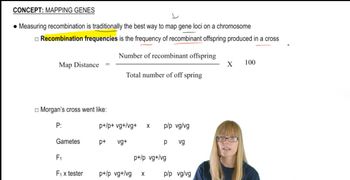
Mapping Genes
Related Practice
Textbook Question

Those who inherit a mutant allele of the RB1 tumor-suppressor gene are at risk for developing a bone cancer called osteosarcoma. You suspect that in these cases, osteosarcoma requires a mutation in the second RB1 allele, and you have cultured some osteosarcoma cells and obtained a cDNA clone of a normal human RB1 gene. A colleague sends you a research paper revealing that a strain of cancer-prone mice develops malignant tumors when injected with osteosarcoma cells, and you obtain these mice. Using these three resources, what experiments would you perform to determine:

(a) Whether osteosarcoma cells carry two RB1 mutations

(b) Whether osteosarcoma cells produce any pRB protein

(c) If the addition of a normal RB1 gene will change the cancer-causing potential of osteosarcoma cells?

447
views
Textbook Question

The table in this problem summarizes some of the data that have been collected on mutations in the BRCA1 tumor-suppressor gene in families with a high incidence of both early-onset breast cancer and ovarian cancer.

Note the coding effect of the mutation found in kindred group 2082. This results from a single base-pair substitution. Draw the normal double-stranded DNA sequence for this codon (with the 5' and 3' ends labeled), and show the sequence of events that generated this mutation, assuming that it resulted from an uncorrected mismatch event during DNA replication.

480
views
Textbook Question

The table in this problem summarizes some of the data that have been collected on mutations in the BRCA1 tumor-suppressor gene in families with a high incidence of both early-onset breast cancer and ovarian cancer.

Examine the types of mutations that are listed in the table, and determine if the BRCA1 gene is likely to be a tumor-suppressor gene or an oncogene.

380
views
Textbook Question

Researchers have identified some tumors that have no recurrent mutations or deletions in known oncogenes or tumor-suppressor genes and no detectable epigenetic alterations. However, these tumors often have large chromosomal deletions. What are some possible explanations that could account for the genetic causes behind these tumors?

427
views
Textbook Question

Although cancer is not a contagious disease in humans or other vertebrates, there have been rare cases in which cancers have spread from one organism to another. Describe three cases of these contagious cancers and what conditions might have led to their appearance.

423
views