Pearson+ LogoPearson+ Logo
Ch. 24 - Cancer Genetics
Klug - Concepts of Genetics  12th Edition
Klug12th EditionConcepts of Genetics ISBN: 9780135564776Not the one you use?Change textbook
Chapter 24, Problem 28a

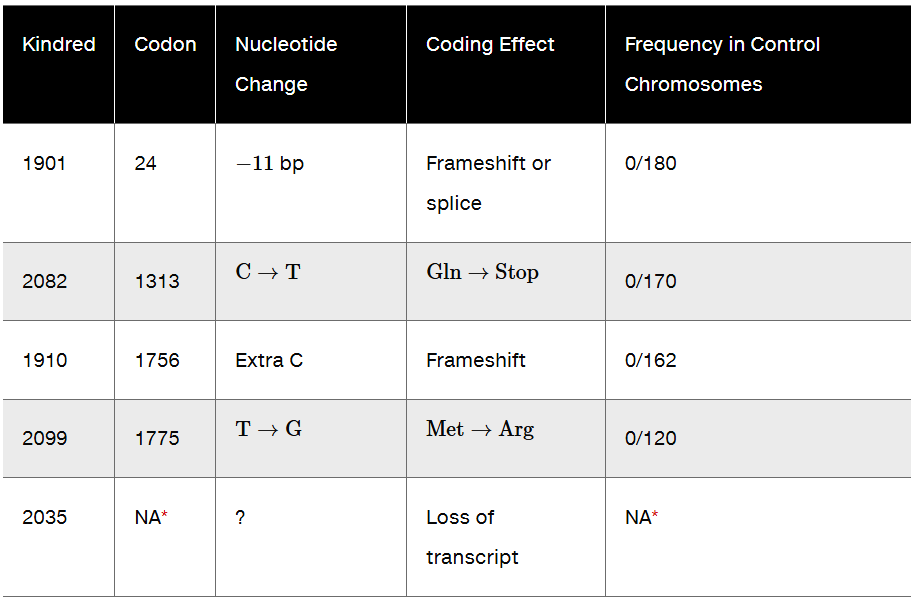
The table in this problem summarizes some of the data that have been collected on mutations in the BRCA1 tumor-suppressor gene in families with a high incidence of both early-onset breast cancer and ovarian cancer.
Table summarizing BRCA1 gene mutations, their codon positions, nucleotide changes, coding effects, and control chromosome frequencies.
Note the coding effect of the mutation found in kindred group 2082. This results from a single base-pair substitution. Draw the normal double-stranded DNA sequence for this codon (with the 5' and 3' ends labeled), and show the sequence of events that generated this mutation, assuming that it resulted from an uncorrected mismatch event during DNA replication.

Verified step by step guidance
1
Step 1: Identify the normal codon sequence for kindred group 2082. The mutation involves a single base-pair substitution (C→T) at codon 1313, which changes the amino acid from glutamine (Gln) to a stop codon. Determine the normal DNA sequence for the codon encoding glutamine. Glutamine is encoded by the codons CAA or CAG in mRNA, which corresponds to the DNA sequence GTT or GTC on the template strand (5' to 3').
Step 2: Write the normal double-stranded DNA sequence for the codon. For example, if the codon is CAA in mRNA, the corresponding DNA sequence would be: Template strand (5' to 3'): GTT; Coding strand (3' to 5'): CAA. Label the 5' and 3' ends of both strands.
Step 3: Illustrate the mismatch event during DNA replication that leads to the mutation. During replication, a cytosine (C) on the template strand is incorrectly paired with adenine (A) instead of guanine (G). This mismatch occurs due to an error in base pairing.
Step 4: Show how the mismatch is uncorrected during subsequent replication cycles. If the mismatch is not repaired, the adenine (A) on the newly synthesized strand will pair with thymine (T) in the next round of replication, resulting in a permanent substitution of C→T in the DNA sequence.
Step 5: Write the mutated double-stranded DNA sequence. After the mutation, the template strand (5' to 3') will have GTT replaced by ATT, and the coding strand (3' to 5') will have CAA replaced by TAA. Label the 5' and 3' ends of both strands and note that TAA is a stop codon, leading to premature termination of translation.

Verified video answer for a similar problem:

This video solution was recommended by our tutors as helpful for the problem above.
Video duration:
2m
Was this helpful?

Key Concepts

Here are the essential concepts you must grasp in order to answer the question correctly.

BRCA1 Gene Function

The BRCA1 gene is a crucial tumor-suppressor gene that plays a significant role in maintaining genomic stability by repairing DNA double-strand breaks. Mutations in this gene can lead to a loss of function, increasing the risk of breast and ovarian cancers. Understanding its normal function helps in comprehending how specific mutations can disrupt cellular processes and contribute to cancer development.
Recommended video:
Guided course
08:26
Functional Genomics

Types of Mutations

Mutations can be classified into several types, including point mutations, insertions, deletions, and frameshifts. A point mutation involves a change in a single nucleotide, which can lead to a different amino acid being incorporated into a protein or a premature stop codon. Recognizing these types is essential for analyzing how specific genetic changes affect protein function and contribute to disease.
Recommended video:
Guided course
10:48
Mutations and Phenotypes

DNA Replication and Mismatch Repair

During DNA replication, errors can occur, leading to mismatches between base pairs. The mismatch repair system is responsible for correcting these errors; however, if a mismatch is not corrected, it can result in a permanent mutation. Understanding the process of DNA replication and the role of mismatch repair is vital for explaining how mutations arise and their potential consequences on gene function.
Recommended video:
Guided course
05:44
Repair Pathways
Related Practice
Textbook Question

Mutations in tumor-suppressor genes are associated with many types of cancers. In addition, epigenetic changes (such as DNA methylation) of tumor-suppressor genes are also associated with tumorigenesis [Otani et al. (2013). Expert Rev Mol Diagn 13:445 455].

Knowing that tumors release free DNA into certain surrounding body fluids through necrosis and apoptosis, Kloten et al. [(2013). Breast Cancer Res. 15(1):R4] outlines an experimental protocol for using human blood as a biomarker for cancer and as a method for monitoring the progression of cancer in an individual.

466
views
Textbook Question

A study by Bose and colleagues (1998). Blood 92:3362-3367] and a previous study by Biernaux and others (1996). Bone Marrow Transplant 17:(Suppl. 3) S45–S47] showed that BCR-ABL fusion gene transcripts can be detected in 25 to 30 percent of healthy adults who do not develop chronic myelogenous leukemia (CML). Explain how these individuals can carry a fusion gene that is transcriptionally active and yet does not develop CML.

499
views
Textbook Question

Those who inherit a mutant allele of the RB1 tumor-suppressor gene are at risk for developing a bone cancer called osteosarcoma. You suspect that in these cases, osteosarcoma requires a mutation in the second RB1 allele, and you have cultured some osteosarcoma cells and obtained a cDNA clone of a normal human RB1 gene. A colleague sends you a research paper revealing that a strain of cancer-prone mice develops malignant tumors when injected with osteosarcoma cells, and you obtain these mice. Using these three resources, what experiments would you perform to determine:

(a) Whether osteosarcoma cells carry two RB1 mutations

(b) Whether osteosarcoma cells produce any pRB protein

(c) If the addition of a normal RB1 gene will change the cancer-causing potential of osteosarcoma cells?

447
views
Textbook Question

The table in this problem summarizes some of the data that have been collected on mutations in the BRCA1 tumor-suppressor gene in families with a high incidence of both early-onset breast cancer and ovarian cancer.

Examine the types of mutations that are listed in the table, and determine if the BRCA1 gene is likely to be a tumor-suppressor gene or an oncogene.

380
views
Textbook Question

The table in this problem summarizes some of the data that have been collected on mutations in the BRCA1 tumor-suppressor gene in families with a high incidence of both early-onset breast cancer and ovarian cancer.

Although the mutations listed in the table are clearly deleterious and cause breast cancer in women at very young ages, each of the kindred groups had at least one woman who carried the mutation but lived until age 80 without developing cancer. Name at least two different mechanisms (or variables) that could underlie variation in the expression of a mutant phenotype, and propose an explanation for the incomplete penetrance of this mutation. How do these mechanisms or variables relate to this explanation?

445
views
Textbook Question

Researchers have identified some tumors that have no recurrent mutations or deletions in known oncogenes or tumor-suppressor genes and no detectable epigenetic alterations. However, these tumors often have large chromosomal deletions. What are some possible explanations that could account for the genetic causes behind these tumors?

427
views