Pearson+ LogoPearson+ Logo
Ch. 24 - Cancer Genetics
Klug - Concepts of Genetics  12th Edition
Klug12th EditionConcepts of Genetics ISBN: 9780135564776Not the one you use?Change textbook
Chapter 24, Problem 27

Those who inherit a mutant allele of the RB1 tumor-suppressor gene are at risk for developing a bone cancer called osteosarcoma. You suspect that in these cases, osteosarcoma requires a mutation in the second RB1 allele, and you have cultured some osteosarcoma cells and obtained a cDNA clone of a normal human RB1 gene. A colleague sends you a research paper revealing that a strain of cancer-prone mice develops malignant tumors when injected with osteosarcoma cells, and you obtain these mice. Using these three resources, what experiments would you perform to determine:
(a) Whether osteosarcoma cells carry two RB1 mutations
(b) Whether osteosarcoma cells produce any pRB protein
(c) If the addition of a normal RB1 gene will change the cancer-causing potential of osteosarcoma cells?

Verified step by step guidance
1
For part (a), to determine whether osteosarcoma cells carry two RB1 mutations, start by isolating genomic DNA from the osteosarcoma cells. Then, perform PCR amplification of the RB1 gene regions followed by DNA sequencing. Compare the sequences to the normal RB1 gene sequence to identify mutations in both alleles. Alternatively, use techniques like Southern blotting or allele-specific PCR to detect deletions or mutations in each allele.
For part (b), to check whether osteosarcoma cells produce any pRB protein, extract total protein from the cells and perform a Western blot analysis using an antibody specific to the pRB protein. This will reveal the presence or absence of pRB and can also indicate if the protein is truncated or altered in size, suggesting a mutation affecting protein expression or stability.
For part (c), to test if adding a normal RB1 gene changes the cancer-causing potential of osteosarcoma cells, transfect the osteosarcoma cells with the normal human RB1 cDNA clone. Then, inject these transfected cells into the cancer-prone mice and monitor tumor development compared to mice injected with untransfected osteosarcoma cells. A reduction in tumor formation would suggest that the normal RB1 gene suppresses the cancer phenotype.
Throughout these experiments, include proper controls such as cells known to have normal RB1 alleles and cells lacking RB1 function to validate your assays and interpretations.
Finally, analyze and interpret the data to understand the role of RB1 mutations and pRB protein expression in osteosarcoma development and progression, and how restoring normal RB1 function might impact tumorigenicity.

Verified video answer for a similar problem:

This video solution was recommended by our tutors as helpful for the problem above.
Video duration:
1m
Was this helpful?

Key Concepts

Here are the essential concepts you must grasp in order to answer the question correctly.

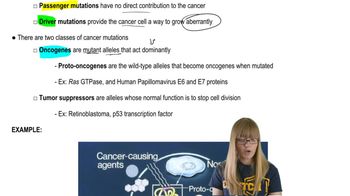
Tumor Suppressor Genes and the Two-Hit Hypothesis

Tumor suppressor genes like RB1 help regulate cell growth and prevent cancer. The two-hit hypothesis states that both alleles of such a gene must be inactivated by mutations for cancer to develop. Understanding this concept is crucial to investigate whether osteosarcoma cells have mutations in both RB1 alleles.
Recommended video:
Guided course
04:46
Cancer Mutations

Gene Expression and Protein Production Analysis

Determining if osteosarcoma cells produce pRB protein involves analyzing gene expression at the mRNA and protein levels. Techniques like Western blotting or immunostaining detect pRB protein presence, while RT-PCR can assess RB1 mRNA, helping to understand functional consequences of mutations.
Recommended video:

Functional Complementation and Tumorigenicity Assays

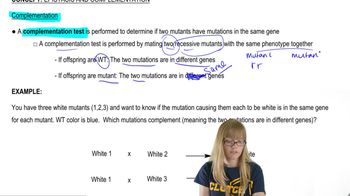
Introducing a normal RB1 gene into cancer cells tests if restoring pRB function reduces tumorigenic potential. Functional complementation assays combined with in vivo tumorigenicity tests in cancer-prone mice reveal whether the normal gene suppresses cancer growth, demonstrating the gene's role in tumor suppression.
Recommended video:
Guided course
05:05
Complementation
Related Practice
Textbook Question

Mutations in tumor-suppressor genes are associated with many types of cancers. In addition, epigenetic changes (such as DNA methylation) of tumor-suppressor genes are also associated with tumorigenesis [Otani et al. (2013).

Expert Rev Mol Diagn 13:445-455].

How might hypermethylation of the TP53 gene promoter influence tumorigenesis?

714
views
Textbook Question

Mutations in tumor-suppressor genes are associated with many types of cancers. In addition, epigenetic changes (such as DNA methylation) of tumor-suppressor genes are also associated with tumorigenesis [Otani et al. (2013). Expert Rev Mol Diagn 13:445 455].

Knowing that tumors release free DNA into certain surrounding body fluids through necrosis and apoptosis, Kloten et al. [(2013). Breast Cancer Res. 15(1):R4] outlines an experimental protocol for using human blood as a biomarker for cancer and as a method for monitoring the progression of cancer in an individual.

466
views
Textbook Question

A study by Bose and colleagues (1998). Blood 92:3362-3367] and a previous study by Biernaux and others (1996). Bone Marrow Transplant 17:(Suppl. 3) S45–S47] showed that BCR-ABL fusion gene transcripts can be detected in 25 to 30 percent of healthy adults who do not develop chronic myelogenous leukemia (CML). Explain how these individuals can carry a fusion gene that is transcriptionally active and yet does not develop CML.

499
views
Textbook Question

The table in this problem summarizes some of the data that have been collected on mutations in the BRCA1 tumor-suppressor gene in families with a high incidence of both early-onset breast cancer and ovarian cancer.

Note the coding effect of the mutation found in kindred group 2082. This results from a single base-pair substitution. Draw the normal double-stranded DNA sequence for this codon (with the 5' and 3' ends labeled), and show the sequence of events that generated this mutation, assuming that it resulted from an uncorrected mismatch event during DNA replication.

480
views
Textbook Question

The table in this problem summarizes some of the data that have been collected on mutations in the BRCA1 tumor-suppressor gene in families with a high incidence of both early-onset breast cancer and ovarian cancer.

Examine the types of mutations that are listed in the table, and determine if the BRCA1 gene is likely to be a tumor-suppressor gene or an oncogene.

380
views
Textbook Question

The table in this problem summarizes some of the data that have been collected on mutations in the BRCA1 tumor-suppressor gene in families with a high incidence of both early-onset breast cancer and ovarian cancer.

Although the mutations listed in the table are clearly deleterious and cause breast cancer in women at very young ages, each of the kindred groups had at least one woman who carried the mutation but lived until age 80 without developing cancer. Name at least two different mechanisms (or variables) that could underlie variation in the expression of a mutant phenotype, and propose an explanation for the incomplete penetrance of this mutation. How do these mechanisms or variables relate to this explanation?

445
views