Pearson+ LogoPearson+ Logo
Ch. 25 - Quantitative Genetics and Multifactorial Traits
Klug - Concepts of Genetics  12th Edition
Klug12th EditionConcepts of Genetics ISBN: 9780135564776Not the one you use?Change textbook
Chapter 25, Problem 28c

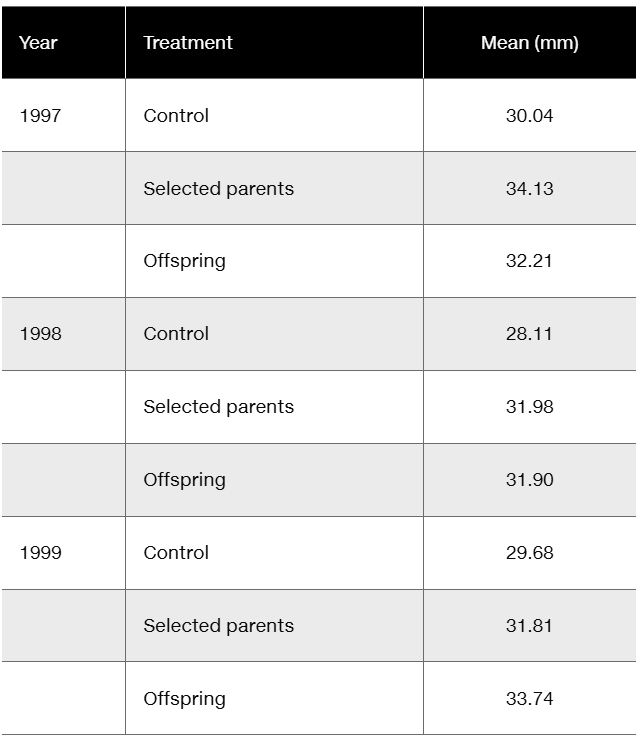
Floral traits in plants often play key roles in diversification, in that slight modifications of those traits, if genetically determined, may quickly lead to reproductive restrictions and evolution. Insight into genetic involvement in flower formation is often acquired through selection experiments that expose realized heritability. Lendvai and Levin (2003) conducted a series of artificial selection experiments on flower size (diameter) in Phlox drummondii. Data from their selection experiments are presented in the following table in modified form and content.
Table showing mean flower diameter in millimeters for control, selected parents, and offspring across 1997-1999 in a selection experiment.
Assuming that the realized heritability in phlox is relatively high, what factors might account for such a high response?

Verified step by step guidance
1
Understand the concept of heritability: Heritability is a measure of how much of the variation in a trait (like flower size) is due to genetic factors versus environmental factors. High heritability means that genetic factors play a significant role in determining the trait.
Relate heritability to evolutionary potential: A population with high heritability for a trait is more likely to respond to selection pressures because genetic changes can be passed on to the next generation. This makes the population more adaptable to environmental changes or selective breeding.
Analyze the context of the problem: In the case of Phlox drummondii, the artificial selection experiments on flower size provide data on realized heritability, which is the heritability observed in response to selection. This data can help determine how much the trait can evolve under selection.
Compare populations with high and low heritability: A population with high heritability for flower size will likely show a stronger response to selection, leading to faster evolutionary changes. In contrast, a population with low heritability may show limited response to selection, as environmental factors dominate the trait's variation.
Conclude the evolutionary implications: Populations with high heritability are generally favored in terms of evolutionary potential because they can adapt more effectively to changing environments or selective pressures, promoting diversification and survival.

Verified video answer for a similar problem:

This video solution was recommended by our tutors as helpful for the problem above.
Video duration:
5m
Was this helpful?

Key Concepts

Here are the essential concepts you must grasp in order to answer the question correctly.

Heritability

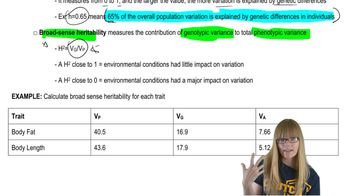
Heritability is a measure of how much of the variation in a trait within a population can be attributed to genetic differences among individuals. It is expressed as a proportion, ranging from 0 to 1, where a higher value indicates that genetics play a larger role in the trait's expression. Understanding heritability is crucial for predicting how traits may respond to selection pressures in evolutionary contexts.
Recommended video:
Guided course
07:04
Calculating Heritability

Artificial Selection

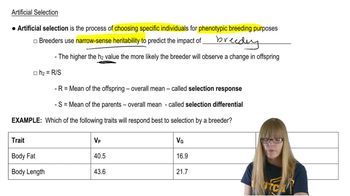
Artificial selection is a process by which humans intentionally breed plants or animals for specific traits. This method allows researchers to study the genetic basis of traits and their heritability by observing changes over generations. In the context of the question, artificial selection experiments on flower size in Phlox drummondii provide insights into how traits can evolve and the potential for populations to adapt.
Recommended video:
Guided course
04:15
Artificial Selection

Evolutionary Potential

Evolutionary potential refers to the capacity of a population to adapt to changing environmental conditions through genetic variation and natural selection. Populations with high heritability for certain traits are more likely to exhibit significant evolutionary changes, as these traits can be effectively passed on to future generations. Thus, a population with high heritability is generally favored in terms of evolutionary potential compared to one with low heritability.
Recommended video:
Guided course
08:16
Phylogenetic Trees
Related Practice
Textbook Question

Floral traits in plants often play key roles in diversification, in that slight modifications of those traits, if genetically determined, may quickly lead to reproductive restrictions and evolution. Insight into genetic involvement in flower formation is often acquired through selection experiments that expose realized heritability. Lendvai and Levin (2003) conducted a series of artificial selection experiments on flower size (diameter) in Phlox drummondii. Data from their selection experiments are presented in the following table in a modified form and content.

Considering that differences in control values represent year-to-year differences in greenhouse conditions, calculate (in mm) the average response to selection over the three-year period

421
views
Textbook Question

Floral traits in plants often play key roles in diversification, in that slight modifications of those traits, if genetically determined, may quickly lead to reproductive restrictions and evolution. Insight into genetic involvement in flower formation is often acquired through selection experiments that expose realized heritability. Lendvai and Levin (2003) conducted a series of artificial selection experiments on flower size (diameter) in Phlox drummondii. Data from their selection experiments are presented in the following table in modified form and content.

Considering that differences in control values represent year-to-year differences in greenhouse conditions, calculate (in mm) the average response to selection over the three-year period. 

429
views
Textbook Question

Floral traits in plants often play key roles in diversification, in that slight modifications of those traits, if genetically determined, may quickly lead to reproductive restrictions and evolution. Insight into genetic involvement in flower formation is often acquired through selection experiments that expose realized heritability. Lendvai and Levin (2003) conducted a series of artificial selection experiments on flower size (diameter) in Phlox drummondii. Data from their selection experiments are presented in the following table in modified form and content.

Calculate the realized heritability for each year and the overall realized heritability. 

488
views
Textbook Question

Floral traits in plants often play key roles in diversification, in that slight modifications of those traits, if genetically determined, may quickly lead to reproductive restrictions and evolution. Insight into genetic involvement in flower formation is often acquired through selection experiments that expose realized heritability. Lendvai and Levin (2003) conducted a series of artificial selection experiments on flower size (diameter) in Phlox drummondii. Data from their selection experiments are presented in the following table in modified form and content.

In terms of evolutionary potential, is a population with high heritability likely to be favored compared to one with a low realized heritability? 

454
views
Textbook Question

In 1988, Horst Wilkens investigated blind cavefish, comparing them with members of a sibling species with normal vision that are found in a lake [Wilkens, H. (1988). Evol. Biol. 25:271–367]. We will call them cavefish and lakefish. Wilkens found that cavefish eyes are about seven times smaller than lakefish eyes. F₁ hybrids have eyes of intermediate size. These data, as well as the F₁ × F₁ cross and those from backcrosses (F₁ × cavefish and F₁ × lakefish), are depicted below. Examine Wilkens's results and respond to the following questions:

Based strictly on the F₁ and F₂ results of Wilkens's initial crosses, what possible explanation concerning the inheritance of eye size seems most feasible? 

517
views
Textbook Question

In 1988, Horst Wilkens investigated blind cavefish, comparing them with members of a sibling species with normal vision that are found in a lake [Wilkens, H. (1988). Evol. Biol. 25:271–367]. We will call them cavefish and lakefish. Wilkens found that cavefish eyes are about seven times smaller than lakefish eyes. F₁ hybrids have eyes of intermediate size. These data, as well as the F₁×F₁ cross and those from backcrosses (F₁×cavefish and F₁×lakefish), are depicted below. Examine Wilkens's results and respond to the following questions:

Based on the results of the F₁ backcross with cavefish, is your explanation supported? Explain. 

513
views