A 'wrongful birth' case was recently brought before a court in which a child with Smith–Lemli–Opitz syndrome was born to apparently healthy parents. This syndrome is characterized by a cluster of birth defects including cleft palate, and an array of problems with the reproductive and urinary organs. Originally considered by their physician as having a nongenetic basis, the parents decided to have another child, who was also born with Smith–Lemli–Opitz syndrome. In the role of a genetic counselor, instruct the court about what occurred, including the probability of the parents having two affected offspring, knowing that the disorder is inherited as a recessive trait. Draw a pedigree of the families of this couple, showing the relevant individuals.

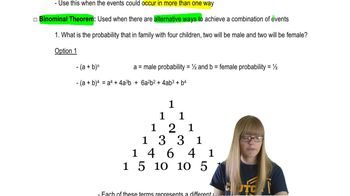
A 'wrongful birth' case was recently brought before a court in which a child with Smith–Lemli–Opitz syndrome was born to apparently healthy parents. This syndrome is characterized by a cluster of birth defects including cleft palate, and an array of problems with the reproductive and urinary organs. Originally considered by their physician as having a nongenetic basis, the parents decided to have another child, who was also born with Smith–Lemli–Opitz syndrome. In the role of a genetic counselor, instruct the court about what occurred, including the probability of the parents having two affected offspring, knowing that the disorder is inherited as a recessive trait. What is the probability that one of them is a carrier and the other is not? [Hint: The p values in (b), (c), and (d) should equal 1.]
Verified step by step guidance
Verified video answer for a similar problem:
Key Concepts
Recessive Inheritance
Carrier Probability
Punnett Square
A 'wrongful birth' case was recently brought before a court in which a child with Smith–Lemli–Opitz syndrome was born to apparently healthy parents. This syndrome is characterized by a cluster of birth defects including cleft palate, and an array of problems with the reproductive and urinary organs. Originally considered by their physician as having a nongenetic basis, the parents decided to have another child, who was also born with Smith–Lemli–Opitz syndrome. In the role of a genetic counselor, instruct the court about what occurred, including the probability of the parents having two affected offspring, knowing that the disorder is inherited as a recessive trait. Calculate the probability that both the male and female are carriers for TSD.
A 'wrongful birth' case was recently brought before a court in which a child with Smith–Lemli–Opitz syndrome was born to apparently healthy parents. This syndrome is characterized by a cluster of birth defects, including cleft palate, and an array of problems with the reproductive and urinary organs. Originally considered by their physician as having a nongenetic basis, the parents decided to have another child, who was also born with Smith–Lemli–Opitz syndrome. In the role of a genetic counselor, instruct the court about what occurred, including the probability of the parents having two affected offspring, knowing that the disorder is inherited as a recessive trait. What is the probability that neither of them is a carrier?
Datura stramonium (the Jimsonweed) expresses flower colors of purple and white and pod textures of smooth and spiny. The results of two crosses in which the parents were not necessarily true breeding are shown below. Based on these results, put forward a hypothesis for the inheritance of the purple/white and smooth/spiny traits.
Datura stramonium (the Jimsonweed) expresses flower colors of purple and white and pod textures of smooth and spiny. The results of two crosses in which the parents were not necessarily true breeding are shown below. Assuming that true-breeding strains of all combinations of traits are available, what single cross could you execute and carry to an F₂ generation that will prove or disprove your hypothesis? Assuming your hypothesis is correct, what results of this cross will support it?
The wild-type (normal) fruit fly, Drosophila melanogaster, has straight wings and long bristles. Mutant strains have been isolated that have either curled wings or short bristles. The genes representing these two mutant traits are located on separate chromosomes. Carefully examine the data from the following five crosses.
Identify each mutation as either dominant or recessive. In each case, indicate which crosses support your answer.
