Pearson+ LogoPearson+ Logo
Ch. 3 - Mendelian Genetics
Klug - Concepts of Genetics  12th Edition
Klug12th EditionConcepts of Genetics ISBN: 9780135564776Not the one you use?Change textbook
Chapter 3, Problem 27a

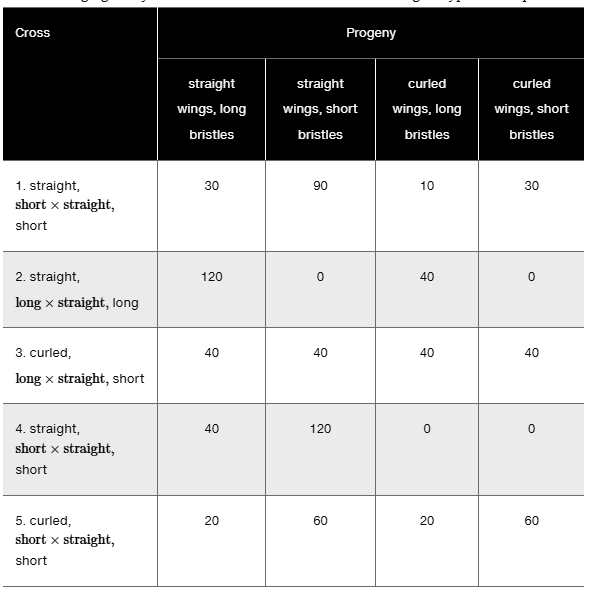
The wild-type (normal) fruit fly, Drosophila melanogaster, has straight wings and long bristles. Mutant strains have been isolated that have either curled wings or short bristles. The genes representing these two mutant traits are located on separate chromosomes. Carefully examine the data from the following five crosses.

Identify each mutation as either dominant or recessive. In each case, indicate which crosses support your answer.

Verified step by step guidance
1
Step 1: Understand the traits and their possible dominance relationships. The wild-type fruit fly has straight wings and long bristles, while mutants have curled wings or short bristles. Since the genes are on separate chromosomes, analyze each trait independently.
Step 2: Examine the phenotypes of the offspring in each cross. For each trait, determine whether the mutant phenotype appears in the heterozygous condition (i.e., when crossed with wild-type) or only in homozygous individuals. If the mutant phenotype appears in heterozygotes, it suggests dominance; if only in homozygotes, it suggests recessiveness.
Step 3: For the curled wings mutation, identify crosses where the mutant phenotype appears in the progeny of a wild-type × mutant cross. If the offspring show the mutant phenotype despite having one wild-type parent, this indicates dominance. Otherwise, if the mutant phenotype only appears when both parents are mutant, it is recessive.
Step 4: Repeat the same analysis for the short bristles mutation. Look for crosses where the mutant phenotype appears in heterozygous offspring to determine dominance or recessiveness.
Step 5: Summarize your conclusions by listing each mutation as dominant or recessive and citing the specific crosses (by their numbers or descriptions) that provide evidence supporting your determination.

Verified video answer for a similar problem:

This video solution was recommended by our tutors as helpful for the problem above.
Video duration:
2m
Was this helpful?

Key Concepts

Here are the essential concepts you must grasp in order to answer the question correctly.

Dominant and Recessive Alleles

Dominant alleles express their trait even if only one copy is present, while recessive alleles require two copies to show the trait. Identifying dominance involves analyzing offspring phenotypes from specific crosses to see if the mutant trait appears in heterozygotes.
Recommended video:
Guided course
04:37
Variations on Dominance

Mendelian Inheritance and Punnett Squares

Mendelian inheritance explains how alleles segregate and assort independently during gamete formation. Punnett squares help predict offspring genotypes and phenotypes from parental crosses, allowing determination of dominance relationships based on observed ratios.
Recommended video:
Guided course
02:48
Chi Square Analysis

Chromosomal Location and Independent Assortment

Genes on separate chromosomes assort independently, meaning the inheritance of one trait does not affect the other. This principle helps interpret crosses involving multiple traits and confirms that mutations on different chromosomes segregate independently.
Recommended video:
Guided course
04:58
Gamete Genetics and Independent Assortment
Related Practice
Textbook Question

A 'wrongful birth' case was recently brought before a court in which a child with Smith–Lemli–Opitz syndrome was born to apparently healthy parents. This syndrome is characterized by a cluster of birth defects including cleft palate, and an array of problems with the reproductive and urinary organs. Originally considered by their physician as having a nongenetic basis, the parents decided to have another child, who was also born with Smith–Lemli–Opitz syndrome. In the role of a genetic counselor, instruct the court about what occurred, including the probability of the parents having two affected offspring, knowing that the disorder is inherited as a recessive trait. What is the probability that one of them is a carrier and the other is not? [Hint: The p values in (b), (c), and (d) should equal 1.]

482
views
Textbook Question

Datura stramonium (the Jimsonweed) expresses flower colors of purple and white and pod textures of smooth and spiny. The results of two crosses in which the parents were not necessarily true breeding are shown below. Based on these results, put forward a hypothesis for the inheritance of the purple/white and smooth/spiny traits.

481
views
Textbook Question

Datura stramonium (the Jimsonweed) expresses flower colors of purple and white and pod textures of smooth and spiny. The results of two crosses in which the parents were not necessarily true breeding are shown below. Assuming that true-breeding strains of all combinations of traits are available, what single cross could you execute and carry to an F₂ generation that will prove or disprove your hypothesis? Assuming your hypothesis is correct, what results of this cross will support it?

829
views
Textbook Question

The wild-type (normal) fruit fly, Drosophila melanogaster, has straight wings and long bristles. Mutant strains have been isolated that have either curled wings or short bristles. The genes representing these two mutant traits are located on separate chromosomes. Carefully examine the data from the following five crosses.

Assign gene symbols and, for each cross, determine the genotypes of the parents.

871
views
Textbook Question

To assess Mendel's law of segregation using tomatoes, a true-breeding tall variety (SS) is crossed with a true-breeding short variety (ss). The heterozygous F₁ tall plants (Ss) were crossed to produce two sets of F₂ data, as follows.

Using the X² test, analyze the results for both datasets. Calculate X² values and estimate the p values in both cases.

974
views
Textbook Question

To assess Mendel's law of segregation using tomatoes, a true-breeding tall variety (SS) is crossed with a true-breeding short variety (ss). The heterozygous F₁ tall plants (Ss) were crossed to produce two sets of F₂ data, as follows.

From the above analysis, what can you conclude about the importance of generating large datasets in experimental conditions?

482
views