Pearson+ LogoPearson+ Logo
Ch. 3 - Mendelian Genetics
Klug - Concepts of Genetics  12th Edition
Klug12th EditionConcepts of Genetics ISBN: 9780135564776Not the one you use?Change textbook
Chapter 3, Problem 11

What is the basis for homology among chromosomes?

Verified step by step guidance
1
Homology among chromosomes is based on the similarity in their DNA sequences, which indicates a shared evolutionary origin.
Homologous chromosomes are pairs of chromosomes (one from each parent) that have the same genes at the same loci, but they may have different alleles for those genes.
The structural basis for homology includes similar length, centromere position, and banding patterns when stained during karyotyping.
During meiosis, homologous chromosomes pair up in a process called synapsis, facilitated by the synaptonemal complex, which ensures proper alignment and recombination.
Homology is critical for genetic recombination (crossing over) during meiosis, which increases genetic diversity by exchanging genetic material between homologous chromosomes.

Verified video answer for a similar problem:

This video solution was recommended by our tutors as helpful for the problem above.
Video duration:
1m
Was this helpful?

Key Concepts

Here are the essential concepts you must grasp in order to answer the question correctly.

Chromosomal Homology

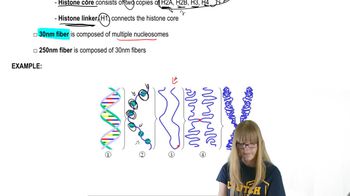
Chromosomal homology refers to the similarity between chromosomes that arise from shared ancestry. Homologous chromosomes have the same genes at the same loci, but may carry different alleles. This concept is crucial for understanding genetic variation and inheritance patterns, as homologous chromosomes pair during meiosis, facilitating genetic recombination.
Recommended video:
Guided course
07:10
Chromosome Structure

Gene Structure and Function

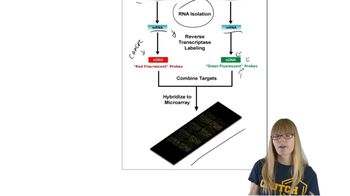
Genes are segments of DNA that encode for proteins and determine traits. Understanding gene structure, including exons and introns, is essential for grasping how homologous chromosomes can carry variations of the same gene. This knowledge helps explain how genetic diversity arises through mutations and recombination during sexual reproduction.
Recommended video:
Guided course
08:26
Functional Genomics

Meiosis and Genetic Recombination

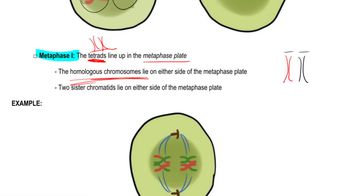
Meiosis is the process of cell division that produces gametes with half the number of chromosomes. During meiosis, homologous chromosomes undergo recombination, where segments of DNA are exchanged, leading to genetic diversity. This process is fundamental to understanding how homologous chromosomes contribute to variation in offspring and the evolutionary significance of genetic diversity.
Recommended video:
Guided course
09:06
Meiosis Steps
Related Practice
Textbook Question

In a cross between a black and a white guinea pig, all members of the F₁ generation are black. The F₂ generation is made up of approximately 3/4 black and 1/4 white guinea pigs. Diagram this cross, showing the genotypes and phenotypes.

2969
views
Textbook Question

In a cross between a black and a white guinea pig, all members of the F₁ generation are black. The F₂ generation is made up of approximately 3/4 black and 1/4 white guinea pigs. What will the offspring be like if two F₂ white guinea pigs are mated?

705
views
Textbook Question

In a cross between a black and a white guinea pig, all members of the F₁ generation are black. The F₂ generation is made up of approximately 3/4 black and 1/4 white guinea pigs. Two different matings were made between black members of the F₂ generation, with the following results. Diagram each of the crosses.

Cross Offspring

Cross 1 All black

Cross 2 3/4 black, 1/4 white

815
views
Textbook Question

In Drosophila, gray body color is dominant to ebony body color, while long wings are dominant to vestigial wings. Assuming that the P₁ individuals are homozygous, work the following crosses through the F₂ generation, and determine the genotypic and phenotypic ratios for each generation.

gray, long x ebony, vestigial

1560
views
Textbook Question

In Drosophila, gray body color is dominant to ebony body color, while long wings are dominant to vestigial wings. Assuming that the P₁ individuals are homozygous, work the following crosses through the F₂ generation, and determine the genotypic and phenotypic ratios for each generation.

gray, vestigial x ebony, long

421
views
Textbook Question

In Drosophila, gray body color is dominant to ebony body color, while long wings are dominant to vestigial wings. Assuming that the P₁ individuals are homozygous, work the following crosses through the F₂ generation, and determine the genotypic and phenotypic ratios for each generation.

gray, long x gray, vestigial.

458
views