Pearson+ LogoPearson+ Logo
Ch. 4 - Extensions of Mendelian Genetics
Klug - Concepts of Genetics  12th Edition
Klug12th EditionConcepts of Genetics ISBN: 9780135564776Not the one you use?Change textbook
Chapter 4, Problem 22

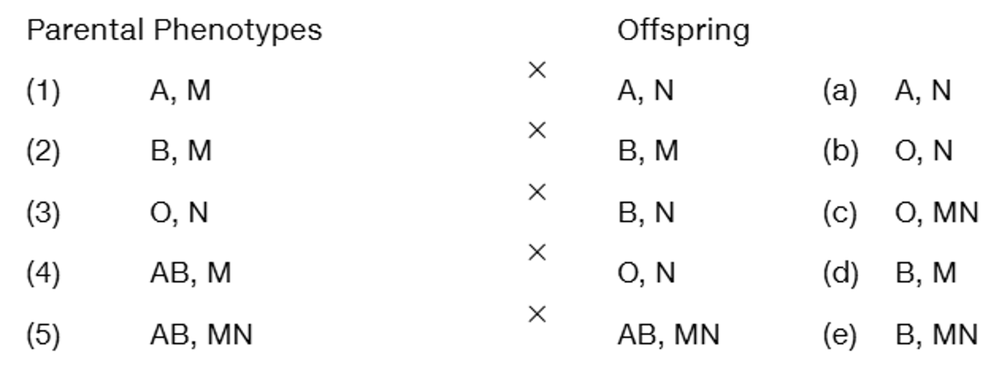
Five human matings (1–5), identified by both maternal and paternal phenotypes for ABO and MN blood-group antigen status, are shown on the left side of the following table:
Table showing five parental phenotype pairs for ABO and MN blood groups matched with five offspring phenotypes for a matching exercise.
Each mating resulted in one of the five offspring shown in the right-hand column (a–e). Match each offspring with one correct set of parents, using each parental set only once. Is there more than one set of correct answers?

Verified step by step guidance
1
Step 1: Understand the inheritance patterns for both ABO and MN blood groups. The ABO blood group is determined by three alleles (I^A, I^B, and i), where I^A and I^B are codominant and i is recessive. The MN blood group is determined by two codominant alleles (M and N).
Step 2: For each parental pair, list the possible genotypes based on their phenotypes. For example, a parent with blood group A could be I^A I^A or I^A i, and a parent with blood group AB must be I^A I^B. Similarly, for MN, a parent with phenotype M could be M M or M N, and N must be N N.
Step 3: Determine all possible offspring genotypes for each parental pair by combining the parental alleles for both ABO and MN systems. Use Punnett squares or allele combination tables to find all possible offspring phenotypes.
Step 4: Match each offspring phenotype (a–e) to the parental pair (1–5) whose possible offspring phenotypes include that offspring. Remember to consider both ABO and MN phenotypes together for accurate matching.
Step 5: After matching all offspring to parental pairs, check if any offspring phenotype can be produced by more than one parental pair. This will help determine if there is more than one correct set of answers.

Verified video answer for a similar problem:

This video solution was recommended by our tutors as helpful for the problem above.
Video duration:
2m
Was this helpful?

Key Concepts

Here are the essential concepts you must grasp in order to answer the question correctly.

ABO Blood Group Inheritance

The ABO blood group system is determined by three alleles (A, B, and O) with A and B being codominant and O recessive. Each individual inherits one allele from each parent, and the combination determines the blood type. Understanding parental genotypes helps predict possible offspring blood types.
Recommended video:
Guided course
05:13
Organelle Inheritance

MN Blood Group Inheritance

The MN blood group is controlled by two codominant alleles, M and N, located on a single gene. Individuals can be MM, MN, or NN, and the phenotype reflects the presence of these alleles. Parental MN genotypes determine the possible MN phenotypes in offspring.
Recommended video:
Guided course
05:13
Organelle Inheritance

Genetic Matching and Phenotypic Prediction

Matching offspring phenotypes to parental phenotypes requires understanding how alleles combine and segregate during reproduction. By analyzing both ABO and MN systems, one can predict which offspring phenotypes are possible from given parental pairs and determine if multiple parental sets can produce the same offspring phenotype.
Recommended video:
Guided course
10:48
Mutations and Phenotypes
Related Practice
Textbook Question

In a plant, a tall variety was crossed with a dwarf variety. All F₁ plants were tall. When F₁xF₁ plants were interbred, 9/16 of the F₂ were tall and 7/16 were dwarf. What proportion of the F₂ plants will be true breeding if self-fertilized? List these genotypes.

523
views
Textbook Question

In a unique species of plants, flowers may be yellow, blue, red, or mauve. All colors may be true breeding. If plants with blue flowers are crossed with red-flowered plants, all F₁ plants have yellow flowers. When these produced an F₂ generation, the following ratio was observed:

9/16 yellow: 3/16 blue: 3/16 red: 1/16 mauve

In still another cross using true-breeding parents, yellow-flowered plants are crossed with mauve-flowered plants. Again, all F₁ plants had yellow flowers, and the F₂ showed a 9:3:3:1 ratio, as just shown.

Describe the inheritance of flower color by defining gene symbols and designating which genotypes give rise to each of the four phenotypes.

722
views
Textbook Question

In a unique species of plants, flowers may be yellow, blue, red, or mauve. All colors may be true breeding. If plants with blue flowers are crossed with red-flowered plants, all F₁ plants have yellow flowers. When these produced an F₂ generation, the following ratio was observed:

9/16 yellow: 3/16 blue: 3/16 red: 1/16 mauve

In still another cross using true-breeding parents, yellow-flowered plants are crossed with mauve-flowered plants. Again, all F₁ plants had yellow flowers, and the F₂ showed a 9:3:3:1 ratio, as just shown. Determine the F₁ and F₂ results of a cross between true-breeding red and true-breeding mauve-flowered plants.

499
views
Textbook Question

A husband and wife have normal vision, although both of their fathers are red–green color-blind, an inherited X-linked recessive condition. What is the probability that their first child will be (a) a normal son, (b) a normal daughter, (c) a color-blind son, (d) a color-blind daughter?

863
views
Textbook Question

In humans, the ABO blood type is under the control of autosomal multiple alleles. Color blindness is a recessive X-linked trait. If two parents who are both type A and have normal vision produce a son who is color-blind and is type O, what is the probability that their next child will be a female who has normal vision and is type O?

1181
views
Textbook Question

In Drosophila, an X-linked recessive mutation, scalloped (sd), causes irregular wing margins. Diagram the F₁ and F₂ results if (a) a scalloped female is crossed with a normal male; (b) a scalloped male is crossed with a normal female. Compare these results with those that would be obtained if the scalloped gene were autosomal.

1656
views