Pearson+ LogoPearson+ Logo
Ch. 4 - Extensions of Mendelian Genetics
Klug - Concepts of Genetics  12th Edition
Klug12th EditionConcepts of Genetics ISBN: 9780135564776Not the one you use?Change textbook
Chapter 4, Problem 20b

In a plant, a tall variety was crossed with a dwarf variety. All F₁ plants were tall. When F₁xF₁ plants were interbred, 9/16 of the F₂ were tall and 7/16 were dwarf. What proportion of the F₂ plants will be true breeding if self-fertilized? List these genotypes.

Verified step by step guidance
1
Step 1: Recognize that the problem involves Mendelian inheritance. The tall (T) trait is dominant, and the dwarf (t) trait is recessive. The F₁ generation being all tall suggests the parental cross was between a homozygous tall (TT) and a homozygous dwarf (tt) plant.
Step 2: Determine the genotypes of the F₁ generation. Since the F₁ plants are all tall, their genotype must be heterozygous (Tt). This is because they inherit one dominant allele (T) from the tall parent and one recessive allele (t) from the dwarf parent.
Step 3: Perform a Punnett square for the F₁ x F₁ cross (Tt x Tt). The possible genotypes in the F₂ generation are: TT (homozygous tall), Tt (heterozygous tall), and tt (homozygous dwarf). The expected proportions are 1/4 TT, 1/2 Tt, and 1/4 tt.
Step 4: Identify the true-breeding genotypes. True-breeding plants are homozygous, meaning they will produce offspring with the same phenotype when self-fertilized. In this case, the true-breeding genotypes are TT (tall) and tt (dwarf).
Step 5: Calculate the proportion of true-breeding plants in the F₂ generation. From the Punnett square, 1/4 of the F₂ plants are TT and 1/4 are tt. Therefore, the total proportion of true-breeding plants is 1/4 + 1/4 = 1/2. The genotypes of these true-breeding plants are TT and tt.

Verified video answer for a similar problem:

This video solution was recommended by our tutors as helpful for the problem above.
Video duration:
57s
Was this helpful?

Key Concepts

Here are the essential concepts you must grasp in order to answer the question correctly.

Mendelian Genetics

Mendelian genetics is the study of how traits are inherited through generations, based on the principles established by Gregor Mendel. It involves understanding dominant and recessive alleles, where dominant traits mask the expression of recessive ones. In this case, the tall variety is dominant over the dwarf variety, leading to all F₁ plants being tall.
Recommended video:
Guided course
03:45
Descriptive Genetics

Genotype and Phenotype

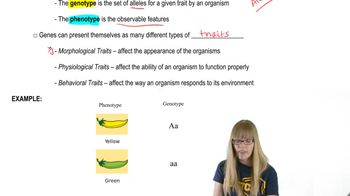
The genotype refers to the genetic makeup of an organism, while the phenotype is the observable physical or biochemical characteristics. In the given scenario, the F₁ plants are heterozygous (Tt) for height, resulting in a tall phenotype. The F₂ generation's phenotypic ratio of 9 tall to 7 dwarf indicates the underlying genotypic diversity.
Recommended video:
Guided course
07:52
Gamete Genotypes

True Breeding

True breeding refers to organisms that, when self-fertilized, produce offspring with the same phenotype and genotype. In this context, true breeding tall plants would be homozygous dominant (TT), while true breeding dwarf plants would be homozygous recessive (tt). The proportion of true breeding plants in the F₂ generation can be determined from the genotypic ratios derived from the Punnett square.
Recommended video:
Guided course
18:27
Chi Square Analysis
Related Practice
Textbook Question

In a species of the cat family, eye color can be gray, blue, green, or brown, and each trait is true breeding. In separate crosses involving homozygous parents, the following data were obtained:

How many genes are involved? Define gene symbols and indicate which genotypes yield each phenotype.

574
views
Textbook Question

In a species of the cat family, eye color can be gray, blue, green, or brown, and each trait is true breeding. In separate crosses involving homozygous parents, the following data were obtained:

In a cross between a gray-eyed cat and one of unknown genotype and phenotype, the F₁ generation was not observed. However, the F₂ resulted in the same F₂ ratio as in cross C. Determine the genotypes and phenotypes of the unknown P₁ and F₁ cats.

582
views
Textbook Question

In a plant, a tall variety was crossed with a dwarf variety. All F₁ plants were tall. When F₁xF₁ plants were interbred, 9/16 of the F₂ were tall and 7/16 were dwarf. Explain the inheritance of height by indicating the number of gene pairs involved and by designating which genotypes yield tall and which yield dwarf. (Use dashes where appropriate.)

798
views
Textbook Question

In a unique species of plants, flowers may be yellow, blue, red, or mauve. All colors may be true breeding. If plants with blue flowers are crossed with red-flowered plants, all F₁ plants have yellow flowers. When these produced an F₂ generation, the following ratio was observed:

9/16 yellow: 3/16 blue: 3/16 red: 1/16 mauve

In still another cross using true-breeding parents, yellow-flowered plants are crossed with mauve-flowered plants. Again, all F₁ plants had yellow flowers, and the F₂ showed a 9:3:3:1 ratio, as just shown.

Describe the inheritance of flower color by defining gene symbols and designating which genotypes give rise to each of the four phenotypes.

722
views
Textbook Question

In a unique species of plants, flowers may be yellow, blue, red, or mauve. All colors may be true breeding. If plants with blue flowers are crossed with red-flowered plants, all F₁ plants have yellow flowers. When these produced an F₂ generation, the following ratio was observed:

9/16 yellow: 3/16 blue: 3/16 red: 1/16 mauve

In still another cross using true-breeding parents, yellow-flowered plants are crossed with mauve-flowered plants. Again, all F₁ plants had yellow flowers, and the F₂ showed a 9:3:3:1 ratio, as just shown. Determine the F₁ and F₂ results of a cross between true-breeding red and true-breeding mauve-flowered plants.

499
views
Textbook Question

Five human matings (1–5), identified by both maternal and paternal phenotypes for ABO and MN blood-group antigen status, are shown on the left side of the following table:

Each mating resulted in one of the five offspring shown in the right-hand column (a–e). Match each offspring with one correct set of parents, using each parental set only once. Is there more than one set of correct answers?

695
views