Pearson+ LogoPearson+ Logo
Ch. 5 - Chromosome Mapping in Eukaryotes
Klug - Concepts of Genetics  12th Edition
Klug12th EditionConcepts of Genetics ISBN: 9780135564776Not the one you use?Change textbook
Chapter 5, Problem 16a

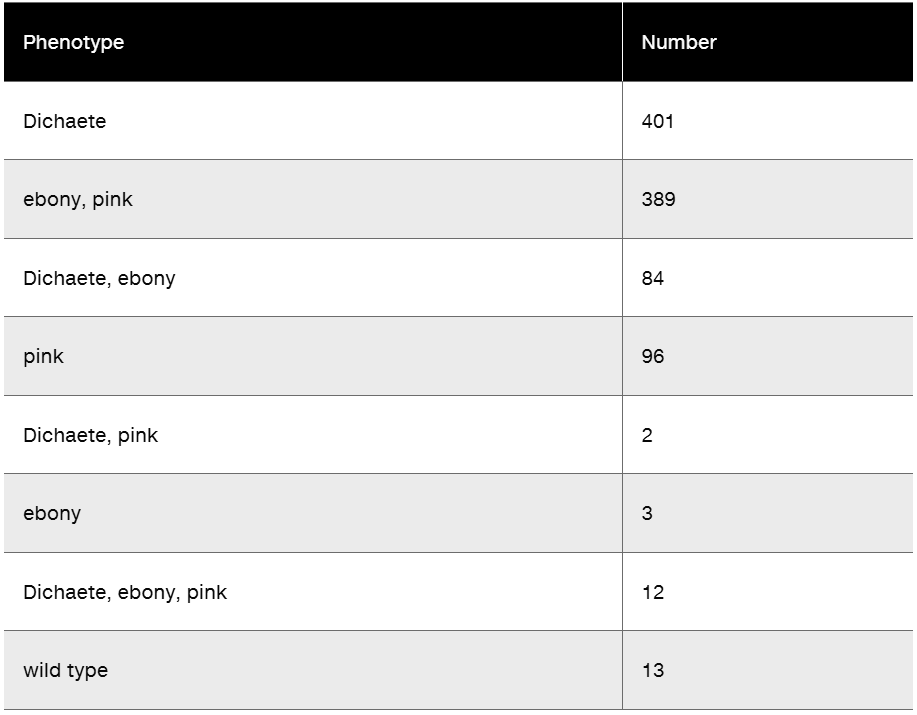
In Drosophila, Dichaete (D) is a mutation on chromosome III with a dominant effect on wing shape. It is lethal when homozygous. The genes ebony body (e) and pink eye (p) are recessive mutations on chromosome III. Flies from a Dichaete stock were crossed to homozygous ebony, pink flies, and the F₁ progeny, with a Dichaete phenotype, were backcrossed to the ebony, pink homozygotes. Using the results of this backcross shown in the table.
Table showing phenotypes and numbers of Drosophila offspring from a backcross involving Dichaete, ebony, and pink mutations.
Diagram this cross, showing the genotypes of the parents and offspring of both crosses.

Verified step by step guidance
1
Step 1: Define the alleles and their dominance relationships. Dichaete (D) is a dominant mutation on chromosome III and lethal when homozygous (D/D lethal). ebony (e) and pink (p) are recessive mutations on the same chromosome. The wild-type alleles are d (for Dichaete), E (for ebony), and P (for pink).
Step 2: Determine the genotypes of the parental flies in the initial cross. The Dichaete stock flies must be heterozygous for Dichaete (D/d) and carry wild-type alleles for ebony and pink (E/P), since ebony and pink mutations are recessive and not expressed in this stock. The ebony, pink flies are homozygous recessive for both ebony and pink (e/e, p/p) and wild-type for Dichaete (d/d).
Step 3: Write the genotype of the F₁ progeny from the initial cross. Since D is dominant and lethal when homozygous, the F₁ flies with the Dichaete phenotype are heterozygous for Dichaete (D/d) and heterozygous for ebony and pink (E/e, P/p).
Step 4: Diagram the backcross between the F₁ heterozygous flies (D/d, E/e, P/p) and the homozygous recessive ebony, pink flies (d/d, e/e, p/p). List all possible gametes from each parent considering the three loci and then combine them to predict offspring genotypes.
Step 5: Use the phenotypic data from the backcross table to assign phenotypes to genotypes. For example, flies with Dichaete phenotype carry at least one D allele, ebony phenotype requires homozygous e/e, and pink phenotype requires homozygous p/p. This will help in confirming the parental genotypes and the arrangement of alleles on the chromosomes.

Verified video answer for a similar problem:

This video solution was recommended by our tutors as helpful for the problem above.
Video duration:
1m
Was this helpful?

Key Concepts

Here are the essential concepts you must grasp in order to answer the question correctly.

Linkage and Recombination

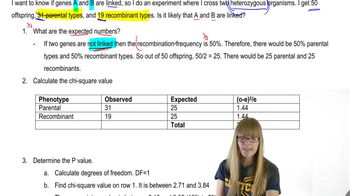
Linkage refers to genes located close together on the same chromosome that tend to be inherited together. Recombination occurs during meiosis when crossing over between homologous chromosomes creates new allele combinations. The frequency of recombinant offspring helps map gene distances and order on chromosomes.
Recommended video:
Guided course
07:33
Chi Square and Linkage

Dominant and Recessive Mutations

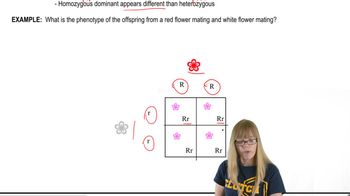
Dominant mutations express their phenotype when present in one copy, while recessive mutations require two copies to show their effect. In this question, Dichaete is dominant and lethal when homozygous, whereas ebony and pink are recessive mutations, influencing how genotypes translate into phenotypes in crosses.
Recommended video:
Guided course
04:37
Variations on Dominance

Backcross and Genetic Cross Diagrams

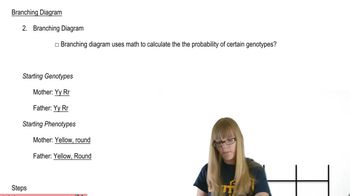
A backcross involves crossing a hybrid organism with one of its parents or a genetically similar individual to analyze inheritance patterns. Diagramming crosses with genotypes and phenotypes clarifies allele segregation, linkage, and recombination events, essential for interpreting offspring ratios and mapping genes.
Recommended video:
Guided course
06:28
Branch Diagram
Related Practice
Textbook Question

Another cross in Drosophila involved the recessive, X-linked genes yellow (y), white (w), and cut (ct). A yellow-bodied, white-eyed female with normal wings was crossed to a male whose eyes and body were normal but whose wings were cut. The F1 females were wild type for all three traits, while the F1 males expressed the yellow-body and white-eye traits. The cross was carried to an F2 progeny, and only male offspring were tallied. On the basis of the data shown here, a genetic map was constructed.

Construct a map, assuming that white is at locus 1.5 on the X chromosome.

1026
views
Textbook Question

Another cross in Drosophila involved the recessive, X-linked genes yellow (y), white (w), and cut (ct). A yellow-bodied, white-eyed female with normal wings was crossed to a male whose eyes and body were normal but whose wings were cut. The F₁ females were wild type for all three traits, while the F₁ males expressed the yellow-body and white-eye traits. The cross was carried to an F₂ progeny, and only male offspring were tallied. On the basis of the data shown here, a genetic map was constructed.

Were any double-crossover offspring expected?

768
views
Textbook Question

Another cross in Drosophila involved the recessive, X-linked genes yellow (y), white (w), and cut (ct). A yellow-bodied, white-eyed female with normal wings was crossed to a male whose eyes and body were normal but whose wings were cut. The F1 females were wild type for all three traits, while the F1 males expressed the yellow-body and white-eye traits. The cross was carried to an F2 progeny, and only male offspring were tallied. On the basis of the data shown here, a genetic map was constructed.

Could the F2 female offspring be used to construct the map? Why or why not?

783
views
Textbook Question

In Drosophila, Dichaete (D) is a mutation on chromosome III with a dominant effect on wing shape. It is lethal when homozygous. The genes ebony body (e) and pink eye (p) are recessive mutations on chromosome III. Flies from a Dichaete stock were crossed to homozygous ebony, pink flies, and the F1 progeny, with a Dichaete phenotype, were backcrossed to the ebony, pink homozygotes. Using the results of this backcross shown in the table,

What is the sequence and interlocus distance between these three genes?

1318
views
Textbook Question

Drosophila females homozygous for the third chromosomal genes pink and ebony (the same genes from Problem 16) were crossed with males homozygous for the second chromosomal gene dumpy. Because these genes are recessive, all offspring were wild type (normal). F1 females were testcrossed to triply recessive males. If we assume that the two linked genes, pink and ebony, are 20 mu apart, predict the results of this cross. If the reciprocal cross were made (F1 males—where no crossing over occurs—with triply recessive females), how would the results vary, if at all?

797
views
Textbook Question

In Drosophila, two mutations, Stubble (Sb) and curled (cu), are linked on chromosome III. Stubble is a dominant gene that is lethal in a homozygous state, and curled is a recessive gene. If a female of the genotype

is to be mated to detect recombinants among her offspring, what male genotype would you choose as a mate?

1322
views