Pearson+ LogoPearson+ Logo
Ch. 5 - Chromosome Mapping in Eukaryotes
Klug - Concepts of Genetics  12th Edition
Klug12th EditionConcepts of Genetics ISBN: 9780135564776Not the one you use?Change textbook
Chapter 5, Problem 18

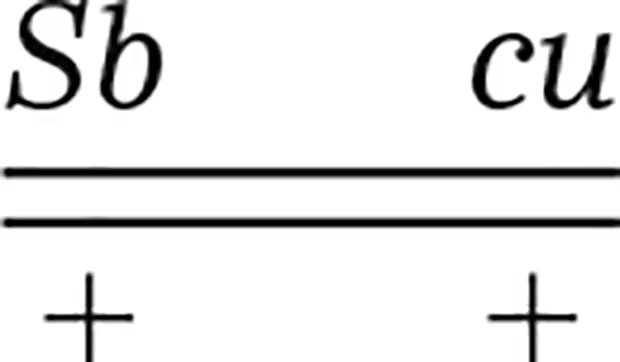
In Drosophila, two mutations, Stubble (Sb) and curled (cu), are linked on chromosome III. Stubble is a dominant gene that is lethal in a homozygous state, and curled is a recessive gene. If a female of the genotype
Genetic notation showing linked genes Stubble (Sb) and curled (cu) on chromosome III with dominant and recessive traits.
is to be mated to detect recombinants among her offspring, what male genotype would you choose as a mate?

Verified step by step guidance
1
Identify the female genotype given: she is heterozygous for the linked genes Stubble (Sb) and curled (cu), with the genotype \( \frac{Sb\;cu}{+\;+} \). This means one chromosome carries both mutant alleles (Sb and cu), and the homologous chromosome carries the wild-type alleles (+ and +).
Recall that Stubble (Sb) is dominant and lethal in homozygous form, while curled (cu) is recessive. This affects which offspring survive and how phenotypes appear.
To detect recombinants among offspring, you need to mate the female with a male whose genotype allows clear identification of recombinant phenotypes. The male should be homozygous recessive for both genes, i.e., \( \frac{+\;+}{+\;+} \) but carrying recessive alleles for both traits, so that any recombinant gametes from the female can be distinguished in the progeny.
In Drosophila genetics, the standard practice is to use a male that is homozygous recessive for both genes (\( sb\;cu \)) so that all offspring phenotypes directly reflect the female's gametes, allowing detection of parental and recombinant types.
Therefore, the male genotype to choose is \( \frac{sb\;cu}{sb\;cu} \), which is homozygous recessive for both Stubble and curled, enabling clear scoring of recombinant offspring.

Verified video answer for a similar problem:

This video solution was recommended by our tutors as helpful for the problem above.
Video duration:
4m
Was this helpful?

Key Concepts

Here are the essential concepts you must grasp in order to answer the question correctly.

Linked Genes and Recombination

Linked genes are located close together on the same chromosome and tend to be inherited together. Recombination occurs during meiosis when crossing over between homologous chromosomes can separate linked genes, producing new allele combinations. Detecting recombinants helps map gene distances and understand linkage.
Recommended video:
Guided course
07:56
Sex-Linked Genes

Dominant Lethal Alleles

A dominant lethal allele causes death when present in a homozygous state, preventing individuals with two copies from surviving. In heterozygotes, the dominant trait is expressed without lethality. This affects genotype frequencies and must be considered when predicting offspring genotypes.
Recommended video:
Guided course
04:37
Variations on Dominance

Test Cross and Choice of Mate Genotype

A test cross involves mating an individual with a known genotype to a homozygous recessive individual to reveal the genotype of the first parent through offspring phenotypes. Choosing a male homozygous recessive for both genes allows detection of recombinant offspring by their phenotypes, clarifying linkage and recombination.
Recommended video:
Guided course
10:20
Monohybrid Cross
Related Practice
Textbook Question

In Drosophila, Dichaete (D) is a mutation on chromosome III with a dominant effect on wing shape. It is lethal when homozygous. The genes ebony body (e) and pink eye (p) are recessive mutations on chromosome III. Flies from a Dichaete stock were crossed to homozygous ebony, pink flies, and the F₁ progeny, with a Dichaete phenotype, were backcrossed to the ebony, pink homozygotes. Using the results of this backcross shown in the table.

Diagram this cross, showing the genotypes of the parents and offspring of both crosses.

1674
views
Textbook Question

In Drosophila, Dichaete (D) is a mutation on chromosome III with a dominant effect on wing shape. It is lethal when homozygous. The genes ebony body (e) and pink eye (p) are recessive mutations on chromosome III. Flies from a Dichaete stock were crossed to homozygous ebony, pink flies, and the F1 progeny, with a Dichaete phenotype, were backcrossed to the ebony, pink homozygotes. Using the results of this backcross shown in the table,

What is the sequence and interlocus distance between these three genes?

1318
views
Textbook Question

Drosophila females homozygous for the third chromosomal genes pink and ebony (the same genes from Problem 16) were crossed with males homozygous for the second chromosomal gene dumpy. Because these genes are recessive, all offspring were wild type (normal). F1 females were testcrossed to triply recessive males. If we assume that the two linked genes, pink and ebony, are 20 mu apart, predict the results of this cross. If the reciprocal cross were made (F1 males—where no crossing over occurs—with triply recessive females), how would the results vary, if at all?

797
views
Textbook Question

If the cross described in Problem 18 were made, and if Sb and cu are 8.2 map units apart on chromosome III, and if 1000 offspring were recovered, what would be the outcome of the cross, assuming that equal numbers of males and females were observed?

559
views
Textbook Question

Are mitotic recombinations and sister chromatid exchanges effective in producing genetic variability in an individual? in the offspring of individuals?

511
views
Textbook Question

What possible conclusions can be drawn from the observations that in male Drosophila, no crossing over occurs, and that during meiosis, synaptonemal complexes are not seen in males but are observed in females where crossing over occurs?

517
views