Pearson+ LogoPearson+ Logo
Ch. 6 - Genetic Analysis and Mapping in Bacteria and Bacteriophages
Klug - Concepts of Genetics  12th Edition
Klug12th EditionConcepts of Genetics ISBN: 9780135564776Not the one you use?Change textbook
Chapter 6, Problem 24b

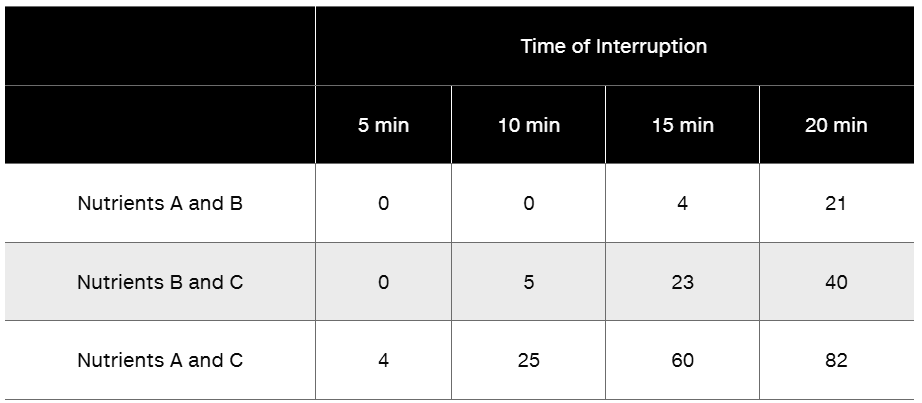
An Hfr strain is used to map three genes in an interrupted mating experiment. The cross is Hfr/a⁺b⁺c⁺ rif x F⁻/a⁻b⁻c⁻ rifT (No map order is implied in the listing of the alleles; rifT is resistance to the antibiotic rifampicin.) The a⁺ gene is required for the biosynthesis of nutrient A, the b⁺ gene for nutrient B, and the c⁺ gene for nutrient C. The minus alleles are auxotrophs for these nutrients. The cross is initiated at time = 0, and at various times, the mating mixture is plated on three types of medium. Each plate contains minimal medium (MM) plus rifampicin plus specific supplements that are indicated in the following table. (The results for each time interval are shown as the number of colonies growing on each plate.)
Table showing colony counts at 5, 10, 15, and 20 minutes for nutrient pairs A and B, B and C, and A and C in interrupted mating.
Based on these data, determine the approximate location on the chromosome of the a, b, and c genes relative to one another and to the F factor.

Verified step by step guidance
1
Step 1: Understand the experimental setup. An Hfr strain (donor) with genes a⁺, b⁺, and c⁺ is crossed with an F⁻ strain (recipient) that is auxotrophic (a⁻, b⁻, c⁻). The interrupted mating experiment measures the time it takes for different genes to be transferred from the Hfr to the F⁻ strain. The presence of rifampicin resistance (rif^T) allows selection for recipient cells that have received donor DNA.
Step 2: Analyze the data for each pair of nutrients at different time points. The number of colonies growing on minimal medium plus rifampicin and specific nutrient supplements indicates successful transfer and expression of those genes. The earliest time at which colonies appear for a gene pair suggests the order and relative position of those genes on the chromosome.
Step 3: Determine the order of gene transfer by comparing the times at which colonies first appear for each nutrient pair. For example, if colonies appear earlier for the A and C pair than for the A and B pair, gene C is transferred before gene B relative to gene A. Use the times when colonies start to appear (non-zero counts) to infer the sequence of gene transfer.
Step 4: Use the relative timing of gene transfer to map the genes on the chromosome. The gene transferred first is closest to the origin of transfer (near the F factor integration site), and subsequent genes are farther away. The difference in time between the appearance of colonies for each gene pair corresponds to the distance between those genes on the chromosome.
Step 5: Summarize the gene order and approximate distances based on the interruption times. Express the gene order as a linear sequence (e.g., F factor - gene A - gene C - gene B) and indicate the relative distances between genes proportional to the time intervals observed in the experiment.

Verified video answer for a similar problem:

This video solution was recommended by our tutors as helpful for the problem above.
Video duration:
1m
Was this helpful?

Key Concepts

Here are the essential concepts you must grasp in order to answer the question correctly.

Hfr Strain and Interrupted Mating

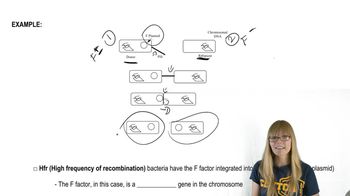
An Hfr (high frequency recombination) strain contains the F factor integrated into its chromosome, allowing it to transfer chromosomal genes to an F- recipient during conjugation. Interrupted mating experiments stop conjugation at specific times, enabling mapping of gene order based on the time genes are transferred. Genes closer to the F factor transfer earlier.
Recommended video:
Guided course
08:52
F Factor and Hfr

Gene Mapping by Time of Entry

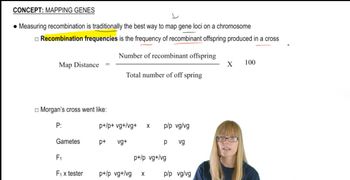
In interrupted mating, the order and relative distances of genes on the bacterial chromosome are determined by the time at which they enter the recipient cell. Genes transferred earlier are closer to the origin of transfer (F factor), and the time intervals between gene transfer reflect their physical distances on the chromosome.
Recommended video:
Guided course
09:09
Mapping Genes

Auxotrophic Markers and Selective Media

Auxotrophic mutations (a-, b-, c-) require specific nutrients for growth, while wild-type alleles (a+, b+, c+) enable biosynthesis of those nutrients. By plating on minimal media supplemented with specific nutrients and rifampicin, only recombinants receiving certain genes survive, allowing identification of gene transfer timing and mapping.
Recommended video:
Guided course
07:11
Mapping with Markers
Related Practice
Textbook Question

In studies of recombination between mutants 1 and 2 from Problem 21, the results shown in the following table were obtained.

When mutant 6 was tested for recombination with mutant 1, the data were the same as those shown above for strain B, but not for K12. The researcher lost the K12 data but remembered that recombination was ten times more frequent than when mutants 1 and 2 were tested. What were the lost values (dilution and plaque numbers)?

512
views
Textbook Question

In Bacillus subtilis, linkage analysis of two mutant genes affecting the synthesis of two amino acids, tryptophan (trp₂⁻) and tyrosine (trp₁⁻), was performed using transformation. Examine the following data and draw all possible conclusions regarding linkage. What is the purpose of Part B of the experiment? [Reference: E. Nester, M. Schafer, and J. Lederberg (1963).]

718
views
Textbook Question

An Hfr strain is used to map three genes in an interrupted mating experiment. The cross is Hfr/a⁺b⁺c⁺ rif x F⁻/a⁻b⁻c⁻ rifT (No map order is implied in the listing of the alleles; rifT is resistance to the antibiotic rifampicin.) The a⁺ gene is required for the biosynthesis of nutrient A, the b⁺ gene for nutrient B, and the c⁺ gene for nutrient C. The minus alleles are auxotrophs for these nutrients. The cross is initiated at time = 0, and at various times, the mating mixture is plated on three types of medium. Each plate contains minimal medium (MM) plus rifampicin plus specific supplements that are indicated in the following table. (The results for each time interval are shown as the number of colonies growing on each plate.)

What is the purpose of rifampicin in the experiment?

1569
views
1
rank
Textbook Question

An Hfr strain is used to map three genes in an interrupted mating experiment. The cross is Hfr/a⁺b⁺c⁺ rif x F⁻/a⁻b⁻c⁻ rifT (No map order is implied in the listing of the alleles; rifT is resistance to the antibiotic rifampicin.) The a⁺ gene is required for the biosynthesis of nutrient A, the b⁺ gene for nutrient B, and the c⁺ gene for nutrient C. The minus alleles are auxotrophs for these nutrients. The cross is initiated at time = 0, and at various times, the mating mixture is plated on three types of medium. Each plate contains minimal medium (MM) plus rifampicin plus specific supplements that are indicated in the following table. (The results for each time interval are shown as the number of colonies growing on each plate.)

Can the location of the rif gene be determined in this experiment? If not, design an experiment to determine the location of rif relative to the F factor and to gene b.

603
views
Textbook Question

A plaque assay is performed beginning with 1 mL of a solution containing bacteriophages. This solution is serially diluted three times by combining 0.1 mL of each sequential dilution with 9.9 mL of liquid medium. Then 0.1 mL of the final dilution is plated in the plaque assay and yields 17 plaques. What is the initial density of bacteriophages in the original 1 mL?

889
views
Textbook Question

In a cotransformation experiment, using various combinations of genes two at a time, the following data were produced. Determine which genes are 'linked' to which others.

716
views