Pearson+ LogoPearson+ Logo
Ch. 6 - Genetic Analysis and Mapping in Bacteria and Bacteriophages
Klug - Concepts of Genetics  12th Edition
Klug12th EditionConcepts of Genetics ISBN: 9780135564776Not the one you use?Change textbook
Chapter 6, Problem 25

A plaque assay is performed beginning with 1 mL of a solution containing bacteriophages. This solution is serially diluted three times by combining 0.1 mL of each sequential dilution with 9.9 mL of liquid medium. Then 0.1 mL of the final dilution is plated in the plaque assay and yields 17 plaques. What is the initial density of bacteriophages in the original 1 mL?

Verified step by step guidance
1
Understand the dilution process: Each dilution step involves taking 0.1 mL of the previous solution and adding it to 9.9 mL of liquid medium. This creates a dilution factor of \(\frac{0.1}{0.1 + 9.9} = \frac{0.1}{10} = 0.01\) for each step.
Calculate the total dilution factor after three serial dilutions by multiplying the dilution factors of each step: \$0.01 \times 0.01 \times 0.01 = (0.01)^3$.
Determine the dilution factor for the plated volume: Since 0.1 mL of the final dilution is plated, the number of plaques corresponds to the number of phages in that 0.1 mL volume of the diluted solution.
Use the plaque count to find the concentration of phages in the final diluted solution by dividing the number of plaques by the plated volume: \(\text{phage concentration in final dilution} = \frac{17}{0.1 \text{ mL}}\).
Calculate the initial phage concentration in the original 1 mL by dividing the concentration in the final dilution by the total dilution factor: \(\text{initial concentration} = \frac{\text{phage concentration in final dilution}}{(0.01)^3}\).

Verified video answer for a similar problem:

This video solution was recommended by our tutors as helpful for the problem above.
Video duration:
40s
Was this helpful?

Key Concepts

Here are the essential concepts you must grasp in order to answer the question correctly.

Serial Dilution

Serial dilution is a stepwise dilution of a substance in solution, where a fixed volume is transferred and diluted repeatedly. Each dilution reduces the concentration by a known factor, allowing for easier quantification of particles like bacteriophages in a sample.

Plaque Assay

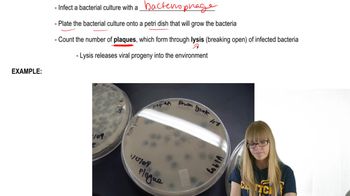
A plaque assay is a method used to quantify the number of infectious virus particles (bacteriophages) in a sample. Each plaque represents an area where a single phage infected and lysed bacterial cells, so counting plaques helps estimate the phage concentration.
Recommended video:
Guided course
03:44
Plaques and Experiments

Calculating Initial Concentration from Dilutions

To find the original concentration, multiply the number of plaques by the inverse of the dilution factor and the plated volume factor. This calculation accounts for the dilution steps and the volume plated, converting plaque counts back to the initial phage density.
Recommended video:
Guided course
07:01
Lac Operon Summary
Related Practice
Textbook Question

An Hfr strain is used to map three genes in an interrupted mating experiment. The cross is Hfr/a⁺b⁺c⁺ rif x F⁻/a⁻b⁻c⁻ rifT (No map order is implied in the listing of the alleles; rifT is resistance to the antibiotic rifampicin.) The a⁺ gene is required for the biosynthesis of nutrient A, the b⁺ gene for nutrient B, and the c⁺ gene for nutrient C. The minus alleles are auxotrophs for these nutrients. The cross is initiated at time = 0, and at various times, the mating mixture is plated on three types of medium. Each plate contains minimal medium (MM) plus rifampicin plus specific supplements that are indicated in the following table. (The results for each time interval are shown as the number of colonies growing on each plate.)

What is the purpose of rifampicin in the experiment?

1569
views
1
rank
Textbook Question

An Hfr strain is used to map three genes in an interrupted mating experiment. The cross is Hfr/a⁺b⁺c⁺ rif x F⁻/a⁻b⁻c⁻ rifT (No map order is implied in the listing of the alleles; rifT is resistance to the antibiotic rifampicin.) The a⁺ gene is required for the biosynthesis of nutrient A, the b⁺ gene for nutrient B, and the c⁺ gene for nutrient C. The minus alleles are auxotrophs for these nutrients. The cross is initiated at time = 0, and at various times, the mating mixture is plated on three types of medium. Each plate contains minimal medium (MM) plus rifampicin plus specific supplements that are indicated in the following table. (The results for each time interval are shown as the number of colonies growing on each plate.)

Based on these data, determine the approximate location on the chromosome of the a, b, and c genes relative to one another and to the F factor.

2507
views
Textbook Question

An Hfr strain is used to map three genes in an interrupted mating experiment. The cross is Hfr/a⁺b⁺c⁺ rif x F⁻/a⁻b⁻c⁻ rifT (No map order is implied in the listing of the alleles; rifT is resistance to the antibiotic rifampicin.) The a⁺ gene is required for the biosynthesis of nutrient A, the b⁺ gene for nutrient B, and the c⁺ gene for nutrient C. The minus alleles are auxotrophs for these nutrients. The cross is initiated at time = 0, and at various times, the mating mixture is plated on three types of medium. Each plate contains minimal medium (MM) plus rifampicin plus specific supplements that are indicated in the following table. (The results for each time interval are shown as the number of colonies growing on each plate.)

Can the location of the rif gene be determined in this experiment? If not, design an experiment to determine the location of rif relative to the F factor and to gene b.

603
views
Textbook Question

In a cotransformation experiment, using various combinations of genes two at a time, the following data were produced. Determine which genes are 'linked' to which others.

716
views
Textbook Question

For the experiment in Problem 26, another gene, g, was studied. It demonstrated positive cotransformation when tested with gene f. Predict the results of testing gene g with genes a, b, c, d, and e.

650
views
Textbook Question

Bacterial conjugation, mediated mainly by conjugative plasmids such as F, represents a potential health threat through the sharing of genes for pathogenicity or antibiotic resistance. Given that more than 400 different species of bacteria coinhabit a healthy human gut and more than 200 coinhabit human skin, Francisco Dionisio [(2002) Genetics 162:1525 1532] investigated the ability of plasmids to undergo between-species conjugal transfer. The following data are presented for various species of the enterobacterial genus Escherichia. The data are presented as 'log base 10' values; for example, -2.0 would be equivalent to 10⁻² as a rate of transfer. Assume that all differences between values presented are statistically significant.

What general conclusion(s) can be drawn from these data?

867
views