Pearson+ LogoPearson+ Logo
Ch. 6 - Genetic Analysis and Mapping in Bacteria and Bacteriophages
Klug - Concepts of Genetics  12th Edition
Klug12th EditionConcepts of Genetics ISBN: 9780135564776Not the one you use?Change textbook
Chapter 6, Problem 27

For the experiment in Problem 26, another gene, g, was studied. It demonstrated positive cotransformation when tested with gene f. Predict the results of testing gene g with genes a, b, c, d, and e.

Verified step by step guidance
1
Understand the concept of cotransformation: Cotransformation occurs when two genes are close enough on the bacterial chromosome that they are transferred together during transformation. Positive cotransformation indicates that the genes are likely physically linked or close to each other.
Review the results of the experiment in Problem 26 to determine the cotransformation relationships between genes a, b, c, d, and e with gene f. This will help establish the relative positions of these genes on the chromosome.
Since gene g shows positive cotransformation with gene f, it suggests that gene g is located near gene f on the chromosome. Use this information to hypothesize the relative positions of gene g with respect to genes a, b, c, d, and e.
Predict the cotransformation results for gene g with each of the genes a, b, c, d, and e based on their proximity to gene f. If a gene is close to gene f, it is likely to show positive cotransformation with gene g as well. Conversely, if a gene is far from gene f, it is less likely to show cotransformation with gene g.
Summarize the predictions for each gene (a, b, c, d, and e) based on their relative distances to gene f and the observed cotransformation patterns. This will provide the expected results of testing gene g with these genes.

Verified video answer for a similar problem:

This video solution was recommended by our tutors as helpful for the problem above.
Video duration:
2m
Was this helpful?

Key Concepts

Here are the essential concepts you must grasp in order to answer the question correctly.

Cotransformation

Cotransformation refers to the phenomenon where two or more genes are transferred together from one organism to another, often observed in bacterial transformation. This occurs when DNA from a donor bacterium is taken up by a recipient, leading to the expression of multiple traits. Understanding cotransformation is crucial for predicting genetic interactions and the likelihood of genes being inherited together.

Gene Interaction

Gene interaction describes how different genes influence each other's expression and the resulting phenotype. In the context of cotransformation, the interaction between genes g and f suggests that they may be located close to each other on the chromosome, affecting the likelihood of their co-inheritance. Analyzing gene interactions helps in predicting the outcomes of genetic experiments.
Recommended video:
Guided course
07:56
Interacting Genes Overview

Linkage Mapping

Linkage mapping is a genetic technique used to determine the relative positions of genes on a chromosome based on the frequency of recombination between them. Genes that are physically close tend to be inherited together, which is essential for predicting the results of testing gene g with other genes. Understanding linkage is vital for making accurate predictions about genetic outcomes in experiments.
Recommended video:
Guided course
07:33
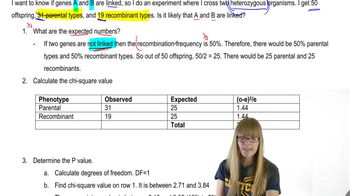
Chi Square and Linkage
Related Practice
Textbook Question

An Hfr strain is used to map three genes in an interrupted mating experiment. The cross is Hfr/a⁺b⁺c⁺ rif x F⁻/a⁻b⁻c⁻ rifT (No map order is implied in the listing of the alleles; rifT is resistance to the antibiotic rifampicin.) The a⁺ gene is required for the biosynthesis of nutrient A, the b⁺ gene for nutrient B, and the c⁺ gene for nutrient C. The minus alleles are auxotrophs for these nutrients. The cross is initiated at time = 0, and at various times, the mating mixture is plated on three types of medium. Each plate contains minimal medium (MM) plus rifampicin plus specific supplements that are indicated in the following table. (The results for each time interval are shown as the number of colonies growing on each plate.)

Can the location of the rif gene be determined in this experiment? If not, design an experiment to determine the location of rif relative to the F factor and to gene b.

603
views
Textbook Question

A plaque assay is performed beginning with 1 mL of a solution containing bacteriophages. This solution is serially diluted three times by combining 0.1 mL of each sequential dilution with 9.9 mL of liquid medium. Then 0.1 mL of the final dilution is plated in the plaque assay and yields 17 plaques. What is the initial density of bacteriophages in the original 1 mL?

889
views
Textbook Question

In a cotransformation experiment, using various combinations of genes two at a time, the following data were produced. Determine which genes are 'linked' to which others.

716
views
Textbook Question

Bacterial conjugation, mediated mainly by conjugative plasmids such as F, represents a potential health threat through the sharing of genes for pathogenicity or antibiotic resistance. Given that more than 400 different species of bacteria coinhabit a healthy human gut and more than 200 coinhabit human skin, Francisco Dionisio [(2002) Genetics 162:1525 1532] investigated the ability of plasmids to undergo between-species conjugal transfer. The following data are presented for various species of the enterobacterial genus Escherichia. The data are presented as 'log base 10' values; for example, -2.0 would be equivalent to 10⁻² as a rate of transfer. Assume that all differences between values presented are statistically significant.

What general conclusion(s) can be drawn from these data?

867
views
Textbook Question

Bacterial conjugation, mediated mainly by conjugative plasmids such as F, represents a potential health threat through the sharing of genes for pathogenicity or antibiotic resistance. Given that more than 400 different species of bacteria coinhabit a healthy human gut and more than 200 coinhabit human skin, Francisco Dionisio [(2002) Genetics 162:1525 1532] investigated the ability of plasmids to undergo between-species conjugal transfer. The following data are presented for various species of the enterobacterial genus Escherichia. The data are presented as 'log base 10' values; for example, -2.0 would be equivalent to 10⁻² as a rate of transfer. Assume that all differences between values presented are statistically significant.

In what species is within-species transfer most likely? In what species pair is between-species transfer most likely?

843
views
Textbook Question

Bacterial conjugation, mediated mainly by conjugative plasmids such as F, represents a potential health threat through the sharing of genes for pathogenicity or antibiotic resistance. Given that more than 400 different species of bacteria coinhabit a healthy human gut and more than 200 coinhabit human skin, Francisco Dionisio [(2002) Genetics 162:1525 1532] investigated the ability of plasmids to undergo between-species conjugal transfer. The following data are presented for various species of the enterobacterial genus Escherichia. The data are presented as 'log base 10' values; for example, -2.0 would be equivalent to 10⁻² as a rate of transfer. Assume that all differences between values presented are statistically significant.

What is the significance of these findings in terms of human health?

811
views