Pearson+ LogoPearson+ Logo
Ch. 6 - Genetic Analysis and Mapping in Bacteria and Bacteriophages
Klug - Concepts of Genetics  12th Edition
Klug12th EditionConcepts of Genetics ISBN: 9780135564776Not the one you use?Change textbook
Chapter 6, Problem 28a

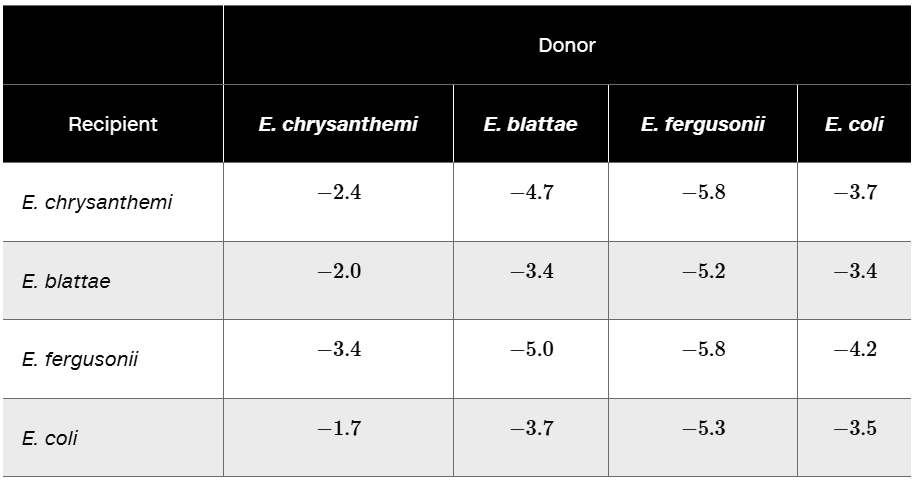
Bacterial conjugation, mediated mainly by conjugative plasmids such as F, represents a potential health threat through the sharing of genes for pathogenicity or antibiotic resistance. Given that more than 400 different species of bacteria coinhabit a healthy human gut and more than 200 coinhabit human skin, Francisco Dionisio [(2002) Genetics 162:1525 1532] investigated the ability of plasmids to undergo between-species conjugal transfer. The following data are presented for various species of the enterobacterial genus Escherichia. The data are presented as 'log base 10' values; for example, -2.0 would be equivalent to 10⁻² as a rate of transfer. Assume that all differences between values presented are statistically significant.
Table showing log10 rates of plasmid transfer between four Escherichia species as donors and recipients, with varying transfer efficiencies.
What general conclusion(s) can be drawn from these data?

Verified step by step guidance
1
Step 1: Understand the data format and what it represents. The table shows log base 10 values of plasmid transfer rates between different Escherichia species, where each value corresponds to the rate of transfer from a donor species (columns) to a recipient species (rows). For example, a value of -2.0 means a transfer rate of 10⁻².
Step 2: Compare transfer rates within species (diagonal values) versus between species (off-diagonal values). Notice that the diagonal values represent transfer within the same species, while off-diagonal values represent transfer between different species.
Step 3: Identify patterns in transfer efficiency by looking at the magnitude of the log values. Higher (less negative) values indicate higher transfer rates. For example, compare the transfer rates from E. coli donors to various recipients and vice versa.
Step 4: Analyze whether plasmid transfer is generally more efficient within the same species or between different species by comparing diagonal and off-diagonal values. Also, observe if some species act as better donors or recipients overall by comparing columns and rows.
Step 5: Draw general conclusions about the ability of plasmids to transfer between species, such as whether interspecies transfer is common or limited, and which species pairs show the highest or lowest transfer rates, indicating potential health risks related to gene sharing.

Verified video answer for a similar problem:

This video solution was recommended by our tutors as helpful for the problem above.
Video duration:
1m
Was this helpful?

Key Concepts

Here are the essential concepts you must grasp in order to answer the question correctly.

Bacterial Conjugation and Plasmid Transfer

Bacterial conjugation is a process where genetic material, often plasmids, is transferred directly from a donor to a recipient cell through cell-to-cell contact. Conjugative plasmids like the F plasmid carry genes that enable this transfer, facilitating the spread of traits such as antibiotic resistance among bacteria. Understanding conjugation is key to interpreting how genes move between species.
Recommended video:

Logarithmic Scale for Transfer Rates

The data on plasmid transfer rates are presented as log base 10 values, meaning a value of -2 corresponds to a transfer rate of 10⁻² or 0.01. This logarithmic representation allows easier comparison of rates that vary over several orders of magnitude. Recognizing this scale is essential to accurately interpret differences in transfer efficiency between species.
Recommended video:

Species-Specific Barriers to Plasmid Transfer

The variation in transfer rates between different Escherichia species suggests that species-specific factors influence conjugation efficiency. Lower transfer rates between certain donor-recipient pairs indicate biological barriers such as restriction-modification systems or incompatibility of conjugation machinery. This concept explains why plasmid transfer is not equally efficient across all species.
Recommended video:
Related Practice
Textbook Question

A plaque assay is performed beginning with 1 mL of a solution containing bacteriophages. This solution is serially diluted three times by combining 0.1 mL of each sequential dilution with 9.9 mL of liquid medium. Then 0.1 mL of the final dilution is plated in the plaque assay and yields 17 plaques. What is the initial density of bacteriophages in the original 1 mL?

889
views
Textbook Question

In a cotransformation experiment, using various combinations of genes two at a time, the following data were produced. Determine which genes are 'linked' to which others.

716
views
Textbook Question

For the experiment in Problem 26, another gene, g, was studied. It demonstrated positive cotransformation when tested with gene f. Predict the results of testing gene g with genes a, b, c, d, and e.

650
views
Textbook Question

Bacterial conjugation, mediated mainly by conjugative plasmids such as F, represents a potential health threat through the sharing of genes for pathogenicity or antibiotic resistance. Given that more than 400 different species of bacteria coinhabit a healthy human gut and more than 200 coinhabit human skin, Francisco Dionisio [(2002) Genetics 162:1525 1532] investigated the ability of plasmids to undergo between-species conjugal transfer. The following data are presented for various species of the enterobacterial genus Escherichia. The data are presented as 'log base 10' values; for example, -2.0 would be equivalent to 10⁻² as a rate of transfer. Assume that all differences between values presented are statistically significant.

In what species is within-species transfer most likely? In what species pair is between-species transfer most likely?

843
views
Textbook Question

Bacterial conjugation, mediated mainly by conjugative plasmids such as F, represents a potential health threat through the sharing of genes for pathogenicity or antibiotic resistance. Given that more than 400 different species of bacteria coinhabit a healthy human gut and more than 200 coinhabit human skin, Francisco Dionisio [(2002) Genetics 162:1525 1532] investigated the ability of plasmids to undergo between-species conjugal transfer. The following data are presented for various species of the enterobacterial genus Escherichia. The data are presented as 'log base 10' values; for example, -2.0 would be equivalent to 10⁻² as a rate of transfer. Assume that all differences between values presented are statistically significant.

What is the significance of these findings in terms of human health?

811
views
Textbook Question

A study was conducted in an attempt to determine which functional regions of a particular conjugative transfer gene (tra1) are involved in the transfer of plasmid R27 in Salmonella enterica. The R27 plasmid is of significant clinical interest because it is capable of encoding multiple-antibiotic resistance to typhoid fever. To identify functional regions responsible for conjugal transfer, an analysis was conducted by Lawley et al. (2002). J. Bacteriol. 184:2173-2180 was conducted in which particular regions of the tra1 gene were mutated and tested for their impact on conjugation. Shown here is a map of the regions tested and believed to be involved in conjugative transfer of the plasmid. Similar coloring indicates related function. Numbers correspond to each functional region subjected to mutation analysis.

Accompanying the map is a table showing the effects of these mutations on R27 conjugation.

Effects of Mutations in Functional Regions of Transfer Region 1 (tra1) on R27 Conjugation


Given the data, do all functional regions appear to influence conjugative transfer?

576
views