Two theoretical genetic strains of a virus (a⁻b⁻c⁻ and a⁺b⁺c⁺) were used to simultaneously infect a culture of host bacteria. Of 10,000 plaques scored, the following genotypes were observed. Determine the genetic map of these three genes on the viral chromosome. Decide whether the interference was positive or negative.

Klug 12th Edition
Ch. 6 - Genetic Analysis and Mapping in Bacteria and Bacteriophages
Problem 16If a single bacteriophage infects one E. coli cell present on a lawn of bacteria and, upon lysis, yields 200 viable viruses, how many phages will exist in a single plaque if three more lytic cycles occur?

Verified step by step guidance
Verified video answer for a similar problem:
Key Concepts
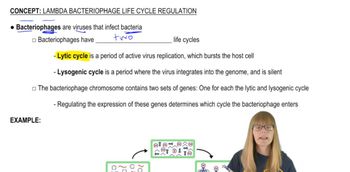
Lytic Cycle of Bacteriophages
Burst Size
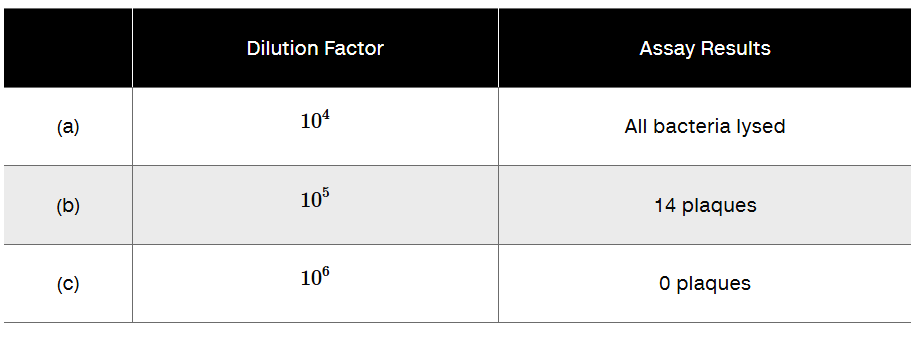
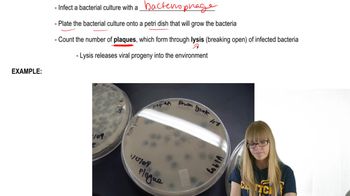
Plaque Formation and Dilution Assays
The bacteriophage genome consists of many genes encoding proteins that make up the head, collar, tail, and tail fibers. When these genes are transcribed following phage infection, how are these proteins synthesized, since the phage genome lacks genes essential to ribosome structure?
If a single bacteriophage infects one E. coli cell present on a lawn of bacteria and, upon lysis, yields 200 viable viruses, how many phages will exist in a single plaque if three more lytic cycles occur?
In recombination studies of the rII locus in phage T4, what is the significance of the value determined by calculating phage growth in the K12 versus the B strains of E. coli following simultaneous infection in E. coli B? Which value is always greater?
In an analysis of rII mutants, complementation testing yielded the following results:
If further testing of the mutations in Problem 18 yielded the following results, what would you conclude about mutant 5?