
Pearson+ LogoPearson+ Logo
Ch. 6 - Genetic Analysis and Mapping in Bacteria and Bacteriophages
Klug - Concepts of Genetics  12th Edition
Klug12th EditionConcepts of Genetics ISBN: 9780135564776Not the one you use?Change textbook
Chapter 6, Problem 17

In recombination studies of the rII locus in phage T4, what is the significance of the value determined by calculating phage growth in the K12 versus the B strains of E. coli following simultaneous infection in E. coli B? Which value is always greater?

Verified step by step guidance
1
Understand the context: The rII locus in phage T4 is used to study genetic recombination. Phage T4 can infect two strains of E. coli: strain B and strain K12. The ability of the phage to grow on these strains depends on whether recombination has occurred.
Recognize the experimental setup: In this experiment, phage T4 is simultaneously infecting E. coli strain B. This allows recombination to occur between the phage genomes. The progeny phages are then tested for their ability to grow on both E. coli B and K12 strains.
Define the significance of the value: The value determined by calculating phage growth on K12 versus B strains reflects the frequency of recombination events. Growth on K12 indicates that recombination has restored the wild-type function of the rII locus, while growth on B indicates the total number of progeny phages.
Identify which value is always greater: The number of phages capable of growing on E. coli B is always greater because all progeny phages (both recombinant and non-recombinant) can grow on this strain. In contrast, only recombinant phages with restored wild-type function can grow on K12.
Conclude the interpretation: The ratio of phage growth on K12 to B provides a measure of recombination frequency. A higher ratio indicates a higher frequency of recombination events that restore the wild-type function of the rII locus.

Verified video answer for a similar problem:

This video solution was recommended by our tutors as helpful for the problem above.
Video duration:
1m
Was this helpful?

Key Concepts

Here are the essential concepts you must grasp in order to answer the question correctly.

Recombination in Genetics

Recombination is a genetic process where genetic material is exchanged between different chromosomes or within the same chromosome. In the context of phage T4, recombination studies help understand how genetic variation occurs and how traits are inherited. This process is crucial for mapping genetic loci, such as the rII locus, and determining the genetic distance between them.
Recommended video:
Guided course
03:37
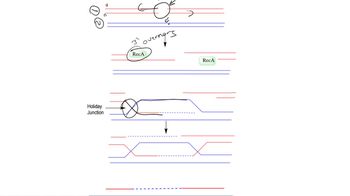
Recombination after Double Strand Breaks

Phage Growth and Strain Differences

Phage growth refers to the replication and proliferation of bacteriophages, which are viruses that infect bacteria. The K12 and B strains of E. coli exhibit different susceptibilities to phage infection, influencing the efficiency of phage growth. Understanding these differences is essential for interpreting the results of recombination studies, as they can affect the observed outcomes in simultaneous infections.
Recommended video:

Simultaneous Infection and Value Comparison

Simultaneous infection involves infecting a host cell with multiple phage types at the same time, allowing researchers to study interactions between different phages. In the context of the rII locus, the value calculated from phage growth in K12 versus B strains indicates the efficiency of recombination. Typically, the value associated with the K12 strain is greater due to its higher permissiveness to phage growth, which can lead to more successful recombination events.
Recommended video:
Guided course
03:44
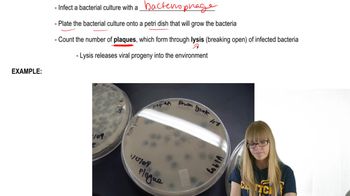
Plaques and Experiments