Pearson+ LogoPearson+ Logo
Ch. 6 - Genetic Analysis and Mapping in Bacteria and Bacteriophages
Klug - Concepts of Genetics  12th Edition
Klug12th EditionConcepts of Genetics ISBN: 9780135564776Not the one you use?Change textbook
Chapter 6, Problem 9

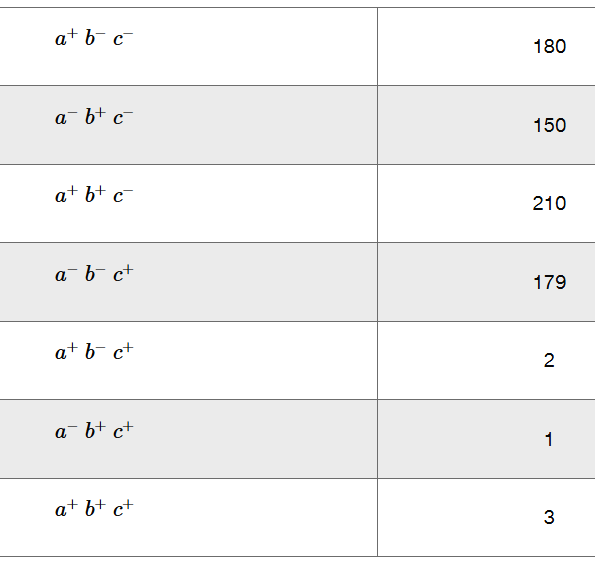
In a transformation experiment, donor DNA was obtained from a prototroph bacterial strain (a⁺b⁺c⁺), and the recipient was a triple auxotroph (a⁻b⁻c⁻). What general conclusions can you draw about the linkage relationships among the three genes from the following transformant classes that were recovered?
Table showing seven bacterial transformant classes with gene combinations a, b, c plus or minus and their corresponding frequencies.

Verified step by step guidance
1
Step 1: Understand the problem. In this transformation experiment, donor DNA from a prototroph strain (a⁺b⁺c⁺) is introduced into a recipient triple auxotroph strain (a⁻b⁻c⁻). The goal is to analyze the transformant classes to infer linkage relationships among the three genes (a, b, c). Linkage refers to the physical proximity of genes on the same DNA molecule, which affects their likelihood of being co-transformed.
Step 2: Examine the transformant classes and their frequencies. The frequencies of the recovered transformants provide clues about the likelihood of co-transformation. Higher frequencies suggest closer linkage between genes, while lower frequencies suggest genes are farther apart or unlinked. For example, the class a⁺b⁺c⁻ has a frequency of 210, which is relatively high, indicating potential linkage between genes a and b.
Step 3: Identify patterns of co-transformation. Look for transformant classes that include combinations of two or three genes being transformed together. For instance, the class a⁺b⁺c⁺ (frequency 3) represents all three genes being co-transformed, which is rare and suggests that all three genes are not tightly linked. Compare this to classes like a⁺b⁺c⁻ (frequency 210), which suggests closer linkage between a and b.
Step 4: Analyze the data for pairwise linkage. Focus on pairs of genes to determine their relative proximity. For example, the high frequency of a⁺b⁺c⁻ (210) compared to a⁺b⁻c⁺ (2) suggests that genes a and b are more closely linked than genes a and c. Similarly, the low frequency of a⁻b⁺c⁺ (1) suggests weak or no linkage between b and c.
Step 5: Draw general conclusions. Based on the transformant frequencies, genes a and b appear to be closely linked, as evidenced by the high frequency of co-transformation. Gene c is less frequently co-transformed with either a or b, suggesting it is farther away or unlinked. The rare occurrence of all three genes being co-transformed (a⁺b⁺c⁺, frequency 3) supports the idea that the three genes are not tightly linked on the same DNA molecule.

Verified video answer for a similar problem:

This video solution was recommended by our tutors as helpful for the problem above.
Video duration:
2m
Was this helpful?

Key Concepts

Here are the essential concepts you must grasp in order to answer the question correctly.

Transformation in Bacteria

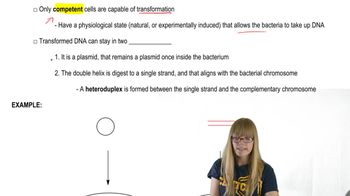
Transformation is a process by which bacteria take up foreign DNA from their environment and incorporate it into their own genome. This mechanism allows for genetic variation and can lead to new traits, such as antibiotic resistance. In the context of the experiment, the donor strain provides functional genes to the recipient strain, which lacks these genes.
Recommended video:
Guided course
05:48
Transformation

Auxotrophy and Prototrophy

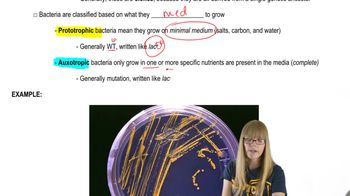
Auxotrophy refers to the inability of an organism to synthesize a particular compound required for its growth, necessitating supplementation from the environment. Prototrophs, on the other hand, can synthesize all necessary compounds and can grow on minimal media. The experiment involves a prototroph donor (a⁺b⁺c⁺) and an auxotroph recipient (a⁻b⁻c⁻), highlighting the genetic complementation that occurs during transformation.
Recommended video:
Guided course
09:35
Bacteria in the Laboratory

Linkage and Genetic Mapping

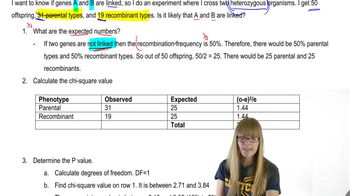
Linkage refers to the tendency of genes located close to each other on a chromosome to be inherited together during meiosis. The frequency of different transformant classes provides insight into the linkage relationships among the genes. By analyzing the ratios of the recovered classes, one can infer which genes are linked and the relative distances between them, aiding in the construction of a genetic map.
Recommended video:
Guided course
07:33
Chi Square and Linkage