Pearson+ LogoPearson+ Logo
Ch. 6 - Genetic Analysis and Mapping in Bacteria and Bacteriophages
Klug - Concepts of Genetics  12th Edition
Klug12th EditionConcepts of Genetics ISBN: 9780135564776Not the one you use?Change textbook
Chapter 6, Problem 10

Describe the role of heteroduplex formation during transformation.

Verified step by step guidance
1
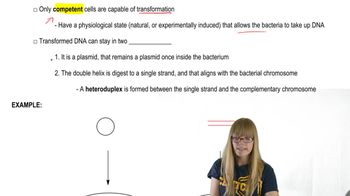
Understand the concept of transformation: Transformation is the process by which a cell takes up foreign DNA from its environment and incorporates it into its own genome. This is a key mechanism of horizontal gene transfer in bacteria.
Define heteroduplex formation: A heteroduplex is a DNA molecule formed when two single strands of DNA from different sources anneal to each other. This occurs during transformation when the foreign DNA aligns with the recipient's DNA.
Explain the alignment process: During transformation, the foreign DNA enters the recipient cell and aligns with a homologous region of the recipient's DNA. This alignment is facilitated by complementary base pairing.
Describe the role of heteroduplex formation: The heteroduplex forms when the foreign DNA strand pairs with the recipient's DNA strand. This pairing allows for the integration of the foreign DNA into the recipient's genome, potentially introducing new genetic traits.
Highlight the importance of mismatch repair: After the heteroduplex forms, the cell's mismatch repair system may recognize and correct any base-pair mismatches between the foreign and recipient DNA strands. This ensures the stability and functionality of the integrated DNA.

Verified video answer for a similar problem:

This video solution was recommended by our tutors as helpful for the problem above.
Video duration:
1m
Was this helpful?

Key Concepts

Here are the essential concepts you must grasp in order to answer the question correctly.

Heteroduplex Formation

Heteroduplex formation occurs when two strands of DNA from different sources pair together, creating a hybrid molecule. This process is crucial during genetic transformation, as it allows for the incorporation of foreign DNA into a host organism's genome. The resulting heteroduplex can lead to genetic variation and the expression of new traits in the transformed organism.
Recommended video:
Guided course
04:06
Formation of Plant Gametes

Transformation

Transformation is a process by which a cell takes up foreign DNA from its environment and incorporates it into its own genome. This mechanism is a key method of horizontal gene transfer in bacteria, enabling them to acquire new genetic traits, such as antibiotic resistance. Understanding transformation is essential for studying genetic engineering and biotechnology applications.
Recommended video:
Guided course
05:48
Transformation

Genetic Recombination

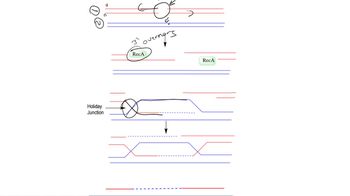
Genetic recombination refers to the process by which genetic material is rearranged during cell division or through mechanisms like transformation. In the context of heteroduplex formation, recombination allows for the exchange of genetic information between the host DNA and the incoming foreign DNA, leading to genetic diversity. This process is fundamental in evolution and the adaptation of organisms to changing environments.
Recommended video:
Guided course
03:37
Recombination after Double Strand Breaks