Pearson+ LogoPearson+ Logo
Ch. 6 - Genetic Analysis and Mapping in Bacteria and Bacteriophages
Klug - Concepts of Genetics  12th Edition
Klug12th EditionConcepts of Genetics ISBN: 9780135564776Not the one you use?Change textbook
Chapter 6, Problem 6

In general, when recombination experiments are conducted with bacteria, participating bacteria are mixed in complete medium, then transferred to a minimal growth medium. Why isn't the protocol reversed: minimal medium first, complete medium second?

Verified step by step guidance
1
insert step 1> Start by understanding the purpose of using different types of media in bacterial recombination experiments. Complete medium contains all the nutrients necessary for bacterial growth, while minimal medium contains only the essential nutrients.
insert step 2> Consider the role of recombination in these experiments. Recombination allows for the exchange of genetic material between bacteria, potentially introducing new genetic traits that can be expressed.
insert step 3> Think about the initial conditions needed for recombination to occur. In a complete medium, all bacteria, regardless of their genetic makeup, can grow and survive, allowing them to come into contact and exchange genetic material.
insert step 4> Reflect on the purpose of transferring bacteria to a minimal medium after recombination. The minimal medium acts as a selective environment, where only bacteria that have acquired the necessary genetic traits through recombination can survive and grow.
insert step 5> Conclude that starting with a minimal medium would not allow all bacteria to survive initially, thus reducing the chances of recombination occurring, as only those with the necessary traits would grow, limiting genetic exchange.

Verified video answer for a similar problem:

This video solution was recommended by our tutors as helpful for the problem above.
Video duration:
2m
Was this helpful?

Key Concepts

Here are the essential concepts you must grasp in order to answer the question correctly.

Recombination in Bacteria

Recombination in bacteria refers to the process by which genetic material is exchanged between bacterial cells, often through mechanisms like transformation, transduction, or conjugation. This genetic exchange can lead to increased genetic diversity and adaptation. Understanding this process is crucial for interpreting the outcomes of recombination experiments.
Recommended video:
Guided course
03:51
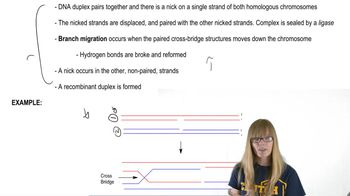
Recombination after Single Strand Breaks

Growth Media in Bacterial Culture

Growth media provide the necessary nutrients for bacterial growth. Complete medium contains all essential nutrients, allowing for robust growth, while minimal medium contains only the basic nutrients required for survival. The choice of medium affects bacterial metabolism and growth rates, which is critical when studying genetic recombination.
Recommended video:
Guided course
04:06
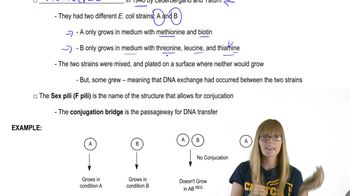
Conjugation Overview

Selection Pressure in Experimental Design

Selection pressure refers to environmental factors that influence which organisms survive and reproduce. In the context of bacterial recombination experiments, starting with complete medium allows for the growth of all bacteria, ensuring that only those with successful recombination events are selected when transferred to minimal medium. This sequential approach enhances the detection of recombination events.
Recommended video:
Guided course
05:54
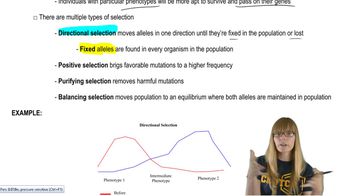
Natural Selection