Pearson+ LogoPearson+ Logo
Ch. 6 - Genetic Analysis and Mapping in Bacteria and Bacteriophages
Klug - Concepts of Genetics  12th Edition
Klug12th EditionConcepts of Genetics ISBN: 9780135564776Not the one you use?Change textbook
Chapter 6, Problem 4

List all major differences between:
(a) The F⁺ x F⁻ and the Hfr x F⁻ bacterial crosses
(b) The F⁺, F⁻, Hfr, and F' bacteria.

Verified step by step guidance
1
Step 1: Understand the nature of the F factor in bacterial conjugation. The F factor (fertility factor) is a plasmid that enables bacteria to transfer genetic material through conjugation. F⁺ bacteria carry the F plasmid, while F⁻ bacteria do not.
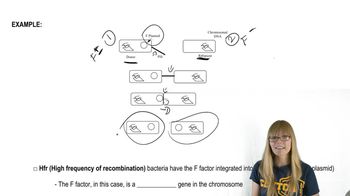
Step 2: Compare the F⁺ x F⁻ and Hfr x F⁻ crosses by focusing on the type of donor cell and the genetic material transferred. In an F⁺ x F⁻ cross, the donor is an F⁺ cell with the F plasmid separate from the chromosome, transferring mainly the plasmid. In an Hfr x F⁻ cross, the donor is an Hfr cell where the F factor is integrated into the bacterial chromosome, transferring chromosomal genes along with the F factor.
Step 3: List the major differences between F⁺, F⁻, Hfr, and F' bacteria by defining each: F⁺ bacteria have the F plasmid as an independent element; F⁻ bacteria lack the F plasmid; Hfr bacteria have the F factor integrated into their chromosome, enabling transfer of chromosomal genes; F' bacteria carry an F plasmid that has excised from the chromosome but includes some chromosomal genes.
Step 4: Highlight the consequences of these differences in terms of gene transfer: F⁺ cells transfer only the F plasmid, converting F⁻ recipients to F⁺; Hfr cells transfer part of their chromosome starting from the integrated F factor, often not converting F⁻ to Hfr due to incomplete transfer; F' cells transfer the F plasmid plus some chromosomal genes, potentially introducing new traits to recipients.
Step 5: Summarize the key distinctions focusing on the genetic material transferred, the integration status of the F factor, and the resulting phenotypes of recipient cells after conjugation.

Verified video answer for a similar problem:

This video solution was recommended by our tutors as helpful for the problem above.
Video duration:
1m
Was this helpful?

Key Concepts

Here are the essential concepts you must grasp in order to answer the question correctly.

F⁺ x F⁻ and Hfr x F⁻ Bacterial Crosses

F⁺ bacteria carry the F plasmid as an independent element and can transfer it to F⁻ cells via conjugation, converting them into F⁺. Hfr bacteria have the F factor integrated into their chromosome, allowing transfer of chromosomal genes to F⁻ cells during conjugation, often resulting in genetic recombination but rarely converting F⁻ to Hfr.
Recommended video:
Guided course
08:52
F Factor and Hfr

F⁺, F⁻, Hfr, and F' Bacteria

F⁺ cells contain the F plasmid as an episome; F⁻ cells lack the F factor entirely. Hfr cells have the F factor integrated into their chromosome, enabling high-frequency recombination. F' bacteria carry an F plasmid that has excised imprecisely, including some chromosomal genes, which can be transferred to recipients, facilitating gene mapping and variation.
Recommended video:
Guided course
08:52
F Factor and Hfr

Bacterial Conjugation and Gene Transfer Mechanisms

Conjugation is the process where genetic material is transferred between bacteria via direct contact, typically through a pilus. The nature of the F factor (plasmid or integrated) determines the type and extent of DNA transferred. Understanding these mechanisms is essential to distinguish how different bacterial crosses affect gene transfer and recombination.
Recommended video:
Guided course
08:52
F Factor and Hfr