Pearson+ LogoPearson+ Logo
Ch. 6 - Genetic Analysis and Mapping in Bacteria and Bacteriophages
Klug - Concepts of Genetics  12th Edition
Klug12th EditionConcepts of Genetics ISBN: 9780135564776Not the one you use?Change textbook
Chapter 6, Problem 3c

With respect to F⁺ and F⁻ bacterial matings, answer the following questions: What is the genetic basis for a bacterium's being F⁺.

Verified step by step guidance
1
Understand that the terms F⁺ and F⁻ refer to the presence or absence of the F factor (fertility factor) in bacteria, which is a plasmid that enables conjugation.
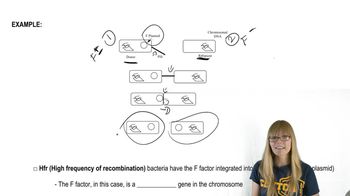
Recognize that an F⁺ bacterium contains the F plasmid, which carries genes necessary for the formation of a sex pilus and the transfer of genetic material to an F⁻ bacterium.
Know that the F plasmid is an extrachromosomal DNA element, meaning it exists independently of the bacterial chromosomal DNA.
Realize that the genetic basis for a bacterium being F⁺ is the presence of this F plasmid, which encodes the machinery for conjugation and DNA transfer.
Summarize that the F⁺ state is determined by whether the bacterium harbors the F plasmid, making it capable of donating genetic material during bacterial conjugation.

Verified video answer for a similar problem:

This video solution was recommended by our tutors as helpful for the problem above.
Video duration:
1m
Was this helpful?

Key Concepts

Here are the essential concepts you must grasp in order to answer the question correctly.

F Plasmid (F Factor)

The F plasmid, or fertility factor, is a circular DNA molecule in bacteria that carries genes enabling the formation of a sex pilus and the initiation of conjugation. A bacterium possessing this plasmid is termed F⁺ and can transfer genetic material to F⁻ cells.
Recommended video:
Guided course
08:52
F Factor and Hfr

Conjugation in Bacteria

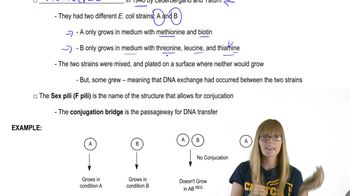
Conjugation is a process where genetic material is transferred from an F⁺ donor bacterium to an F⁻ recipient through direct contact via the sex pilus. This mechanism facilitates horizontal gene transfer and genetic diversity among bacterial populations.
Recommended video:
Guided course
04:06
Conjugation Overview

Genetic Basis of F⁺ Status

A bacterium is F⁺ because it contains the F plasmid, which encodes the genes necessary for pilus formation and DNA transfer. The presence of this plasmid distinguishes F⁺ cells from F⁻ cells, which lack the F factor and cannot initiate conjugation.
Recommended video:
Guided course
07:39
Genetic Cloning