Pearson+ LogoPearson+ Logo
Ch. 6 - Genetic Analysis and Mapping in Bacteria and Bacteriophages
Klug - Concepts of Genetics  12th Edition
Klug12th EditionConcepts of Genetics ISBN: 9780135564776Not the one you use?Change textbook
Chapter 6, Problem 2

Write a short summary that contrasts how recombination occurs in bacteria and bacteriophages.

Verified step by step guidance
1
Step 1: Define recombination in the context of genetics as the process by which genetic material is rearranged to produce new combinations of genes, increasing genetic diversity.
Step 2: Explain that in bacteria, recombination typically occurs through processes such as transformation (uptake of free DNA), transduction (DNA transfer via bacteriophages), and conjugation (direct transfer between bacteria), often involving homologous recombination where similar DNA sequences are exchanged.
Step 3: Describe that in bacteriophages, recombination mainly occurs during the infection cycle, especially through mechanisms like site-specific recombination or homologous recombination when multiple phage genomes are present in the same host, allowing exchange of genetic material between phage genomes.
Step 4: Contrast the two by noting that bacterial recombination often involves integration of foreign DNA into the bacterial chromosome to create genetic variation in the bacterial population, while phage recombination primarily reshuffles phage genetic material to generate new phage variants.
Step 5: Summarize that bacterial recombination is a key driver of bacterial evolution and adaptation, whereas phage recombination contributes to phage diversity and can influence phage-host interactions.

Verified video answer for a similar problem:

This video solution was recommended by our tutors as helpful for the problem above.
Video duration:
2m
Was this helpful?

Key Concepts

Here are the essential concepts you must grasp in order to answer the question correctly.

Bacterial Recombination Mechanisms

In bacteria, recombination primarily occurs through processes like transformation, transduction, and conjugation, which involve the exchange or uptake of DNA between cells. These mechanisms allow bacteria to acquire genetic diversity without sexual reproduction, often involving homologous recombination to integrate new DNA into the genome.
Recommended video:
Guided course
03:51
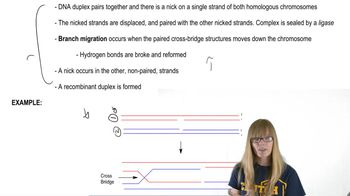
Recombination after Single Strand Breaks

Phage Recombination Processes

Bacteriophages undergo recombination mainly during their replication cycles, especially through genetic exchanges between phage genomes during co-infection of a host. This can involve homologous recombination or site-specific recombination, enabling phages to generate genetic diversity and adapt to host defenses.
Recommended video:
Guided course
08:39
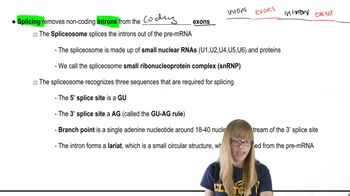
mRNA Processing

Differences in Recombination Context and Purpose

While bacterial recombination often serves to increase genetic variation and adaptability in a population, phage recombination is closely tied to their replication and survival within host cells. Bacterial recombination involves DNA transfer between cells, whereas phage recombination occurs within the viral genomes during infection.
Recommended video:
Guided course
03:37
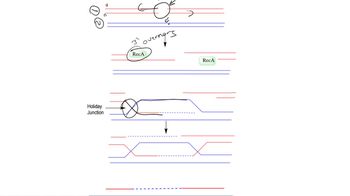
Recombination after Double Strand Breaks
Related Practice
Textbook Question

How do we know that bacteriophages recombine genetic material through transduction and that cell-to-cell contact is not essential for transduction to occur?

531
views
Textbook Question

In this chapter, we have focused on genetic systems present in bacteria and on the viruses that use bacteria as hosts (bacteriophages). In particular, we discussed mechanisms by which bacteria and their phages undergo genetic recombination, which allows geneticists to map bacterial and bacteriophage chromosomes. In the process, we found many opportunities to consider how this information was acquired. From the explanations given in the chapter, what answers would you propose to the following questions? How do we know that intergenic exchange occurs in bacteriophages?

471
views
Textbook Question

In this chapter, we have focused on genetic systems present in bacteria and on the viruses that use bacteria as hosts (bacteriophages). In particular, we discussed mechanisms by which bacteria and their phages undergo genetic recombination, which allows geneticists to map bacterial and bacteriophage chromosomes. In the process, we found many opportunities to consider how this information was acquired. From the explanations given in the chapter, what answers would you propose to the following questions? How do we know that in bacteriophage T4 the rII locus is subdivided into two regions, or cistrons?

428
views
Textbook Question

With respect to F⁺ and F⁻ bacterial matings, answer the following questions: How was it established that physical contact between cells was necessary?

418
views
Textbook Question

With respect to F⁺ and F⁻ bacterial matings, answer the following questions: How was it established that chromosome transfer was unidirectional?

500
views
Textbook Question

With respect to F⁺ and F⁻ bacterial matings, answer the following questions: What is the genetic basis for a bacterium's being F⁺.

602
views