Pearson+ LogoPearson+ Logo
Ch. 7 - Sex Determination and Sex Chromosomes
Klug - Concepts of Genetics  12th Edition
Klug12th EditionConcepts of Genetics ISBN: 9780135564776Not the one you use?Change textbook
Chapter 7, Problem 13

Assume that on rare occasions the attached X chromosomes in female gametes become unattached. Based on the parental phenotypes in Problem 12, what outcomes in the F₁ generation would indicate that this has occurred during female meiosis?

Verified step by step guidance
1
Review the concept of attached X chromosomes in female meiosis: Normally, the two X chromosomes in female Drosophila are physically attached and segregate together, producing gametes with both X chromosomes or none. When they become unattached, they segregate independently, leading to different gamete types.
Recall the parental phenotypes and genotypes from Problem 12 to understand the expected inheritance pattern when X chromosomes are attached. This will help establish the baseline for comparison with the F₁ generation outcomes.
Predict the expected F₁ phenotypes assuming attached X chromosomes: Since the X chromosomes segregate together, offspring will inherit either both X chromosomes or none, leading to specific phenotypic ratios based on the parental genotypes.
Predict the F₁ phenotypes if the X chromosomes become unattached during female meiosis: Unattached X chromosomes segregate independently, producing gametes with single X chromosomes. This will result in different phenotypic ratios in the F₁ generation compared to the attached scenario.
Compare the observed F₁ phenotypic ratios to the expected ratios for attached and unattached X chromosomes. The presence of phenotypes that can only arise from independent segregation of X chromosomes indicates that detachment occurred during female meiosis.

Verified video answer for a similar problem:

This video solution was recommended by our tutors as helpful for the problem above.
Video duration:
4m
Was this helpful?

Key Concepts

Here are the essential concepts you must grasp in order to answer the question correctly.

Attached X Chromosomes in Female Meiosis

Attached X chromosomes refer to two X chromosomes physically connected and inherited together during female meiosis, leading to non-independent assortment. Normally, these chromosomes segregate as a unit, but if they become unattached, they can segregate independently, altering expected genetic outcomes in offspring.
Recommended video:
Guided course
00:30
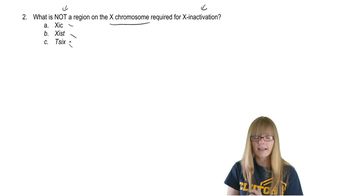
Regions of X Chromosomes

Parental Phenotypes and Genetic Linkage

Parental phenotypes represent the traits observed in the original generation, often linked to specific chromosome arrangements. Understanding how linked genes on attached X chromosomes are inherited helps predict offspring phenotypes; deviations from these predictions suggest changes in chromosome behavior during meiosis.
Recommended video:
Guided course
07:33
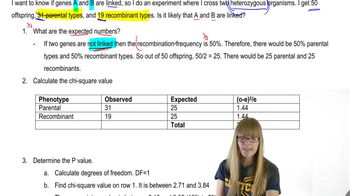
Chi Square and Linkage

Meiotic Segregation and Recombination Outcomes

Meiosis involves segregation of homologous chromosomes into gametes. If attached X chromosomes become unattached, independent segregation or recombination can occur, producing novel allele combinations in the F₁ generation. Observing unexpected phenotypes indicates such meiotic alterations.
Recommended video:
Guided course
03:51
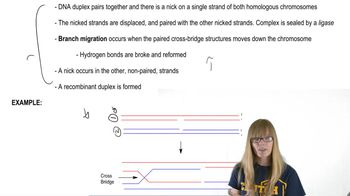
Recombination after Single Strand Breaks