Pearson+ LogoPearson+ Logo
Ch. 7 - Sex Determination and Sex Chromosomes
Klug - Concepts of Genetics  12th Edition
Klug12th EditionConcepts of Genetics ISBN: 9780135564776Not the one you use?Change textbook
Chapter 7, Problem 10b

An insect species is discovered in which the heterogametic sex is unknown. An X-linked recessive mutation for reduced wing (rw) is discovered. Contrast the F1 and F2 generations from a cross between a female with reduced wings and a male with normal-sized wings when the male is the heterogametic sex.

Verified step by step guidance
1
Identify the sex determination system given that the male is heterogametic. In this case, males have XY sex chromosomes and females have XX.
Determine the genotypes of the parents: the female with reduced wings must be homozygous recessive (X\_rwX\_rw) because the mutation is X-linked recessive, and the male with normal wings must have the genotype X\_RY (where X\_R is the normal allele).
Predict the F\_1 generation genotypes by crossing X\_rwX\_rw (female) with X\_RY (male). Write out the possible gametes and combine them to find the offspring genotypes and phenotypes.
Analyze the phenotypes of the F\_1 generation, noting which individuals show reduced wings and which show normal wings, considering the X-linked recessive inheritance pattern and the heterogametic male.
For the F\_2 generation, perform a cross between F\_1 individuals (usually F\_1 heterozygous females and F\_1 normal males) and determine the expected genotypic and phenotypic ratios, again considering the X-linked recessive inheritance and male heterogamety.

Verified video answer for a similar problem:

This video solution was recommended by our tutors as helpful for the problem above.
Video duration:
1m
Was this helpful?

Key Concepts

Here are the essential concepts you must grasp in order to answer the question correctly.

Heterogametic Sex and Sex Chromosomes

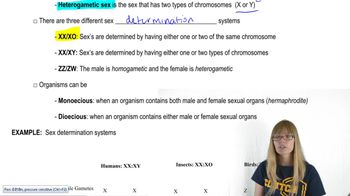
The heterogametic sex produces two different types of sex chromosomes (e.g., XY in males), while the homogametic sex produces identical sex chromosomes (e.g., XX in females). Identifying which sex is heterogametic is crucial for predicting inheritance patterns of X-linked traits, as males typically have only one X chromosome, affecting how recessive mutations are expressed.
Recommended video:
Guided course
04:24
Sex Determination

X-linked Recessive Inheritance

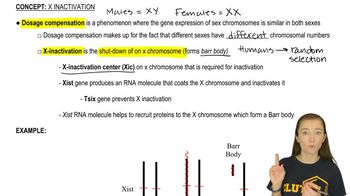
X-linked recessive traits are carried on the X chromosome and usually manifest in males who have only one X chromosome, making them hemizygous. Females must inherit two copies of the recessive allele to express the trait. This inheritance pattern influences the phenotypic ratios observed in offspring, especially when crossing heterozygous females with normal or affected males.
Recommended video:
Guided course
09:30
X-Inactivation

Mendelian Crosses and Generational Analysis (F1 and F2)

Mendelian genetics involves analyzing offspring (F1 and F2 generations) from specific parental crosses to predict genotype and phenotype ratios. The F1 generation results from the initial cross, while the F2 generation comes from crossing F1 individuals. Understanding these generations helps contrast expected phenotypic outcomes when considering sex-linked traits and heterogametic sex.
Recommended video:
Related Practice
Textbook Question

What specific observations (evidence) support the conclusions about sex determination in Drosophila and humans?

791
views
Textbook Question

Describe how nondisjunction in human female gametes can give rise to Klinefelter and Turner syndrome offspring following fertilization by a normal male gamete.

645
views
Textbook Question

An insect species is discovered in which the heterogametic sex is unknown. An X-linked recessive mutation for reduced wing (rw) is discovered. Contrast the F1 and F2 generations from a cross between a female with reduced wings and a male with normal-sized wings when the female is the heterogametic sex.

636
views
Textbook Question

When cows have twin calves of unlike sex (fraternal twins), the female twin is usually sterile and has masculinized reproductive organs. This calf is referred to as a freemartin. In cows, twins may share a common placenta and thus fetal circulation. Predict why a freemartin develops.

1131
views
Textbook Question

An attached-X female fly, XXY, expresses the recessive X-linked white-eye mutation. It is crossed to a male fly that expresses the X-linked recessive miniature-wing mutation. Determine the outcome of this cross in terms of sex, eye color, and wing size of the offspring.

815
views
Textbook Question

Assume that on rare occasions the attached X chromosomes in female gametes become unattached. Based on the parental phenotypes in Problem 12, what outcomes in the F₁ generation would indicate that this has occurred during female meiosis?

455
views