Pearson+ LogoPearson+ Logo
Ch. 7 - Sex Determination and Sex Chromosomes
Klug - Concepts of Genetics  12th Edition
Klug12th EditionConcepts of Genetics ISBN: 9780135564776Not the one you use?Change textbook
Chapter 7, Problem 27

When the cloned cat Carbon Copy (CC) was born, she had black patches and white patches, but completely lacked any orange patches. The knowledgeable students of genetics were not surprised at this outcome. Starting with the somatic ovarian cell used as the source of the nucleus in the cloning process, explain how this outcome occurred.

Verified step by step guidance
1
Understand the genetic basis of coat color in cats: Coat color in cats is determined by the X-linked gene responsible for orange and black pigmentation. Female cats (XX) can be heterozygous for this gene, meaning they can carry one allele for orange (Xᴼ) and one allele for black (Xᴮ). Due to X-chromosome inactivation, one X chromosome is randomly inactivated in each cell during early development, leading to a mosaic pattern of orange and black patches in heterozygous females.
Recognize the role of X-chromosome inactivation: In the somatic ovarian cell used for cloning, one of the two X chromosomes was already inactivated. This inactivation is a random process and is maintained in all descendant cells. If the X chromosome carrying the orange allele (Xᴼ) was inactivated in the donor cell, only the X chromosome carrying the black allele (Xᴮ) would remain active.
Understand the cloning process: In cloning, the nucleus from the donor somatic cell is transferred into an enucleated egg cell. The genetic material in the nucleus, including the inactivated X chromosome, is preserved. Therefore, the cloned organism will inherit the same pattern of X-chromosome inactivation as the donor cell.
Explain the absence of orange patches: Since the Xᴼ chromosome was inactivated in the donor somatic cell, all cells in the cloned cat (CC) will have the Xᴮ chromosome active. This means that CC will only express the black pigmentation gene and will lack any orange pigmentation, resulting in black and white patches but no orange patches.
Conclude with the importance of X-chromosome inactivation: This phenomenon explains why the cloned cat CC does not have orange patches. The pattern of X-chromosome inactivation in the donor somatic cell is faithfully replicated in the cloned organism, leading to the observed coat color phenotype.

Verified video answer for a similar problem:

This video solution was recommended by our tutors as helpful for the problem above.
Video duration:
1m
Was this helpful?

Key Concepts

Here are the essential concepts you must grasp in order to answer the question correctly.

Cloning and Somatic Cell Nuclear Transfer (SCNT)

Cloning, particularly through Somatic Cell Nuclear Transfer (SCNT), involves transferring the nucleus of a somatic cell into an enucleated egg cell. This process allows the genetic material from the somatic cell to dictate the traits of the resulting organism. In the case of Carbon Copy, the somatic cell used was derived from a cat, which determined her genetic makeup and the expression of specific coat colors.
Recommended video:

Genetic Expression and Coat Color in Cats

In cats, coat color is determined by multiple genes, including those responsible for black, white, and orange fur. The presence of black and white patches in Carbon Copy indicates that the genes for these colors were expressed, while the absence of orange patches suggests that the genetic material from the donor cell did not include the allele for orange fur. This selective expression is crucial in understanding the phenotype of cloned animals.
Recommended video:
Guided course
02:09
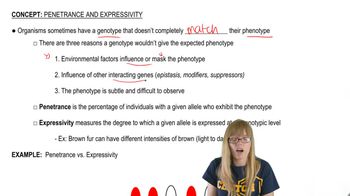
Penetrance and Expressivity

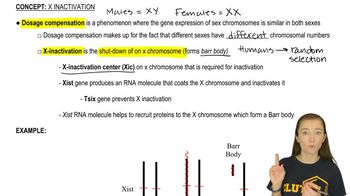
X-Chromosome Inactivation

In female mammals, including cats, one of the two X chromosomes is randomly inactivated in each cell, a process known as X-chromosome inactivation. This phenomenon can lead to a mosaic pattern of coat colors, as seen in tortoiseshell cats. Since Carbon Copy was cloned from a somatic cell, the inactivation pattern of the X chromosomes in the donor cell influenced the absence of orange patches, resulting in her unique coat coloration.
Recommended video:
Guided course
09:30
X-Inactivation
Related Practice
Textbook Question

In the wasp Bracon hebetor, a form of parthenogenesis (the development of unfertilized eggs into progeny) resulting in haploid organisms is not uncommon. All haploids are males. When offspring arise from fertilization, females almost invariably result. P. W. Whiting has shown that an X-linked gene with nine multiple alleles (Xₐ, Xb, etc.) controls sex determination. Any homozygous or hemizygous condition results in males, and any heterozygous condition results in females. If an Xₐ/Xb female mates with an Xₐ male and lays 50 percent fertilized and 50 percent unfertilized eggs, what proportion of male and female offspring will result?

612
views
Textbook Question

The Amami spiny rat (Tokudaia osimensis) lacks a Y chromosome, yet scientists at Hokkaido University in Japan have reported that key sex-determining genes continue to be expressed in this species. Provide possible explanations for why male differentiation can still occur in this mammalian species despite the absence of a Y chromosome.

842
views
Textbook Question

In mice, the X-linked dominant mutation Testicular feminization (Tfm) eliminates the normal response to the testicular hormone testosterone during sexual differentiation. An XY mouse bearing the Tfm allele on the X chromosome develops testes, but no further male differentiation occurs—the external genitalia of such an animal are female. From this information, what might you conclude about the role of the Tfm gene product and the X and Y chromosomes in sex determination and sexual differentiation in mammals? Can you devise an experiment, assuming you can 'genetically engineer' the chromosomes of mice, to test and confirm your explanation?

748
views
Textbook Question

In reptiles, sex determination was thought to be controlled by sex-chromosome systems or by temperature-dependent sex determination without an inherited component to sex. But in the Australian lizard, Pogona vitticeps, it was recently revealed that sex is determined by both chromosome composition and by the temperature at which eggs are incubated. What effects might climate change have on temperature-dependent sex determination in this species, and how might this impact the sex ratio for this species in subsequent generations?

951
views
Textbook Question

In chickens, a key gene involved in sex determination has recently been identified. Called DMRT1, it is located on the Z chromosome and is absent on the W chromosome. Like SRY in humans, it is male determining. Unlike SRY in humans, however, female chickens (ZW) have a single copy while males (ZZ) have two copies of the gene. Nevertheless, it is transcribed only in the developing testis. Working in the laboratory of Andrew Sinclair (a co-discoverer of the human SRY gene), Craig Smith and colleagues were able to 'knock down' expression of DMRT1 in ZZ embryos using RNA interference techniques. In such cases, the developing gonads look more like ovaries than testes. What conclusions can you draw about the role that the DMRT1 gene plays in chickens in contrast to the role the SRY gene plays in humans?

878
views