Pearson+ LogoPearson+ Logo
Ch. 8 - Chromosome Mutations: Variation in Number and Arrangement
Klug - Concepts of Genetics  12th Edition
Klug12th EditionConcepts of Genetics ISBN: 9780135564776Not the one you use?Change textbook
Chapter 8, Problem 11

Contrast the genetic composition of gametes derived from tetrads of inversion heterozygotes where crossing over occurs within a paracentric versus a pericentric inversion.

Verified step by step guidance
1
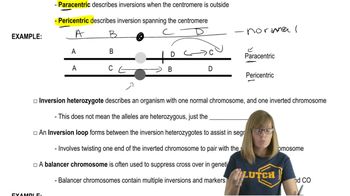
Step 1: Understand the difference between paracentric and pericentric inversions. A paracentric inversion occurs when the inverted segment does not include the centromere, while a pericentric inversion includes the centromere within the inverted segment.
Step 2: Analyze the image provided. The illustration shows a chromosomal inversion where segments of the chromosome are rearranged. In the case of crossing over within a paracentric inversion, the resulting gametes may include acentric fragments (lacking a centromere) and dicentric chromosomes (with two centromeres), which are often non-viable.
Step 3: For crossing over within a pericentric inversion, the inversion includes the centromere. The recombination results in gametes with duplications and deletions of genetic material, but these gametes retain centromeres, making them potentially viable but genetically imbalanced.
Step 4: Compare the genetic composition of gametes. In paracentric inversions, crossing over leads to structural abnormalities (acentric and dicentric chromosomes), whereas in pericentric inversions, crossing over results in genetic imbalances due to duplications and deletions.
Step 5: Conclude that the type of inversion (paracentric vs. pericentric) significantly impacts the viability and genetic composition of gametes derived from crossing over events within inversion heterozygotes.

Verified video answer for a similar problem:

This video solution was recommended by our tutors as helpful for the problem above.
Video duration:
1m
Was this helpful?

Key Concepts

Here are the essential concepts you must grasp in order to answer the question correctly.

Tetrads and Crossing Over

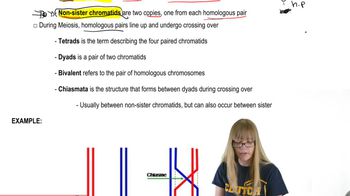
Tetrads are structures formed during meiosis when homologous chromosomes pair up. Crossing over occurs when segments of DNA are exchanged between these paired chromosomes, leading to genetic recombination. This process increases genetic diversity in gametes, which is crucial for evolution and adaptation.
Recommended video:
Guided course
07:38
Crossing Over Terminology

Paracentric Inversion

Paracentric inversion is a chromosomal rearrangement where a segment of a chromosome is inverted, but the inversion does not include the centromere. When crossing over occurs in paracentric inversions, it can lead to the formation of acentric fragments, which can result in gametes with missing genetic information, affecting viability.
Recommended video:

Pericentric Inversion

Pericentric inversion involves the inversion of a chromosome segment that includes the centromere. During crossing over in pericentric inversions, the resulting gametes can have duplications and deletions of genetic material. This can lead to viable but genetically unbalanced offspring, impacting traits and fitness.
Recommended video: