Predict how the synaptic configurations of homologous pairs of chromosomes might appear when one member is normal and the other member has sustained a deletion or duplication.
Ch. 8 - Chromosome Mutations: Variation in Number and Arrangement

All textbooks
Klug 12th Edition
Ch. 8 - Chromosome Mutations: Variation in Number and Arrangement
Problem 12
Klug 12th Edition
Ch. 8 - Chromosome Mutations: Variation in Number and Arrangement
Problem 12Chapter 8, Problem 12
Human adult hemoglobin is a tetramer containing two alpha (α) and two beta (β) polypeptide chains. The α gene cluster on chromosome 16 and the β gene cluster on chromosome 11 share amino acid similarities such that 61 of the amino acids of the α-globin polypeptide (141 amino acids long) are shared in identical sequence with the β-globin polypeptide (146 amino acids long). How might one explain the existence of two polypeptides with partially shared function and structure on two different chromosomes?
Verified step by step guidance1
Step 1: Understand the biological context — human adult hemoglobin is composed of two alpha (α) and two beta (β) polypeptide chains, each encoded by gene clusters located on different chromosomes (α on chromosome 16 and β on chromosome 11).
Step 2: Recognize that the α- and β-globin polypeptides share a significant number of identical amino acids (61 out of 141 in α-globin and 146 in β-globin), indicating a degree of sequence similarity and possibly a common evolutionary origin.
Step 3: Consider the concept of gene duplication and divergence, where an ancestral globin gene duplicated in the genome, and over time, the copies evolved separately on different chromosomes, leading to related but distinct polypeptides.
Step 4: Explain that this evolutionary process can result in paralogous genes—genes related by duplication within a genome—that retain some structural and functional similarities but also acquire unique features to fulfill specialized roles.
Step 5: Conclude that the presence of two polypeptides with partially shared function and structure on different chromosomes is best explained by gene duplication followed by divergence, which allows the organism to produce hemoglobin with subunits adapted for cooperative oxygen binding.

Verified video answer for a similar problem:
This video solution was recommended by our tutors as helpful for the problem above.
Video duration:
2mWas this helpful?
Key Concepts
Here are the essential concepts you must grasp in order to answer the question correctly.
Gene Duplication and Divergence
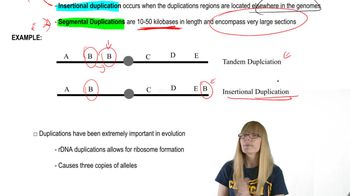
Gene duplication is an evolutionary process where a gene is copied in the genome, allowing one copy to maintain the original function while the other accumulates mutations. Over time, this can lead to related genes with similar sequences but distinct functions, explaining the presence of α- and β-globin genes on different chromosomes with shared amino acid sequences.
Recommended video:
Guided course
Duplications
Homologous Genes and Protein Families
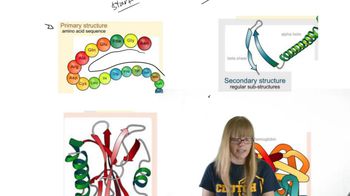
Homologous genes arise from a common ancestral gene and often encode proteins with similar structures and functions. The α- and β-globin genes belong to the globin gene family, sharing sequence similarities due to their evolutionary relationship, which results in polypeptides with partially overlapping roles in oxygen transport.
Recommended video:
Guided course
Proteins
Chromosomal Localization and Gene Clusters
Genes encoding related proteins are often organized in clusters on different chromosomes, reflecting their evolutionary history and regulation. The α-globin cluster on chromosome 16 and the β-globin cluster on chromosome 11 illustrate how gene families can be distributed across the genome yet maintain coordinated expression and functional similarity.
Recommended video:
Guided course
Segmentation Genes
Related Practice
Textbook Question
613
views
Textbook Question
Inversions are said to 'suppress crossing over.' Is this terminology technically correct? If not, restate the description accurately.
682
views
Textbook Question
Contrast the genetic composition of gametes derived from tetrads of inversion heterozygotes where crossing over occurs within a paracentric versus a pericentric inversion.
900
views
Textbook Question
Discuss Ohno's hypothesis on the role of gene duplication in the process of evolution. What evidence supports this hypothesis?
584
views
Textbook Question
What roles have inversions and translocations played in the evolutionary process?
914
views
Textbook Question
The primrose, Primula kewensis, has 36 chromosomes that are similar in appearance to the chromosomes in two related species, P. floribunda (2n=18) and P. verticillata (2n=18). How could P. kewensis arise from these species? How would you describe P. kewensis in genetic terms?
894
views