Mendelian ratios are modified in crosses involving autotetraploids. Assume that one plant expresses the dominant trait green seeds and is homozygous (WWWW). This plant is crossed to one with white seeds that is also homozygous (wwww). If only one dominant allele is sufficient to produce green seeds, predict the F₁ and F₂ results of such a cross. Assume that synapsis between chromosome pairs is random during meiosis.

Klug 12th Edition
Ch. 8 - Chromosome Mutations: Variation in Number and Arrangement
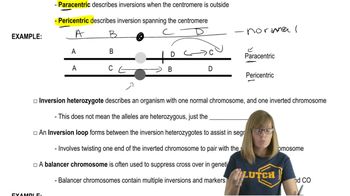
Problem 21The outcome of a single crossover between nonsister chromatids in the inversion loop of an inversion heterozygote varies depending on whether the inversion is of the paracentric or pericentric type. What differences are expected?
Verified step by step guidance
Verified video answer for a similar problem:
Key Concepts
Crossover Events
Inversion Types
Genetic Consequences of Inversions
Having correctly established the F₂ ratio in Problem 18, predict the F₂ ratio of a 'dihybrid' cross involving two independently assorting characteristics (e.g., P₁ = WWWWAAAA x wwwwaaaa).
A couple planning their family are aware that through the past three generations on the husband's side a substantial number of stillbirths have occurred and several malformed babies were born who died early in childhood. The wife has studied genetics and urges her husband to visit a genetic counseling clinic, where a complete karyotype-banding analysis is performed. Although the tests show that he has a normal complement of 46 chromosomes, banding analysis reveals that one member of the chromosome 1 pair (in group A) contains an inversion covering 70 percent of its length. The homolog of chromosome 1 and all other chromosomes show the normal banding sequence.
How would you explain the high incidence of past stillbirths?
A couple planning their family are aware that through the past three generations on the husband's side a substantial number of stillbirths have occurred and several malformed babies were born who died early in childhood. The wife has studied genetics and urges her husband to visit a genetic counseling clinic, where a complete karyotype-banding analysis is performed. Although the tests show that he has a normal complement of 46 chromosomes, banding analysis reveals that one member of the chromosome 1 pair (in group A) contains an inversion covering 70 percent of its length. The homolog of chromosome 1 and all other chromosomes show the normal banding sequence.
What can you predict about the probability of abnormality/normality of their future children?
A couple planning their family are aware that through the past three generations on the husband's side a substantial number of stillbirths have occurred and several malformed babies were born who died early in childhood. The wife has studied genetics and urges her husband to visit a genetic counseling clinic, where a complete karyotype-banding analysis is performed. Although the tests show that he has a normal complement of 46 chromosomes, banding analysis reveals that one member of the chromosome 1 pair (in group A) contains an inversion covering 70 percent of its length. The homolog of chromosome 1 and all other chromosomes show the normal banding sequence.
Would you advise the woman that she will have to bring each pregnancy to term to determine whether the fetus is normal? If not, what else can you suggest?