Pearson+ LogoPearson+ Logo
Ch. 8 - Chromosome Mutations: Variation in Number and Arrangement
Klug - Concepts of Genetics  12th Edition
Klug12th EditionConcepts of Genetics ISBN: 9780135564776Not the one you use?Change textbook
Chapter 8, Problem 19

Having correctly established the F₂ ratio in Problem 18, predict the F₂ ratio of a 'dihybrid' cross involving two independently assorting characteristics (e.g., P₁ = WWWWAAAA x wwwwaaaa).

Verified step by step guidance
1
Identify the two independently assorting characteristics and their alleles. For example, consider the alleles W and w for the first trait, and A and a for the second trait.
Determine the genotypes of the parental (P₁) generation. In this case, one parent is homozygous dominant for both traits (WWWWAAAA) and the other is homozygous recessive for both traits (wwwwaaaa).
Predict the F₁ generation genotype by crossing the P₁ parents. Since each parent is homozygous, all F₁ offspring will be heterozygous for both traits (WwAa).
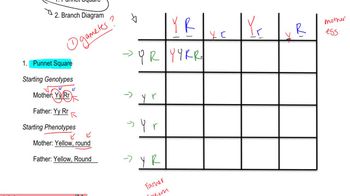
Set up the F₂ generation by crossing two F₁ individuals (WwAa x WwAa). Use a Punnett square or the product rule to determine the genotypic and phenotypic ratios.
Calculate the expected phenotypic ratio for the F₂ generation by considering the independent assortment of each trait. For two traits with dominant and recessive alleles, the classic dihybrid phenotypic ratio is 9:3:3:1, representing the combinations of dominant and recessive phenotypes.

Verified video answer for a similar problem:

This video solution was recommended by our tutors as helpful for the problem above.
Video duration:
2m
Was this helpful?

Key Concepts

Here are the essential concepts you must grasp in order to answer the question correctly.

Dihybrid Cross

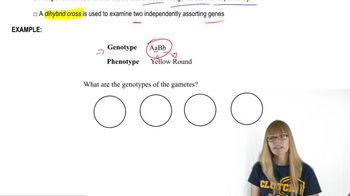
A dihybrid cross involves two traits, each with two alleles, crossed between two individuals. It examines how alleles for different genes segregate and combine in offspring, typically resulting in a phenotypic ratio that reflects independent assortment.
Recommended video:
Guided course
15:24
Punnet Square

Independent Assortment

Independent assortment is Mendel’s principle stating that alleles of different genes segregate independently during gamete formation. This leads to new combinations of traits in offspring, which is key to predicting phenotypic ratios in dihybrid crosses.
Recommended video:
Guided course
04:58
Gamete Genetics and Independent Assortment

F₂ Generation and Phenotypic Ratios

The F₂ generation results from crossing two F₁ individuals. In a dihybrid cross with independent assortment, the typical F₂ phenotypic ratio is 9:3:3:1, representing the distribution of combined traits among offspring.
Recommended video:
Guided course
10:48
Mutations and Phenotypes
Related Practice
Textbook Question

Drosophila may be monosomic for chromosome 4, yet remain fertile. Contrast the F₁ and F₂ results of the following crosses involving the recessive chromosome 4 trait, bent bristles:

monosomic IV, bent bristles x diploid, normal bristles

520
views
Textbook Question

Drosophila may be monosomic for chromosome 4, yet remain fertile. Contrast the F₁ and F₂ results of the following crosses involving the recessive chromosome 4 trait, bent bristles:

monosomic IV, normal bristles x diploid, bent bristles.

536
views
Textbook Question

Mendelian ratios are modified in crosses involving autotetraploids. Assume that one plant expresses the dominant trait green seeds and is homozygous (WWWW). This plant is crossed to one with white seeds that is also homozygous (wwww). If only one dominant allele is sufficient to produce green seeds, predict the F₁ and F₂ results of such a cross. Assume that synapsis between chromosome pairs is random during meiosis.

710
views
Textbook Question
The mutations called bobbed in Drosophila result from variable reductions (deletions) in the number of amplified genes coding for rRNA. Researchers trying to maintain bobbed stocks have often documented their tendency to revert to wild type in successive generations. Propose a mechanism based on meiotic recombination which could account for this reversion phenomenon. Why would wild-type flies become more prevalent in Drosophila cultures?
480
views
Textbook Question

The outcome of a single crossover between nonsister chromatids in the inversion loop of an inversion heterozygote varies depending on whether the inversion is of the paracentric or pericentric type. What differences are expected?

541
views
Textbook Question

A couple planning their family are aware that through the past three generations on the husband's side a substantial number of stillbirths have occurred and several malformed babies were born who died early in childhood. The wife has studied genetics and urges her husband to visit a genetic counseling clinic, where a complete karyotype-banding analysis is performed. Although the tests show that he has a normal complement of 46 chromosomes, banding analysis reveals that one member of the chromosome 1 pair (in group A) contains an inversion covering 70 percent of its length. The homolog of chromosome 1 and all other chromosomes show the normal banding sequence.

How would you explain the high incidence of past stillbirths?

653
views