
Textbook Question
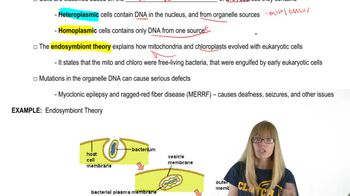
What is the endosymbiotic theory, and why is this theory relevant to the study of extranuclear DNA in eukaryotic organelles?
775
views

 Verified step by step guidance
 04:11
04:11
 09:09
09:09 09:12
09:12What is the endosymbiotic theory, and why is this theory relevant to the study of extranuclear DNA in eukaryotic organelles?
The maternal-effect mutation bicoid (bcd) is recessive. In the absence of the bicoid protein product, embryogenesis is not completed. Consider a cross between a female heterozygous for the bicoid alleles (bcd⁺/bcd⁻) and a male homozygous for the mutation (bcd⁻/bcd⁻).
Predict the outcome (normal vs. failed embryogenesis) in the F₁ and F₂ generations of the cross described.
The specification of the anterior–posterior axis in Drosophila embryos is initially controlled by various gene products that are synthesized and stored in the mature egg following oogenesis. Mutations in these genes result in abnormalities of the axis during embryogenesis. These mutations illustrate maternal effect. How do such mutations vary from those produced by organelle heredity? Devise a set of parallel crosses and expected outcomes involving mutant genes that contrast maternal effect and organelle heredity.
Consider the case where a mutation occurs that disrupts translation in a single human mitochondrion found in the oocyte participating in fertilization. What is the likely impact of this mutation on the offspring arising from this oocyte?
Earlier, we described CC, the cat created by nuclear transfer cloning, whereby a diploid nucleus from one cell is injected into an enucleated egg cell to create an embryo. Cattle, sheep, rats, dogs, and several other species have been cloned using nuclei from somatic cells. Embryos and adults produced by this approach often show a number of different mitochondrial defects. Explain possible reasons for the prevalence of mitochondrial defects in embryos created by nuclear transfer cloning.
The maternal-effect mutation bicoid (bcd) is recessive. In the absence of the bicoid protein product, embryogenesis is not completed. Consider a cross between a female heterozygous for the bicoid alleles (bcd⁺/bcd⁻) and a male homozygous for the mutation (bcd⁻/bcd⁻).
How is it possible for a male homozygous for the mutation to exist?