Pearson+ LogoPearson+ Logo
Ch. 9 - Extranuclear Inheritance
Klug - Concepts of Genetics  12th Edition
Klug12th EditionConcepts of Genetics ISBN: 9780135564776Not the one you use?Change textbook
Chapter 9, Problem 15

The specification of the anterior–posterior axis in Drosophila embryos is initially controlled by various gene products that are synthesized and stored in the mature egg following oogenesis. Mutations in these genes result in abnormalities of the axis during embryogenesis. These mutations illustrate maternal effect. How do such mutations vary from those produced by organelle heredity? Devise a set of parallel crosses and expected outcomes involving mutant genes that contrast maternal effect and organelle heredity.

Verified step by step guidance
1
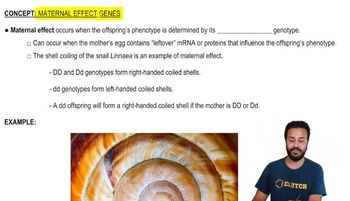
Understand the concept of maternal effect: Maternal effect refers to the phenomenon where the phenotype of the offspring is determined by the genotype of the mother, due to gene products deposited in the egg during oogenesis. These gene products influence early embryonic development, such as the anterior-posterior axis specification in Drosophila.
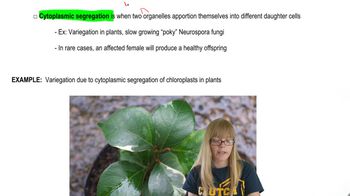
Understand organelle heredity: Organelle heredity involves the inheritance of genetic material from organelles such as mitochondria or chloroplasts. This type of inheritance is non-Mendelian and typically maternal, as organelles are passed to offspring through the cytoplasm of the egg.
Devise parallel crosses for maternal effect: For maternal effect, cross a homozygous mutant female (e.g., for a gene affecting axis specification) with a wild-type male. The offspring will exhibit the mutant phenotype regardless of their own genotype, as the mother's genotype determines the phenotype.
Devise parallel crosses for organelle heredity: For organelle heredity, cross a female with mutant organelle DNA (e.g., mitochondrial mutation) with a wild-type male. The offspring will inherit the mutant organelle DNA and exhibit the mutant phenotype, as organelle DNA is maternally inherited.
Compare expected outcomes: In maternal effect, the offspring's phenotype is determined by the mother's genotype, not their own. In organelle heredity, the offspring's phenotype is determined by the organelle DNA inherited from the mother. These mechanisms differ in the source of the genetic material influencing the phenotype.

Verified video answer for a similar problem:

This video solution was recommended by our tutors as helpful for the problem above.
Video duration:
2m
Was this helpful?

Key Concepts

Here are the essential concepts you must grasp in order to answer the question correctly.

Maternal Effect Genes

Maternal effect genes are genes expressed in the mother that produce products (like RNA or proteins) that are deposited into the egg during oogenesis. These products influence the development of the embryo, particularly in establishing body axes. Mutations in these genes can lead to developmental defects in the offspring, regardless of the genotype of the offspring, as they rely on maternal contributions for early development.
Recommended video:
Guided course
03:38
Maternal Effect

Organelle Heredity

Organelle heredity refers to the inheritance of traits determined by genes located in organelles, such as mitochondria or chloroplasts, rather than nuclear DNA. This type of inheritance is often maternal, as organelles are typically passed down from the mother’s egg. Mutations in organelle DNA can lead to specific phenotypic traits, but these traits are inherited differently than those influenced by maternal effect genes, as they depend on the organelle's genetic material.
Recommended video:
Guided course
05:13
Organelle Inheritance

Genetic Crosses

Genetic crosses are experimental methods used to study inheritance patterns by mating individuals with known genotypes. In the context of maternal effect and organelle heredity, parallel crosses can be devised to observe the outcomes of offspring from parents with mutations in maternal effect genes versus those with mutations in organelle genes. By analyzing the phenotypes of the offspring, researchers can distinguish the effects of maternal contributions from those of organelle inheritance.
Recommended video:
Guided course
26:08
Trihybrid Cross
Related Practice
Textbook Question

What is the endosymbiotic theory, and why is this theory relevant to the study of extranuclear DNA in eukaryotic organelles?

773
views
Textbook Question

Earlier, we described CC, the cat created by nuclear transfer cloning, whereby a diploid nucleus from one cell is injected into an enucleated egg cell to create an embryo. Cattle, sheep, rats, dogs, and several other species have been cloned using nuclei from somatic cells. Embryos and adults produced by this approach often show a number of different mitochondrial defects. Explain possible reasons for the prevalence of mitochondrial defects in embryos created by nuclear transfer cloning.

462
views
Textbook Question

Mitochondrial replacement therapy (MRT) offers a potential solution for women with mtDNA-based diseases to have healthy children. Based on what you know about the importance of nuclear gene products to mitochondrial functions, will MRT ensure that children will not inherit or develop a mtDNA-based diseases?

535
views
Textbook Question

The maternal-effect mutation bicoid (bcd) is recessive. In the absence of the bicoid protein product, embryogenesis is not completed. Consider a cross between a female heterozygous for the bicoid alleles (bcd⁺/bcd⁻) and a male homozygous for the mutation (bcd⁻/bcd⁻).

Predict the outcome (normal vs. failed embryogenesis) in the F₁ and F₂ generations of the cross described.

443
views
Textbook Question

The maternal-effect mutation bicoid (bcd) is recessive. In the absence of the bicoid protein product, embryogenesis is not completed. Consider a cross between a female heterozygous for the bicoid alleles (bcd⁺/bcd⁻) and a male homozygous for the mutation (bcd⁻/bcd⁻).

How is it possible for a male homozygous for the mutation to exist?

722
views
Textbook Question

(a) In humans the mitochondrial genome encodes a low number of proteins, rRNAs, and tRNAs but imports approximately 1100 proteins encoded by the nuclear genome. Yet, with such a small proportion from the mitochondrial genome encoding proteins and RNAs, a disproportionately high number of genetic disorders due to mtDNA mutations have been identified [Bigger, B. et al. (1999)]. What inheritance pattern would you expect in a three-generation pedigree in which the grandfather expresses the initial mtDNA defect? What inheritance pattern would you expect in a three-generation pedigree in which the grandmother expresses the initial mtDNA defect?

(b) Considering the description in part (a) above, how would your pedigrees change if you knew that the mutation that caused the mitochondrial defect was recessive and located in the nuclear genome, was successfully transported into mitochondria, and negated a physiologically important mitochondrial function?

665
views