Pearson+ LogoPearson+ Logo
Ch. 1 - The Molecular Basis of Heredity, Variation, and Evolution
Sanders - Genetic Analysis: An Integrated Approach 3rd Edition
Sanders3rd EditionGenetic Analysis: An Integrated ApproachISBN: 9780135564172Not the one you use?Change textbook
Chapter 1, Problem 20b

The following segment of DNA is the template strand transcribed into mRNA:
   5'-...GACATGGAA...-3'
What is the amino acid sequence produced by translation?

Verified step by step guidance
1
Identify the direction of the template strand. The template strand is given as 5'-...GACATGGAA...-3'. Remember that transcription produces an mRNA strand complementary to the template strand, and the mRNA is synthesized in the 5' to 3' direction.
Determine the complementary mRNA sequence. Use base-pairing rules: A pairs with U (in RNA), T pairs with A, G pairs with C, and C pairs with G. Write the mRNA sequence in the 5' to 3' direction.
Divide the mRNA sequence into codons. Codons are groups of three nucleotides that correspond to specific amino acids. Start from the 5' end of the mRNA sequence and group the nucleotides into triplets.
Use the genetic code table to translate each codon into its corresponding amino acid. For example, AUG codes for methionine (start codon), and other codons correspond to specific amino acids or stop signals.
Write the resulting amino acid sequence. Begin with the amino acid corresponding to the start codon (if present) and continue translating until a stop codon is encountered, which signals the end of translation.

Verified video answer for a similar problem:

This video solution was recommended by our tutors as helpful for the problem above.
Video duration:
1m
Was this helpful?

Key Concepts

Here are the essential concepts you must grasp in order to answer the question correctly.

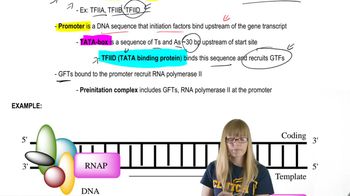
Transcription

Transcription is the process by which the genetic information in DNA is copied into messenger RNA (mRNA). During this process, RNA polymerase binds to the DNA template strand and synthesizes a complementary RNA strand. The mRNA then carries the genetic code from the nucleus to the ribosome, where it will be translated into a protein.
Recommended video:
Guided course
09:16
Eukaryotic Transcription

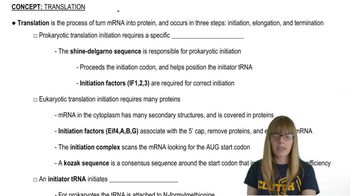
Translation

Translation is the process by which the sequence of nucleotides in mRNA is decoded to produce a specific sequence of amino acids, forming a protein. This occurs at the ribosome, where transfer RNA (tRNA) molecules bring amino acids to the mRNA template according to the codon sequence. Each set of three nucleotides (codon) corresponds to a specific amino acid, which is linked together to form a polypeptide chain.
Recommended video:
Guided course
07:58
Translation initiation

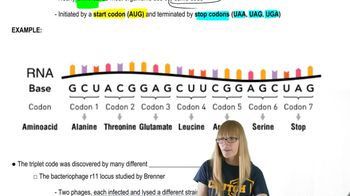
Genetic Code

The genetic code is a set of rules that defines how the sequence of nucleotides in mRNA is translated into the sequence of amino acids in proteins. It consists of 64 codons, each made up of three nucleotides, which specify 20 different amino acids. The code is nearly universal among all organisms, allowing for the translation of genetic information across different species.
Recommended video:
Guided course
11:43
The Genetic Code